- How BIS Registration Works: The process involves identifying the correct Indian Standards, testing samples in NABL labs, and submitting technical documents to the Bureau of Indian Standards.
- Mandatory Compliance: BIS Certification is legally required for products under Quality Control Orders (QCOs), including electronics, steel, chemicals, and toys.
- Process Efficiency: While the BIS registration process can be navigated via the official portal, expert guidance ensures faster approval and fewer rejections during lab testing.
Introduction
Two weeks ago, a manufacturer based in Pune contacted us in a panic. Their shipment of industrial valves worth ₹45 Lakhs was stuck at the Nhava Sheva port. The Customs officer had flagged the consignment for one simple reason: the product packaging lacked the mandatory BIS Standard Mark.
This is not an isolated incident. In the last year alone, the Indian government has aggressively expanded the list of products requiring mandatory compliance. For business owners, the message is clear: Compliance is no longer just a "good-to-have" quality badge; it is the fundamental license to operate in the Indian market.
If you are a manufacturer or importer, you are likely grappling with confusing questions. Which scheme applies to my product? Do I need a factory audit? Can I just pay the fee and get the license?
The Bureau of Indian Standards (BIS) operates on strict technical protocols. Understanding how BIS registration works is the first step to ensuring your supply chain remains uninterrupted. This guide pulls back the curtain on the entire BIS registration process, moving beyond the textbook definitions to give you the practical, on-the-ground reality of getting certified in 2025.
What is BIS Certification and Why Do You Need It?
The Bureau of Indian Standards (BIS) is the National Standards Body of India, established under the BIS Act, 2016. Its primary mandate is to protect the Indian consumer from substandard, unsafe, or toxic products.
Think of BIS Certification like a driving license for your product. Just as you cannot legally drive a car without a license, you cannot legally manufacture, store, or sell specific products in India without a valid BIS license.
The Legal Framework: Quality Control Orders (QCOs)
The government enforces these standards through Quality Control Orders (QCOs). When a Ministry (like the Ministry of Steel or MeitY) issues a QCO for a product, BIS registration becomes mandatory immediately.
- Real-World Impact: If you sell non-certified goods listed under a QCO, it is treated as a criminal offense. The penalties include jail time of up to two years and fines starting at ₹2 Lakhs (or 10 times the value of seized goods).
ISI Mark vs. CRS Registration
To understand how BIS registration works, you must first identify which "bucket" your product falls into. The BIS registration process is split into two primary schemes.
1. Scheme-I: The ISI Mark (Product Certification Scheme)
This is the traditional, rigorous certification model. It is applicable to high-risk or critical infrastructure products Under BIS ISI.
- Products: Cement, Structural Steel, Food Products (Condensed Milk), Chemicals (Toluene, Caustic Soda), Toys, and Tyres.
- The Workflow: This scheme requires Product Testing AND a Factory Inspection. A BIS scientist will physically visit your factory to verify your production capabilities.
2. Scheme-II: CRS (Compulsory Registration Scheme)
Introduced to keep pace with the fast-evolving tech industry, this scheme is simplified under BIS CRS.
- Products: Laptops, Mobile Phones, Power Adapters, Smart Watches, LED Lights, and Solar Photovoltaic Systems.
- The Workflow: This scheme generally requires only Product Testing. There is usually no factory inspection required. The license is granted based on the test reports from an NABL-accredited lab.
Key Benefits of Obtaining BIS Registration
Beyond just avoiding jail time, getting certified offers tangible business advantages. Here is how BIS certification directly impacts your growth:
| Benefit Category | Business Impact |
| Legal Protection | Prevents Raids & Seizures: A valid license protects your warehouse and retail partners from enforcement raids, ensuring business continuity. |
| Market Access | Unlocks Large Contracts: Government tenders (e.g., Railways, Defense) and large retail chains (e.g., Reliance, Croma) only buy BIS-certified goods. |
| Consumer Trust | The "Safety Seal": The ISI Mark is instantly recognized by Indian families as a symbol of safety. It justifies a premium price point over non-branded competitors. |
| Global Acceptance | Export Advantage: Many developing nations in SAARC and Africa recognize Indian Standards, opening doors to new export markets. |
| Quality Control | Reduced Defects: The mandatory lab testing process forces your factory to upgrade its quality control, reducing product failures and returns in the long run. |
Essential Documents Checklist for BIS Registration
One of the most common questions we get is, "What paperwork do I need?" Incomplete documentation is the leading cause of "queries" and delays in the BIS registration system.
| Document Category | Specific Requirements |
| Proof of Address | Factory License, GST Certificate, or Certificate of Incorporation indicating the manufacturing address. |
| Authorized Signatory | Aadhar Card, PAN Card, and an Authorization Letter on company letterhead. |
| Technical Details | Process Flowchart: A diagram showing the manufacturing steps. Machinery List: Make, model, and capacity of production equipment. |
| Quality Control | Testing Equipment List: Details of in-house lab gear with valid calibration certificates. |
| Test Reports | Original Test Report from the BIS-recognized NABL Laboratory. |
| Brand Proof | Trademark Registration certificate or brand owner authorization letter. |
| For Foreigners | AIR Nomination Form: Nomination of the Authorized Indian Representative (Form-VI/VII). |
How BIS Registration Works: The Step-by-Step Process
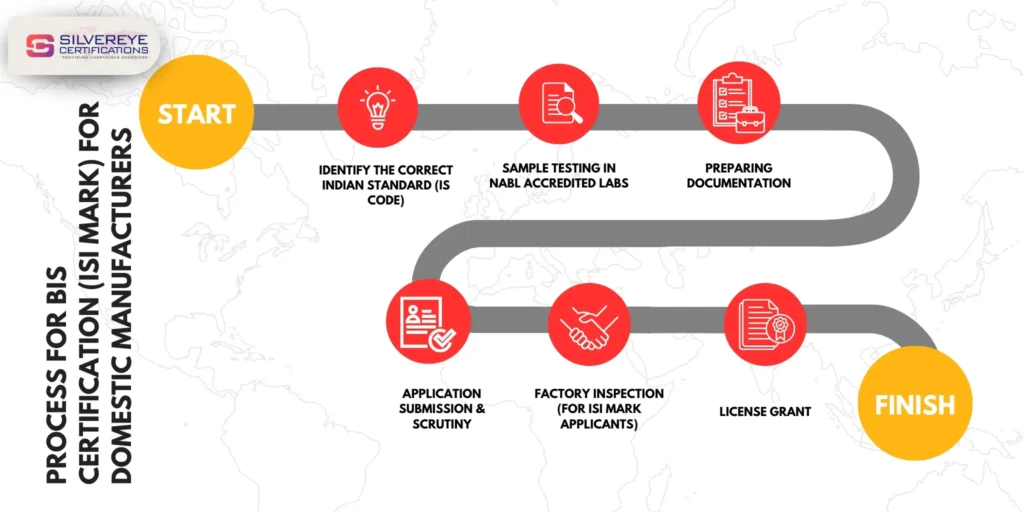
Alt Text: Detailed flowchart showing the step by step process of BIS registration and testing workflow.
Let’s break down the BIS registration process into actionable phases. This is the exact roadmap we follow at Silvereye Certifications for our clients.
Step 1: Identifying the Correct Indian Standard (IS Code)
Every product is governed by a specific Indian Standard. This is a technical document that outlines the safety, chemical, and performance parameters the product must meet.
- The Trap: Many applicants fail here. For example, "Steel" is not a category. You must know if your product is "Hot Rolled Carbon Steel" (IS 2062) or "High Tensile Steel" (IS 14268).
- Our Advice: Never guess. Check the latest QCO notification or consult a specialist. Applying under the wrong IS Code results in immediate rejection and forfeiture of fees.
Step 2: Sample Testing (The Make-or-Break Phase)
Once the standard is identified, you must prove your product meets it.
- Sample Selection: You must pick raw samples from your manufacturing lot.
- The Lab: These samples must be sent to a BIS-recognized laboratory. You cannot use a private, non-accredited lab, nor can you use your own factory test reports for the final submission.
- The Risk: If your sample fails even one parameter (e.g., a power adapter heating up 2 degrees beyond the limit), the entire process stops. You have to rectify the defect, manufacture a new batch, and pay the testing fees again.
Step 3: Online Application Submission
With a passing Test Report in hand (which must not be older than 90 days), you proceed to the official government portal, Manak Online.
- Digital Profile: You must create a user profile for your factory.
- Document Upload: This involves uploading the test report, factory licenses, and technical documents (see the checklist below).
- Fee Payment: You pay the government application fee and the initial license fee.
Step 4: Factory Audit (Only for ISI Mark/Scheme-I)
If you are applying for an ISI Mark (e.g., for Steel or Chemicals), the Bureau of Indian Standards will assign a scientist to audit your facility.
- What they check: They are not just looking at the final product. They audit your raw material sourcing, your manufacturing machinery, and most importantly, your Quality Control (QC) Lab.
- The Requirement: You must have a fully functional in-house lab to test the product daily. If your in-house lab equipment is missing or not calibrated, the officer will raise a "Non-Conformity" (NC).
Step 5: Scrutiny and Grant of License
Once the audit is clear and the independent lab report matches the standards, the application moves to the final scrutiny stage.
- The Output: BIS grants a license document containing your unique CM/L Number (for ISI) or R-Number (for CRS).
- Marking: You can now legally print the Standard Mark on your product and packaging.
Expert Insight: The timeline for CRS (Electronics) is typically 20-30 days, while the ISI Mark process can take 3-4 months due to the physical audit requirement.
BIS Certification Cost Breakdown
One of the most common questions we get is, "How much does BIS registration cost?" The total expense is not a single fixed fee; it is a combination of government charges, testing fees, and professional service charges.
Here is a transparent breakdown to help you budget:
| Cost Component | Estimated Expense (INR) | Who gets paid? |
| Application Fee | ₹1,000 (Non-refundable) | BIS (Government) |
| Annual License Fee | ₹1,000 (Minimum) | BIS (Government) |
| Marking Fee | Calculated based on production volume (e.g., ₹0.40 per unit) | BIS (Government) |
| Lab Testing Fee | Variable: ₹20,000 to ₹3,00,000+ (Depends on product complexity) | NABL Laboratory |
| Official Inspection Fee | ₹7,000 per day (Only for ISI Mark audits) | BIS (Government) |
| Consultancy Fee | Variable (One-time project fee) | SEYECS (Consultant) |
Note: Lab testing fees vary wildly. A simple electrical switch might cost ₹15,000 to test, while a Lithium-Ion battery or a specific grade of Steel could cost upwards of ₹1.5 Lakhs per sample.
Timelines: How Long Does It Take?
The time it takes to complete the BIS registration process depends heavily on which scheme your product falls under.
1. For CRS (Electronics & IT Goods)
This process is faster as it usually does not require a factory visit.
- Lab Testing: 10 – 15 Working Days
- BIS Portal Processing: 10 – 15 Working Days
- Total Estimated Time: 20 to 30 Working Days
2. For ISI Mark (Steel, Chemicals, Toys)
This process is longer due to the mandatory physical audit.
- Lab Testing: 15 – 30 Days (Some chemical tests take 28 days alone).
- Factory Audit Queue: 30 – 45 Days (Depends on BIS officer availability).
- Total Estimated Time: 3 to 4 Months
Validity and Renewal of BIS License
A common misconception is that BIS registration is a one-time permanent license. It is not.
- Initial Validity: The license is typically granted for 1 to 2 years initially.
- Renewal Process: You do not need to re-test the product for renewal (unless the Indian Standard itself has changed).
- How to Renew: You must submit your production data and pay the marking fees for the upcoming period.
- Renewal Duration: Once renewed, the license can be extended for up to 5 years at a time.
Pro Tip: Always apply for renewal at least 3 months before expiry. If the license expires, you have to start the entire process from scratch, including re-testing.
Two Ways to Obtain BIS Certification: A Transparent Comparison
At Silvereye Certifications, we believe in empowering our clients with the right information. Before you decide to work with us, it is important to understand that you have two distinct paths for obtaining BIS Certification.
Path 1: The Direct Application (Official Government Route)
Yes, you can apply on your own. The Bureau of Indian Standards permits any manufacturer to register directly through the official government portal.
- Official Website: You can access the application forms and pay the statutory fees directly at www.bis.gov.in.
- The Benefit: By applying directly, you only pay the mandatory government fees and lab testing charges. You save on professional consultancy fees.
- The Requirement: This route is best suited for companies that have a dedicated in-house compliance team with deep technical knowledge of Indian Standards and testing protocols.
Path 2: Partnering with SEYECS (Professional Consultancy)
Most businesses choose this route to save time, reduce internal workload, and mitigate the risk of rejection. When you hire SEYECS, you are paying for technical expertise and project management, not just form-filing.
- The Benefit: We handle the complex "heavy lifting"—from coordinating with NABL labs to drafting technical responses for BIS officers.
- The Cost: In addition to government/lab fees, you pay a service fee for our expert guidance.
Comparison: Direct Application vs. SEYECS Assisted
To help you make an informed decision, here is a breakdown of the two approaches:
| Feature | Direct Application (Official Route) | Partnering with SEYECS |
| Where to Apply | Directly at bis.gov.in | We manage the portal for you |
| Cost | Government Fees + Lab Fees Only | Gov. Fees + Lab Fees + Service Fee |
| Lab Coordination | You must find a lab & manage samples | We handle logistics & daily lab follow-ups |
| Document Review | You are responsible for accuracy | We pre-audit documents to prevent errors |
| Risk of Rejection | Higher (due to technical oversight) | Minimal (due to pre-compliance checks) |
| Query Resolution | You must draft technical justifications | Our engineers draft precise responses |
Why Manufacturers Choose SEYECS
While the official portal is open to everyone, the process is not just administrative—it is deeply technical.
- Lab Failures: A single error in sample sealing or testing parameters can cause a lab failure, forcing you to restart and pay testing fees again.
- Audit Anxiety: For ISI Mark applications, facing a government scientist during a factory audit requires rigorous preparation. We conduct mock audits to ensure your in-house lab staff is ready to demonstrate testing methods confidently.
The Bottom Line: If you have the time and technical resources, the direct route is available. If you want speed, certainty, and expert support, SEYECS is here to help.
Conclusion
Securing BIS Certification is a rigorous journey. It demands attention to detail, technical knowledge of Indian Standards, and patience with government protocols. However, it is also a mark of trust that instantly elevates your brand in the eyes of the Indian consumer.
You now have a clear roadmap of how BIS registration works. You can choose to navigate the BIS registration process via the official portal at bis.gov.in, or you can choose efficiency and certainty by partnering with experts.
At Silvereye Certifications, we ensure your documentation is flawless and your testing is managed efficiently, preventing costly rejections. Don't let compliance hurdles keep your inventory stuck at the border.
Ready to certify your product for the Indian market?
Stop worrying about complex paperwork and start selling.
Contact SEYECS Today for a free compliance assessment of your product.
Frequently Asked Questions
Is BIS registration mandatory for imported goods?
Yes. The "Make in India" policy and Quality Control Orders apply equally to domestic and foreign goods. If you import a product listed under a QCO, the foreign factory must hold a valid FMCS (Foreign Manufacturers Certification Scheme) license.
How do I check if a product needs BIS certification?
You must check the list of products under "Mandatory Certification" on the BIS website. Common categories include electronics, steel, cement, toys, chemical fertilizers, and footwear.
Can a trader or importer apply for the license?
No. The license is granted strictly to the manufacturing unit (the physical factory). An importer cannot hold the license in their name. However, the importer can act as the Authorized Indian Representative (AIR) for the foreign manufacturer.
What happens if my product fails the lab test?
If the sample fails, the application process for that specific request is closed. You must analyze the root cause of the failure, modify your production process, produce a new sample, and restart the testing phase.
How long does the entire BIS registration process take?
CRS (Electronics): 20–30 working days.
ISI Mark (Steel/Chemicals): 3–4 months (due to factory inspection queues).
Can I include multiple product models in one license?
Yes, within limits. This is known as "Series Approval." If you manufacture multiple models that share the same safety design (e.g., same PCB layout and power rating) and only differ in cosmetic features or color, you can group them into a single "Series." This significantly saves on testing costs. However, BIS has strict technical guidelines on what qualifies as a series.
Is the BIS license valid for a lifetime?
No. A BIS license is initially granted for 1 to 2 years. It is not a one-time permanent registration. You must apply for renewal before the expiry date.
What happens if I move my factory to a new location?
The license will be cancelled. A BIS license is location-specific. It is granted to the physical address of the factory, not just the company.
How can I verify if a BIS certificate is genuine?
You can verify any license using the BIS Care App (available on Android/iOS) or the official website. Simply enter the CM/L Number (for ISI products) or R-Number (for CRS products).