Official BIS approval confirming a product meets Indian safety and quality standards; mandatory for many high-risk products.
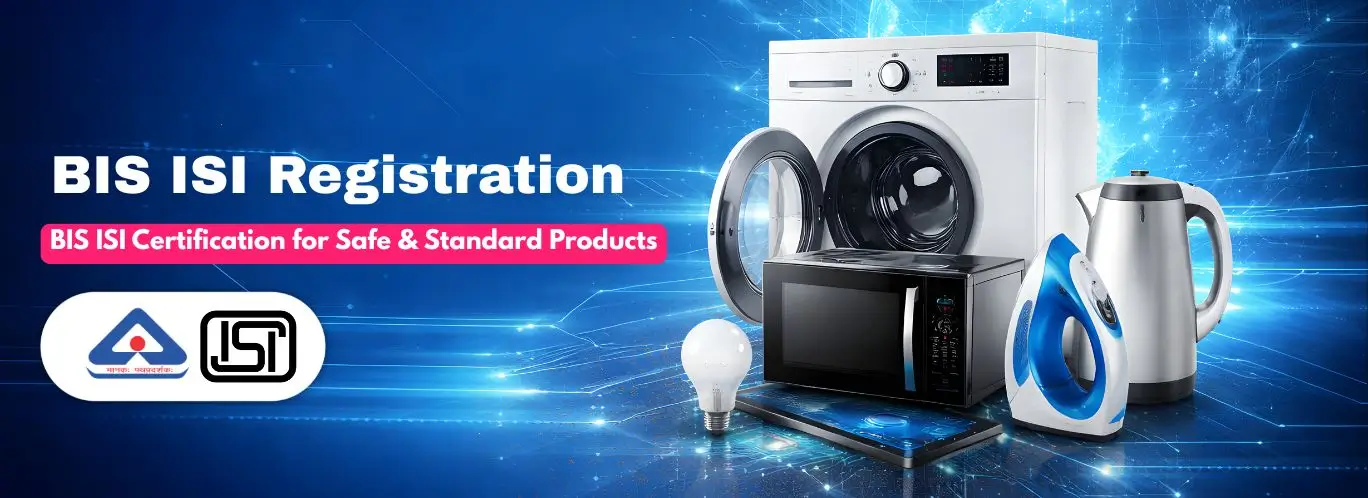
There is a small circular stamp that has quietly become one of the most powerful gatekeepers of the Indian market. It is not flashy. Most consumers could not tell you what the letters stand for. But without it, you cannot legally sell cement, steel, electrical cables, pressure cookers, packaged water, toys, furniture, or household appliances in India — and that list grows every year.
The ISI Mark — issued under India's BIS Scheme-I certification framework — is the country's oldest and most widely applied quality compliance mark. Since 1950, it has been the minimum bar for products sold in a market of 1.4 billion people. And in 2026, the government has done something it has not done at this scale in a decade: added two enormous new product categories in back-to-back months.
Furniture became mandatory in February 2026. Household and commercial electrical appliances followed in March 2026. Combined, these two QCOs bring hundreds of everyday products — chairs, beds, desks, ovens, vacuum cleaners, dishwashers, shavers, massage devices — under mandatory BIS ISI certification for the first time. If your business touches either of these categories, your compliance clock has already started.

BIS ISI Mark Certification is the product quality and safety certification issued by the Bureau of Indian Standards (BIS) under Scheme-I of the BIS (Conformity Assessment) Regulations, 2018. When a product carries the ISI Mark — that circular stamp with the letters ISI and a licence number beneath it — it means BIS has tested the product, inspected the factory, verified the quality control processes, and issued a formal licence confirming the product meets the relevant Indian Standard (IS).
BIS operates under the BIS Act, 2016, which gave the Bureau significantly expanded powers compared to its predecessor legislation. It can now mandate hallmarking of precious metals, facilitate Self-Declaration of Conformity for certain categories, and impose criminal penalties — not just civil fines — for non-compliance. The ISI Mark sits under this framework as the primary certification instrument for physical goods.
The practical trigger for mandatory ISI certification is a Quality Control Order (QCO) — a government notification issued by a relevant ministry (typically DPIIT or the Ministry of Consumer Affairs) under Section 16 of the BIS Act. Once a QCO is notified for a product category, no entity can manufacture, import, sell, store, or exhibit that product in India without a valid BIS licence and the ISI Mark. The list currently covers 700+ product categories and is expanding.
ISI Certification is essential for businesses dealing with products regulated by the Bureau of Indian Standards (BIS). It confirms that a product meets India’s safety, performance, and quality requirements and is legally approved for sale in the country.
ISI Certification strengthens credibility, ensures legal compliance, and supports smooth market entry for both manufacturers and importers.
The Indian consumer market is rapidly shifting. With rising e-commerce penetration and an increasing number of counterfeit products, BIS has become more active than ever. In 2024–25, the Bureau executed over 6,200 raids on manufacturers selling non-compliant goods. Major consumer brands in appliances, electricals, and construction materials faced heavy penalties for missing ISI Mark labels.
From a business standpoint, ISI Certification delivers four concrete advantages:BIS regularly inspects markets and factories. An active ISI license protects your brand.
Silvereye Certifications has seen many cases where brand owners only applied for ISI after facing seizure notices. Proactive compliance always reduces cost and risk.
There is a small circular stamp that has quietly become one of the most powerful gatekeepers of the Indian market. You have probably seen it thousands of times — on a packet of biscuits, on a switch plate, on a steel bar at a construction site, on the side of a pressure cooker, on a helmet hanging in a showroom. That stamp is the ISI mark. And behind those three letters sits a legal framework that determines whether your product can be manufactured, imported, sold, or even stored for sale in India.
The ISI mark is issued under the Bureau of Indian Standards (BIS) Scheme I — a mandatory product licensing system where the manufacturer must prove, to a BIS-appointed inspector visiting the actual factory, that what they produce consistently meets India's national quality and safety standards. It is not a self-declaration. It is not a one-time lab test. It is an ongoing licence, backed by real inspections, real testing, and real legal consequences for non-compliance.
As of early 2026, the ISI Mark covers more than 600 product categories notified under Quality Control Orders (QCOs) issued by various central government ministries. That number has risen sharply over the past 24 months — with furniture and office chairs brought in from February 2026, household and commercial electrical appliances from March 2026, and several chemical and industrial categories added through 2025. If you haven't checked the current QCO list against your product category recently, now is exactly the right time.
BIS issues frequent notifications modifying standards, timelines, and mandatory product lists. Below is a human-written interpretation of major updates (verified with the official source
Several of these categories now require mandatory ISI Certification.
IS 1489 (Part 1 & 2) and IS 269 were revised in 2024–25. Cement brands must comply to maintain their ISI license.
Silvereye Certifications tracks these notifications daily because non-compliance unknowingly pushes manufacturers into penalty zones.
The scope of ISI Mark compliance is wider than most people first expect. It catches manufacturers, importers, distributors, and retailers — not just the producer at the top of the chain. Here is where each player in the supply chain stands.
| Stakeholder | Compliance Obligation | What Happens Without It |
|---|---|---|
| Indian Manufacturer | Must hold a valid BIS ISI Mark licence (CM/L number) before manufacturing any QCO-notified product for sale in India | Manufacturing non-compliant goods is a criminal offence under BIS Act, 2016 — even before a single unit leaves the factory |
| Foreign Manufacturer | Must obtain ISI Mark via FMCS — a BIS factory inspection at your overseas facility is mandatory before the licence is issued | Shipments blocked at Indian customs; demurrage charges accumulate; product seized or forced back |
| Importer / Trader | Cannot hold the ISI licence — but must import only from foreign manufacturers who already hold a valid CM/L licence | Entire consignment refused clearance; importer personally liable under BIS Act for facilitating non-compliant import |
| Distributor / Wholesaler | Must only stock, warehouse, and supply ISI-marked products in QCO-covered categories | BIS market surveillance teams inspect warehouses; stocking non-compliant goods triggers seizure and prosecution |
| Retailer / Shop Owner | Must display and sell only ISI-marked products for notified categories — both online and offline | Retailers face enforcement action under BIS Act — liability does not rest entirely with the manufacturer or importer |
| E-commerce Seller | Must list only ISI-marked products; CM/L licence number must appear in product listings; BIS number must be verifiable | Platform suspensions, listing removals, and account-level penalties on Amazon India, Flipkart, and other major platforms |
| OEM Brand Owner | If the product carries your brand but is manufactured by someone else, you need a signed Brand Authorisation Letter from your side — the ISI licence is held by the factory, not the brand | BIS may question the legitimacy of the marking; customs may flag mismatch between brand and licensed manufacturer |
| Government & PSU Buyer | Most central and state government tenders explicitly require ISI-marked products as an eligibility condition for notified categories | Bidders without confirmed ISI certification on specified products are disqualified from tendering — regardless of price or track record |
The following table provides a category-wise list of products covered under BIS Scheme-I (ISI Mark Certification). This list includes only currently notified products and excludes all de-notified items.
| Product Category | Key Products Included | Status |
|---|---|---|
| Electrical Wiring Cables & Accessories | PVC cables, flexible wires, switches, sockets, plugs | Mandatory |
| Steel & Steel Products | TMT bars, structural steel, pipes, tubes | Mandatory |
| Cement | Ordinary Portland, Portland Pozzolana, Portland Slag cement | Mandatory |
| Packaged Drinking Water | Packaged natural mineral water, drinking water | Mandatory |
| LPG Cylinders & Valves | LPG cylinders, valves, pressure regulators | Mandatory |
| Toys & Educational Games | All toys sold in India — domestic and imported | Mandatory |
| Automotive Tyres & Tubes | Passenger, commercial, two-wheeler tyres | Mandatory |
| Footwear | Leather, rubber, PU and canvas footwear categories | Mandatory |
| Stainless Steel Utensils & Containers | Cookware, pressure cookers, flasks, water bottles | Mandatory — strict customs enforcement active |
| FURNITURE — NEW February 2026 | Work chairs, general chairs, tables, desks, storage units, wardrobes, beds, bunk beds | MANDATORY from Feb 14, 2026 |
| HOUSEHOLD & COMMERCIAL ELECTRICAL APPLIANCES — NEW March 2026 | Vacuum cleaners, cooking ranges, ovens, dishwashers, shavers, massage appliances, tumble dryers, food processors, fabric steamers, personal e-transporters and 80+ more | MANDATORY from Mar 19, 2026 (large enterprises) |
| Hinges (NEW March 2026) | All hinges — manufactured, imported, stored, sold, or exhibited | Mandatory from March 21, 2026 |
| S.NO. | IS No. | Products |
|---|---|---|
| 1 | IS 12330 | Sulphate Resisting Portland Cement |
| 2 | IS 12600 | Low heat Portland Cement |
| 3 | IS 1489 (Part 1) | Portland Pozzolana Cement-Part1 Fly-ash based |
| 4 | IS 1489 (Part 2) | Portland Pozzolana Cement-Part 2 Calcined clay based |
| 5 | IS 269 | Ordinary Portland Cement |
| 6 | IS 3466 | Masonry Cement |
| 7 | IS 455 | Portland Slag Cement |
| 8 | IS 6452 | High Alumina Cement for Structural use |
| 9 | IS 6909 | Super sulphated cement |
| 9 | IS 6909 | Super sulphated cement |
| 10 | IS 8041 | Rapid hardening Portland cement |
| 11 | IS 8042 | White Portland Cement |
| 12 | IS 8043 | Hydrophobic Portland Cement |
| 13 | IS 8229 | Oil well Cement |
| 14 | IS 16415: 2015 | Composite Cement- Specification. |
| 15 | IS 16993: 2018 | Microfine Ordinary Portland Cement- Specification. |
| S.NO. | IS No. | Products |
|---|---|---|
| 1 | IS 12640 (Part 1) | Residual current operated circuit breakers for house hold and similar uses-Part 1 Circuit breakers without integral overcurrent protection (RCCBs) |
| 2 | IS 12640 (Part 2) | Residual current operated circuit breakers for household and similar uses–Part 2 Circuit breakers with integral overcurrent protection(RCVOs) |
| 3 | IS 13010 | AC watt-hour meters, class 0.5, 1 & 2 |
| 4 | IS 13779 | AC static watt-hour meters, class 1 & 2 |
| 5 | IS 14697 | AC static transformer operated watt-hour and VAR-hour meters, class 0.2S & 0.5S |
| 6 | IS 15111 (Part 1 & 2) | Self Ballasted Lamps for General Lighting Services – Part 1 : Safety Requirements & Part 2 : Performance Requirements |
| 7 | IS 302 (Part 2/Sec 3) | Safety of household and similar electrical appliances – Electric iron |
| 8 | IS 302 (Part 2/Sec 201) | Safety of household and similar electrical appliances– Electric immersion water-heaters |
| 9 | IS 302 (Part 2/Sec 202) | Safety of household and similar electrical appliances –Electric stoves |
| 10 | IS 302 (Part 2/Sec 30) | Safety of household and similar electrical appliances-Room heaters |
| 11 | IS 3854 | Switches for domestic and similar purposes |
| 12 | IS 418 | Tungsten filament general service electric lamps (upto100 W ) |
| 13 | IS 694 | PVC insulated cables for working voltages up to and including 1100V |
| 14 | IS 8828 | Electrical Accessories-Circuit breakers for overcurrent protection for household and similar installations |
| 15 | IS 9968 (Part 1) | Elastomer insulated cables (Part.1): For working voltages up to and including1100 V |
| S.NO. | IS No. | Products |
|---|---|---|
| 1 | IS 14625 | Plastic Feeding Bottles |
| 2 | IS 5168 | Glass Feeding Bottles |
| S.NO. | IS No. | Products |
|---|---|---|
| 1 | IS 10109 | Oil pressure stove, offset burner type |
| 2 | IS 2787 | Multi-burner oil pressure stoves |
| 3 | IS 1342 | Oil pressure stoves |
| S.NO. | IS No. | Products |
|---|---|---|
| 1 | IS 13098 | Automotive vehicles –Tubes for pneumatic tyres |
| 2 | IS 15627 | Automotive vehicles– Pneumatic tyres for two and three-wheeled motor vehicles |
| 3 | IS 15633 | Automotive vehicles-Pneumatic tyres for passenger car vehicles– Diagonal and radial ply |
| 4 | IS 15636 | Automotive vehicles- Pneumatic tyres for commercial vehicles-Diagonal and radial ply |
| S.NO. | IS No. | Products |
|---|---|---|
| 1 | IS 14899 | Liquefied petroleum gas containers for automotive use |
| 2 | IS 15100 | Multifunction valve assembly for permanently fixed liquefied petroleum gas (LPG) containers for automotive use |
| 3 | IS 3196 (Part 4) | Welded low carbon steel cylinders exceeding 5 litre Water capacity for low pressure liquefiable gases Part 4 Cylinders for toxic and corrosive gases |
| 4 | IS 3196 (Part 1) | Welded low carbon steel gas cylinder exceeding 5 litre water capacity for low pressure liquefiable gases Part1 Cylinders for liquefied petroleum gas (LPG) |
| 5 | IS 3196 (Part 2) | Welded low carbon steel gas cylinder exceeding 5-litre water capacity for low pressure liquefiable gases Part 2 Cylinders for liquefiable gases other than LPG. |
| 6 | IS 3224 | Valve fittings for compressed gas cylinder excluding liquefied petroleum gas cylinders |
| 7 | IS 3745 | Yoke Type Valve Connection for Small Medical Gas Cylinders |
| 8 | IS 7142 | Welded low carbon steel cylinders for low pressure liquefiable gases not exceeding 5 litre water capacity |
| 9 | IS 7285 (Part 1) | Refillable Seamless steel gas cylinders Part1 Normalized steel cylinders |
| 10 | IS 7285 (Part 2) | Refillable Seamless steel gas cylinders Part 2 Quenched and tempered steel cylinders with tensile strength less than 1100 MPa (112 kgf/mm2) |
| 11 | IS 7302 | Valve fittings for gas cylinder valves for use with breathing apparatus |
| 12 | IS 7312 | Welded and seamless steel dissolved acetylene gas cylinders |
| 13 | IS 8737 | Valve fittings for use with liquefied petroleum gas cylinders of more than 5 litre water capacity Part 2 Valve fittings for newly manufactured LPG cylinders |
| 14 | IS 8776 | Valve Fittings for Use with Liquefied Petroleum Gas (LPG) Cylinders up to and Including 5-Litre Water Capacity |
| 15 | IS 9798 | Low pressure regulators for use with liquefied petroleum gas (LPG) mixtures |
| S.NO. | IS No. | Products |
|---|---|---|
| 1 | IS 3055 (Part 1) | Clinical thermometers :Part1 Solid stem type |
| 2 | IS 3055 (Part 2) | Clinical thermometers :Part 2 Enclosed scale type |
| 3 | IS 7620 (Part 1) | Diagnostic Medical X-Ray Equipment |
| S.NO. | IS No. | Products |
|---|---|---|
| 1 | IS 1785 (Part 1) : 1983 | Plain Hard-drawn Steel Wire For Pre-stressed Concrete: Part 1 Cold Drawn Stress-relieved Wire |
| 2 | IS 1785 (Part 2) : 1983 | Plain hard-drawn steel wire for pre-stressed concrete Part 2: As drawn wire |
| 3 | IS 6003:2010 | Indented wire for Pre-stressed concrete |
| 4 | IS 6006:2014 | Uncoated stress relieved strand for Pre-stressed concrete. |
| 5 | IS 13620:1993 | Fusion bonded epoxy coated reinforcing bars |
| 6 | IS 14268:1995 | Uncoated Stress Relieved Low Relaxation Seven-ply Strand For Pre-stressed Concrete. |
| 7 | IS 277:2003 | Galvanized steel sheets ( plain and corrugated) |
| 8 | IS 2002:2009 | Steel plates for pressure vessels for intermediate and high temperature service including boilers. |
| 9 | IS 2041:2009 | Steel plates for pressure vessels used at moderate and low temperature |
| 10 | IS 2830:2012 | Carbon steel cast billet ingots ,billets, blooms and slabs for rerolling into steel for general structural purpose |
| 11 | IS 1786:2008 | High strength deformed steel bars and wires for concrete reinforcement |
| 12 | IS 648:2006 | Cold rolled non-oriented electrical steel sheets and strip-fully processed type (CRNO) |
| 13 | IS 3024:2015 | Grain oriented electrical steel sheet & strip (CRGO) |
| 14 | IS 15391:2003 | Oriented Electrical Steel Sheet and Strip- Semi-Processed Type- Specification. |
| 15 | IS 2062:2011 | Hot rolled medium and high tensile structural steel |
| 16 | IS 432 : Part 1:1982 | Mild Steel and Medium Tensile Steel Bars and Hard–Drawn Steel Wire for Concrete Reinforcement: Part 1 Mild steel and medium tensile steel bars |
| 17 | IS 432 : Part 2:1982 | Mild steel and Medium Tensile steel bars and Hard–Drawn Steel Wire for Concrete Reinforcement: Part 2 Hard- Drawn Steel Wire |
| 18 | IS 513 (Part-1): 2016 | Cold reduced carbon steel sheets and strips Part 1 Cold Forming and Drawing Purpose |
| 19 | IS 513(Part-2):2016 | Cold reduced carbon steel sheets and strips Part 2 High Tensile and Multi-phase Steel |
| 20 | IS 1079: 2017 | Hot Rolled Carbon Steel Sheet, Plate and Strip — Specification |
| 21 | IS 1875:1992 | Carbon steel billets, blooms, slabs and bars for forgings. |
| 22 | IS 2879:1998 | Mild steel for metal arc welding electrodes. |
| 23 | IS 3502:2009 | Steel Chequered Plates |
| 24 | IS 5986: 2017 | Hot Rolled Steel Sheet, Plate and Strip for Forming and Flanging Purposes — Specification. |
| 25 | IS 6240:2008 | Hot Rolled Steel Plate (up to 6 mm) Sheet and Strip for the Manufacture of Low Pressure Liquefiable Gas Cylinders |
| 26 | IS 7283:1992 | Hot Rolled bars for production of bright bars and machined parts for engineering applications |
| 27 | IS 7887:1992 | Mild steel wire rods for general engineering purposes. |
| 28 | IS 10748:2004 | Hot Rolled Steel Strip for Welded Tubes and Pipes |
| 29 | IS 11513:2017 | Hot Rolled Carbon Steel Strip for Cold Rolling Purposes — Specification |
| 30 | IS 15647:2006 | Hot rolled steel narrow width strip for welded tubes and pipes |
| 31 | IS 7904:2017 | High carbon steel wire rods- Specification |
| 32 | IS 14246:2013 | Continuously pre-painted galvanized steel sheets and coils |
| 33 | IS 15965:2012 | Pre-painted aluminium zinc alloy metallic coated steel strip and sheet (Plain). |
| 34 | IS 280: 2006 | Mild steel wire for General Engineering purposes. |
| 35 | IS 1835:1976 | Round Steel wire for ropes |
| 36 | IS 4368:1967 | Alloy Steel billets, blooms and slabs for forging for general engineering purposes. |
| 37 | IS 4454 (Part 1) : 2001 | Steel wire for mechanical springs Part-1 cold drawn unalloyed steel wire. |
| 38 | IS 4454 (Part 2): 2001 | Steel wire for mechanical springs Part-2 oil hardened and tempered steel wire |
| 39 | IS 4824:2006 | Bead Wires for Tyres |
| 40 | IS 11169 (Part 1): 1984 | Steels for Cold Heading/Cold extrusion application Part-1 Wrought carbon and low alloy steels |
| 41 | IS 11587:1986 | Structural Weather resistant steel |
| 42 | IS 15103: 2002 | Fire resistant Steel- Specification |
| 43 | IS 15914:2011 | High Tensile Strength Flat Rolled Steel Plate (Up to 6 mm), Sheet and Strip for the Manufacture of Welded Gas Cylinder |
| 44 | IS 15961:2012 | Hot Dip aluminium- Zinc alloy metallic coated steel strip and sheet (Plain) |
| 45 | IS 15962:2012 | Structural Steel for Building for Structures with improved seismic Resistance |
| 46 | IS 5522:2014 | Stainless Steel sheets and strips for utensils- Specification |
| 47 | IS 6911:2017 | Stainless Steel Plate, Sheet and Strip- Specification |
| 48 | IS 15997:2012 | Low Nickel Austenitic Stainless Steel Sheet and Strip For Utensils and Kitchen Applications- Specification |
| 49 | IS 1110 : 1990 | Ferrosilicon – Specification |
| 50 | IS 1029 : 1970 | Specification for Hot rolled steel strip (bailing) |
| 51 | IS 2385 : 1977 | Specification for Hot-rolled mild steel sheet and strip in coil form for cold-reduced tinplate and cold-reduced black plate |
| 52 | IS 3039 : 1988 | Specification for Structural steel for construction of hulls of ships |
| 53 | IS 9550 2001 | Bright steel bars – v Specification |
| 54 | IS 5517 : 1993 | Steel for hardening and tempering – Specification |
| 55 | IS 16732: 2019 | Galvanized Structural Steel – Specification |
| 56 | IS 7494 : 1981 | Specification for Steel for valves for internal combustion engines |
| 57 | IS 12146 : 1987 | Specification for Carbon manganese steel forgings for pressure vessels |
| 59 | IS 2831 : 2012 | Carbon steel cast billet ingots, billets, blooms and slabs for re-rolling into structural steel (ordinary quality) – Specification |
| 60 | IS 1148: 2009 | Steel Rivet Bars (medium And High Tensile) – For Structural Purposes |
| 61 | IS 1673: 1984 | Specification for Mild Steel Wire, Cold Heading Quality |
| 62 | IS 2255: 1977 | Specification for Mild Steel Wire Rod for the Manufacture of Machine Screws (By Cold Heading Process) |
| 63 | IS 3195: 1992 | Steel For the Manufacture of Volute And Helical Springs (for Railway Rolling Stock) – Specifications |
| 64 | IS 3431: 1982 | Specification for Steel for the manufacture of volute, helical and laminated springs for automotive suspension |
| 65 | IS 4398: 1994 | Carbon-chromium Steel for the Manufacture of Balls, Rollers and Bearing Races- Specification |
| 66 | IS 6967: 1973 | Specification for Steel For Electrically welded round Link Chains. |
| 67 | IS 8951: 2001 | Steel Cast Billet Ingots, Billets and Blooms for production of High Carbon Steel Wire Rods- Specification |
| 68 | IS 8952: 1995 | Steel ingots, blooms and billets for production of mild steel wire rods for general engineering purposes – Specification |
| 69 | IS 17111: 2019 (ISO 683- 17: 2014) | Heat-Treated Steels Alloy and Free-Cutting Steels — Ball and Roller Bearing Steels |
| 70 | IS 12594: 1988 | Hot-dip Zinc Coating on Structural Steel Bars for Concrete Reinforcement – Specification |
| 71 | IS 14650:1999 | Carbon Steel Cast Billet Ingots, Billets, Blooms and Slabs for Rerolling purposes- Specification |
| 72 | IS 2090:1983 | Specification for High Tensile Steel Bars used in Pre-stressed Concrete |
| 73 | IS 11952:1986 | Steels For Piston Pins (Gudgeon Pins) |
| 74 | IS 1566:1982 | Specification for Hard-drawn Steel Wire Fabric For Concrete Reinforcement |
| 75 | IS 1170: 1992 | Ferrochromium – Specification |
| 76 | IS 1993 : 2018 | Cold-reduced Electrolytic Tin Plate |
| 77 | IS 12591:2018 | Cold-reduced Electrolytic Chromium/Chromium oxide – coated steel |
| 78 | IS 412:1975 | Expanded Metal Steel Sheets For General Purposes |
| 79 | IS 2100: 1970 | Steel Billets,Bars And Sections For Boilers |
| 80 | IS 8917: 1978 | Plates For Galvanizing Pots |
| 81 | IS 9442: 1980 | Hot Rolled Steel Plates Sheets And Strips For Manufacture of Agricultural Discs |
| 81 | IS 1470: 2013 | Silicomanganese – Specification |
| 82 | IS 15911:2010 | Structural Steel (Ordinary Quality) |
| 83 | IS 1171: 2011 | Ferromanganese – Specification |
| 84 | IS 4431: 1978 | Carbon And Carbon- Manganese Free- Cutting Steels |
| 85 | IS 5518: 1996 | Steels For Die Blocks For Drop Forging |
| 86 | IS 8748: 1978 | Forged/Rolled CTC Segments |
| 87 | IS 12145: 1987 | Quenched And Tempered Alloy Steel Forgings For Pressure Vessels |
| 88 | IS 14698:1999 | Carbon And Low Alloy Billets, Blooms, Slabs And Bars For Manufacture Of Shell BodiesAnd Proof Shots Used In Defence Services |
| 89 | IS/ISO 11951 : 2016 | Cold – Reduced tinmill products – Blackplate |
| S.NO. | IS No. | Products |
|---|---|---|
| 1 | IS 1180 (Part 1) | Out door type Oil immersed Distribution Transformers upto and including 2500 kVA, 33 KV-specification Part 1 Mineral oil immersed |
| 2 | IS 12615 | Energy Efficient Induction Motors-Three Phase Squirrel Cage |
| 3 | IS 2993 | A.C. motor capacitors |
| 4 | IS 13340 | Power Capacitors of Self-healing Type for AC Power Systems having Rated Voltage up to 650V |
| 5 | IS 13585 Part 1 | Shunt Power Capacitors of the Non-Self-Healing Type for AC System having a Rated Voltage up to and Including 1000V Part-1 General Performance, Testing amd Rating Safety Requirements Guide for Installation and Operation |
| S.NO. | IS No. | Products |
|---|---|---|
| 1 | IS 302 (Part 2/ Section 14) | Hand-held Blender |
| 2 | IS 4250 | Domestic Electric Food Mixer (Liquidizers and Grinders) and Centrifugal Juicer |
| 3 | IS 15558 | Instantaneous Domestic Water Heater for use with Liquefied Petroleum Gas |
| 4 | IS 1391 (Part-1): 2017 | Room Air Conditioners- Specification Part 1 Unitary Air Conditioners |
| 5 | IS 1391 (Part-2): 2018 | Room Air Conditioners- Specification Part 2 Split Air Conditioners |
| 6 | IS 8148:2018 | Ducted and Package Air Conditionerss |
| 7 | IS 11329:2018 | Finned type Heat Exchanger for Room Air Conditioner |
| 8 | IS 10617:2018 | Hermetic compressor Hermetic Compressors-Specification |
| S.NO. | IS No. | Products |
|---|---|---|
| 1 | IS 1293 : 2005 | Plugs and socket-outlets of Rated Voltage up to and including 250 Volts and Rated current up to and including 16 amperes |
| 2 | IS 15884:2010 | Alternating Current Direct Connected Static Prepayment Meters for Active Energy (Class1 and 2) |
| 3 | IS 4246: 2002 | Domestic Gas Stoves for use with Liquefied Petroleum Gases |
| 4 | IS 14900: 2018 | Transparent Float Glass |
| 5 | IS 2347:2017 | Domestic Pressure Cooker |
| S.NO. | IS No. | Products |
|---|---|---|
| 1 | IS 1554(Part 1) : 1988 | Specification for PVC Insulated (Heavy Duty) Electric Cables Part 1 For Working Voltages up to and Including 1100 V |
| 2 | IS 1554(Part 2) : 1988 | Specification for PVC Insulated (Heavy Duty) Electric Cables Part 2 For Working Voltages from 3.3 kV up to and Including 11 kV |
| 3 | IS 7098 (Part 1) : 1988 | Specification for Crosslinked Polyethylene Insulated PVC Sheathed Cables Part 1 for working voltages up to and including 1100 V |
| 4 | IS 7098 (Part 2) : 2011 | Crosslinked polyethylene insulated Thermoplastics sheathed cables – Specification Part 2 for working voltages from 3.3 kV up to and including 33 kV |
| 5 | IS 7098 (Part 3) : 1993 | Cross-Linked Polyethylene Insulated Thermoplastics Sheathed Cables Part 3 For Working Voltages from 66 kV Up to and Including 220 kV |
| 6 | IS 14255 : 1995 | Aerial Bunched Cables – For Working Voltages Up to and Including 1100 Volts – Specification |
| 7 | IS 9968 (Part 2) : 2002 | Specification for Elastomer Insulated Cables Part 2 For Working Voltages form 3.3 kV Up to and Including 33 kV |
| 8 | IS 8784 : 1987 | Specification for Thermocouple Compensating Cables |
| 9 | IS 9857 : 1990 | Welding Cables – Specification |
| 10 | IS 14494 : 2019 | Elastomer Insulated Flexible Cables for Use in Mines – Specification |
| 11 | IS 2593 : 1984 | Specification for Flexible Cables for Miner’s Cap-Lamps |
| 12 | IS 5950 : 1984 | Specification for Shot Firing Cables (for use other than in shafts) |
| 13 | IS 17048 : 2018 | Halogen Free Flame Retardant (HFFR) Cables for Working Voltages Up to and Including 1100 V – Specification |
| S.NO. | IS No. | Products |
|---|---|---|
| 1 | IS 302-2-76:1999 | Safety of Household and similar electrical appliances – Part 2 particular requirement Sec 76 electric fence energizers |
| 2 | IS 2083:2024 | Flashlight – Specification |
| 3 | IS 17875: 2022 | Stainless Steel Seamless pipes and tubes for general service |
| 4 | IS 17876: 2022 | Stainless Steel Welded pipes and tubes for general service |
| 5 | IS 17631: 2022 | Work chairs |
| 6 | IS 17632: 2022 | General purpose chairs and stools |
| 7 | IS 17633: 2022 | Tables and desks |
| 8 | IS 17634: 2022 | Storage units |
| 9 | IS 17635: 2022 | Beds |
| 10 | IS 17636: 2022 | Bunk beds |
| S.NO. | IS No. | Products |
|---|---|---|
| 1 | IS 4123:1982 | Chain Pipe Wrenches |
| 2 | IS 4508:1992 | Open Ended Slugging Wrenches (Spanners) |
| 3 | IS 4509:1992 | Ring Slugging Wrenches (Spanners) |
| 4 | IS 6149:1984 | Single-ended Open-jaw Adjustable Wrenches |
| 5 | IS 2028:2004 | Open-Jaw Wrenches (Spanners) |
| 6 | IS 2029:1998 | Ring Wrenches (Spanners) |
| 7 | IS 4003 (Part 1): 1978 | Pipe Wrenches –General Purpose |
| 8 | IS 4003 (Part 2): 1986 | Pipe Wrenches – Heavy Duty |
| 9 | IS 3650:1981 | Combination Side Cutting Pliers |
| 10 | IS 15041:2001 | Textiles – Flat woven webbing slings made of man-made fibres for general services |
| S.NO. | IS No. | Products |
|---|---|---|
| 1 | IS 1084:2005 | Textiles — Manila Ropes — Specification |
| 2 | IS 11066:2022 | Fibre Ropes — Polyester — 3-, 4-, 8- and 12- Strand Ropes |
| 3 | IS 14928:2001 | Textiles — Composite Synthetic Fibre Ropes — Specification |
| 4 | IS 14929: 2022 | Mixed Polyolefin Fibre Ropes |
| 5 | IS 1804:2004 | Steel wire ropes – Fibre main cores – Specification |
| 6 | IS 4572:2022 | Fibre Ropes — Polyamide — 3-, 4-, 8- and 12- Strand Ropes |
| 7 | IS 5175:2022 | Fibre Ropes — Polypropylene Split Film, Monofilament And Multifilament ( PP2 ) and Polypropylene High-Tenacity Multifilament ( PP3 ) —3-, 4-, 8- and 12- Strand Ropes |
| 8 | IS 8674 : 2013 | Fibre Ropes — Polyethylene —3- And 4-Strand Ropes |
| 9 | IS 17609 : 2021 | Fibre Ropes Of Polyester / Polyolefin dual Fibres |
| 10 | IS 12933 (Part 1/2): 2003 | Solar Flat Plate Collector for Solar Water Heating Systems |
| 11 | IS 16544: 2016 | All Glass Evacuated Tubes Solar Water Heating System |
| 12 | IS 16542: 2016 | Storage Water Tank for All Glass Evacuated Tubes Solar Water Heating Systems |
| S.NO. | IS No. | Products |
|---|---|---|
| 1 | IS 18471 (Part 1) : 2023/ ISO 15481:1999 | Fasteners – Cross Recessed Drilling Screws with Tapping Screw Thread Part 1 Pan Head |
| 2 | IS 18471 (Part 2) :2023/ ISO 15482:1999 | Fasteners – Cross Recessed Drilling Screws with Tapping Screw Thread Part 2 Countersunk Head |
| 3 | IS 18471 (Part 3) :2023/ ISO 15483:1999 | Fasteners – Cross Recessed Drilling Screws with Tapping Screw Thread Part 3 Raised Countersunk Head |
| 4 | IS 18476 : 2023/ ISO 15480:2019 | Fasteners – Hexagon Washer Head Drilling Screws with Tapping Screw Thread |
| 5 | IS 18480 (Part 1) :2023/ ISO 7049 : 2011 | Cross Recessed Tapping Screws: Part 1 Pan Head |
| 6 | IS 18480 (Part 2) :2023/ ISO 7050 : 2011 | Cross Recessed Tapping Screws Part 2 Countersunk Flat Head |
| 7 | IS 18480 (Part 3) :2023/ ISO 7051 : 2011 | Cross Recessed Tapping Screw Part 3 Raised Countersunk Oval Head |
| 8 | IS 7483 : 2018/ ISO 7045 : 2011 | Pan Head Screws With Type H or Type Z Cross Recess – Product Grade A |
| 9 | IS 7485 (Part 1) : 2018/ ISO 7046 -1 : 2011 | Countersunk Flat Head Screws (Common head Style) With Type H or Type Z Cross Recess – Product Grade A Part 1 Steel Screws of Property Class 4.8 |
| 10 | 7485 (Part 2) : 2018/ISO 7046-2 : 2011 | Countersunk flat head screws (common head style) with type H or Type Z Cross Recess – Product Grade A part 2 Steel Screws of Property Class 8.8, Stainless Steel Screws and Non – Ferrous Metal Screws |
| 11 | IS 7486 : 2018/ ISO 7047 : 2011 | Raised countersunk head screws (Common Head Style) with type H or type Z cross recess – Product grade A |
| 12 | IS 18507 : 2024 | Drywall Screws – Specification |
| 13 | IS 18508 : 2024 | Chipboard Screws – Specification |
| 14 | IS 18509 : 2023 | Cross-recessed Countersunk Head Wood Screws – Specification |
| S.NO. | IS No. | Products |
|---|---|---|
| 1 | IS 17954:2023 | Telescopic Ball Bearing Drawer Slide |
| 2 | IS 2494 (Part 1): 1994 | V-Belts – Endless V-Belts for Industrial Purposes – General Purpose |
| 3 | IS 2494 (Part 2): 1993 | V-Belts – Endless V-Belts for Industrial Purposes – fire resistant and antistatic V-Belts |
| 4 | IS 14261: 1995 | Transmission Devices – V – Belts endless narrow V-Belts for industrial use |
| S.NO. | IS No. | Products |
|---|---|---|
| 1 | IS 302 (Part 2/Sec 21): 2018 | Appliances for stationary storage type electric water heaters |
| 2 | IS 302 (Part 2/Sec 35): 2017 | Appliances for electric instantaneous water heaters |
| 3 | IS 368: 2014 | Electric Immersion Water Heaters |
| 4 | IS 2082: 2018 | Stationary storage type electric water heaters |
| 5 | IS 2494 (Part 1): 1994 | Mini domestic water heater for use with piped natural gas (PNG)s |
| S.NO. | IS No. | Products |
|---|---|---|
| 1 | IS 2095 (Part 1):2011 | Gypsum plaster boards – Specification: Part 1 plain gypsum plaster boards |
| 2 | IS 17400:2021 | Glass Fibre Reinforced Gypsum Panels |
| 3 | IS 2095 (Part 2): 2022 | Gypsum Plaster Boards – Coated/ Laminated Gypsum Plaster Boards |
| 4 | IS 2095 (Part 3):2022 | Gypsum Plaster Boards – Reinforced Gypsum Plaster Boards and Ceiling Tiles |
| 5 | IS 2373:1981 | Mini domestic water heater for use with piped natural gas (PNG)s |
| 6 | IS 2373:1981 | Water meters (bulk type) |
| 7 | IS 779: 1994 | Water meters (domestic type) |
| 8 | IS 2692: 1989 | Ferrules for water services |
| S.NO. | IS No. | Products |
|---|---|---|
| 1 | IS 459:1992 | Corrugated and Semi – Corrugated Asbestos Cement Sheets |
| 2 | IS 1592:2003 | Asbestos Cement Pressure Pipes and Joints |
| 3 | IS 2096:1992 | Asbestos Cement Flat Sheets |
| 4 | IS 2098:1997 | Asbestos Cement Building Boards |
| 5 | IS 6908:1991 | Asbestos – Cement Pipes and Fittings for Sewerage and Drainage |
| 6 | IS 13000:1990 | Silica-Asbestos-Cement Flat Sheets |
| 7 | IS 8870:1978 | Asbestos Cement Cable Conduits and Troughs |
| 8 | IS 9627:1980 | Asbestos Cement Pressure Pipes (Light Duty) |
| 9 | IS 13008:1990 | Shallow Corrugated Asbestos Cement Sheets |
| 10 | IS 14862:2000 | Fibre Cement Flat Sheets |
| 11 | IS 14871:2000 | Fibre Reinforced Cement Products – Long Corrugated or Asymmetrical Section Sheets and Fittings for Roofing and Cladding |
| S.NO. | IS No. | Products |
|---|---|---|
| 1 | IS 302 (Part 2/Sec 9): 2009 | Safety of household and similar electrical appliances – particular requirements – toasters, grills, roasters and similar appliances |
| 2 | IS 302 (Part 2/Sec 31): 2009 | Safety of household and similar electrical appliances – particular requirements – range hoods |
| 3 | IS 302 (Part 2/Sec 23): 2009 | Safety of household and similar electrical appliances – particular requirements – appliances for skin or hair care |
| 4 | IS 302 (Part 2/ Sec 80): 2017 | Household and similar electrical appliances – Safety – particular requirements for fans |
| 5 | IS 302 (Part 2/Sec 75): 2018 | Safety of Household and Similar Electrical Appliances – Particular Requirements – Commercial Dispensing Appliances and Vending Machines |
| 6 | IS 302 (Part 2/Sec 7): 2010 | Safety of household and similar electrical appliances – particular requirements – domestic electric clothes washing machines |
| S.NO. | IS No. | Products |
|---|---|---|
| 1 | IS 17042 (Part-1): 2018 | Diesel Engines – NOx Reduction Agent AUS 32 |
| 2 | IS 3315:2019 | Evaporative Air Coolers (Desert Coolers) |
| 3 | IS 17570 (Part 1): 2021 ISO 16890-2: 2016 | Air Filters for general ventilation – Technical specifications requirements and classification system based upon particulate matter efficiency (ePM) |
| 4 | IS 302 (Part 2/ Sec 80): 2017 | Household and similar electrical appliances – Safety – particular requirements for fans |
| 5 | IS 302 (Part 2/Sec 75): 2018 | Safety of Household and Similar Electrical Appliances – Particular Requirements – Commercial Dispensing Appliances and Vending Machines |
| 6 | IS 302 (Part 2/Sec 7): 2010 | Safety of household and similar electrical appliances – particular requirements – domestic electric clothes washing machines |
| S.NO. | IS No. | Products |
|---|---|---|
| 1 | IS 14772: 2020 | Boxes and Enclosures for Electrical Accessories for Household and Similar Fixed Electrical Installations |
| 2 | IS 14927 (Part 2): 2001 | Cable Trunking and Ducting Systems for Electrical Installations – Cable Trunking and Ducting Systems Intended for Mounting on Walls or Ceiling |
| 3 | IS 1258: 2005 | Bayonet Lamp Holders |
| 4 | IS 15787: 2008 | Switch-socket-outlets (non-interlock type) |
| 5 | IS 13774:2021 | Live Working Gloves of Insulating Material |
| 6 | IS 15652:2006 | Insulating Mats for Electrical Purposes |
| S.NO. | IS No. | Products |
|---|---|---|
| 1 | IS 878 :2008 | Laboratory glassware – Graduated measuring cylinders |
| 2 | IS 915:2012 | Laboratory glassware – One – Mark volumetric flasks |
| 3 | IS 1381 (Part 1):2003 | Laboratory glassware – Narrow-necked boiling flasks |
| 4 | IS 1117:2018 | Laboratory glassware – Single volume pipettes |
| 5 | IS 2619:2018 | Glass beakers |
| 6 | IS 7466 :1994 | Rubber Gaskets for Pressure Cookers |
| 7 | IS 2414:2005 | Cycle and Rickshaw Pneumatic Tyres |
| 8 | IS 2415 :2015 | Cycle – Rubber Tubes (Moulded or Jointed) |
| S.NO. | IS No. | Products |
|---|---|---|
| 1 | IS 12817:2020 | Stainless steel butt hinges |
| 2 | IS 1341:2018 | Steel Butt Hinges |
| 3 | IS 205:1992 | Non-ferrous metal butt hinges |
| 4 | IS 206:2010 | Tee and strap hinges |
| 5 | IS 362:1991 | Parliament hinges |
| 6 | IS 3818:1992 | Continuous (Piano) hinges |
| 7 | IS 3843:1995 | Steel back flap hinges |
| 8 | IS 453:1993 | Double-acting spring hinges |
| 9 | IS 18297:2023 | Cabinet hinges |
| 10 | IS 550 (Part 1) : 2014 | Safes |
| 11 | IS 5244 : 2020 | Safe deposit locker cabinets |
| 12 | IS 17566 : 2021 | Key locks for security equipment |
| S.NO. | IS No. | Products |
|---|---|---|
| 1 | IS 9755 : 2021 | Textiles—High Density Polyethylene (HDPE) /Polypropylene (PP) Woven Sacks for Packaging Fertilizers |
| 2 | IS 11652 : 2017 | Textiles — High Density Polyethylene (HDPE)/ Polypropylene (PP) Woven Sacks for Packaging of 50 kg Cement |
| 3 | IS 16709 : 2017 | Textiles — Polypropylene (PP) Woven, Laminated, Block Bottom Valve Sacks for Packaging of 50 kg Cement |
| 4 | IS 16703 : 2017 | Textiles — Polypropylene (PP)/ High Density Polyethylene (HDPE) Laminated Woven Sacks for Mail Sorting, Storage, Transport and Distribution |
| 5 | IS 1269(Part 1) : 1997 | Legal Metrology – Material Measure of length – Woven metallic and glass fibre tape measures |
| 6 | IS 1269(Part 2) : 1997 | Legal Metrology – Material Measure of length – Steel tape measures |
| S.NO. | IS No. | Products |
|---|---|---|
| 1 | IS 2266 : 2019 | Steel Wire Ropes for General Engineering Purposes |
| 2 | IS 2365 : 2018 | Steel Wire Suspension Ropes for Lifts, Elevators and Hoists |
| 3 | IS 1855:2022 | Stranded steel wire ropes for winding and man –riding haulages in mines |
| 4 | IS 1856:2005 | Steel Wire Rope forhaulage |
| 5 | IS 2141:20005 | Hot Dip Galvanized Stay Strand |
| 6 | IS 4521:2001 | Wire Ropes Used in Oil Wells and Oil Well Drilling |
| 7 | IS 6590:1972 | Braided Nylon Ropes for Mountaineering Purposes |
| 8 | IS 278:2009 | Galvanized Steel Barbed Wire for Fencing |
| 9 | IS 16014:2018 | Mechanically Woven, Double- Twisted, Hexagonal Wire Mesh Gabions, Revet Mattresses and Rock Fall Netting and Other Rock Fall Netting and Other Products for Civil Engineering Purposes (Galvanized Steel Wire or Galvanized Steel Wire with polymer coating) |
| S.NO. | IS No. | Products |
|---|---|---|
| 1 | IS 2745:1983 | Non-metal helmet for firemen and civil defence personnel |
| 2 | IS 2925:1984 | Industrial safety helmets |
| 3 | IS 9562:1980 | Non- metal helmet for Police Force |
| 4 | IS 17681:2022 | Bottled water dispensers |
| 5 | IS 6343:1982 | Door closers (pneumatically regulated) for light doors weighing up to 40 kg |
| 6 | IS 14912:2001 | Door closers, concealed type (hydraulically regulated) |
| 7 | IS 3564:1995/td> | Hydraulically Regulated Door Closers |
| 8 | IS 6315:1992 | Floor springs (hydraulically regulated) for heavy doors |
| 9 | IS 1019:1974 | Rim Latches |
| 10 | IS 208:2020 | Door Handles |
| 11 | IS 4992:1975 | Door handles for mortice lock (vertical type) |
| S.NO. | IS No. | Products |
|---|---|---|
| 1 | IS 13997:2014 | Drums, Large Open Top |
| 2 | IS 1783 (Part 1) :2014 | Drums Large, Fixed Ends – Grade A |
| 3 | IS 1783 (Part 2) :2014 | Drums, Large, Fixed Ends – Grade |
| 4 | IS 2552:1989 | Steel Drums (Galvanized and Ungalvanized) |
| 5 | IS 3575:1993 | Bitumen Drums |
| 6 | IS 916:2000 | Square Tins for Solid Products |
| 7 | IS 10325:2000 | Square Tins – 15 Kilograms or litre for Ghee, Vanaspati, Edible Oils and Bakery |
| S.NO. | IS No. | Products |
|---|---|---|
| 1 | IS 12444:2020 | Copper Wire Rods for Electrical Applications |
| 2 | IS 613:2000 | Copper Rods and Bars for Electrical Purposes |
| 3 | IS 1897:2008 | Copper strip for electrical purposes |
| 4 | IS 4171:1983 | Copper rods and bars for general engineering purposes |
| 5 | IS 1545: 1994 | Solid drawn copper and copper alloy tubes for condensers and heat exchangers |
| 6 | IS 2501: 1995 | Solid drawn copper tubes for general engineering purposes |
| 7 | IS 14810: 2000 | Copper Tubes for plumbing- Specification |
| 8 | IS 10773:1995 | Wrought Copper Tubes for Refrigeration and Air- Conditioning Purpose |
| 9 | IS 4412:1981 | Copper wires for general engineering purposes |
| S.NO. | IS No. | Products |
|---|---|---|
| 1 | IS 16718 : 2021 | Polypropylene Spun Bonded Non—Woven Crop Cover and Fruit Skirting Bags for Agriculture and Horticulture Applications |
| 2 | IS 16513 : 2016 | Insect nets for Agriculture and Horticulture purpose |
| 3 | IS 16202 : 2014 | Woven Ground covers for Horticulture Application |
| 4 | IS 17070 : 2019 | Jute Agro textiles for Growth of Plants and Suppression of Weeds |
| 5 | IS 15907 : 2010 | High Density Polyethylene (HDPE) woven beds for vermiculture |
| 6 | IS 16089 : 2013 | Sapling bags for growth of seedling /sapling |
| 7 | IS 16190 : 2014 | High Density Polyethylene (HDPE) laminated woven lay flat tube for irrigation purpose |
| 8 | IS 16390 : 2015 | Nylon Knitted seamless gloves for tobacco harvesters |
| 9 | IS 16627 : 2017 | High density polyethylene (HDPE) laminated woven lay flat tube for use in mains and submains of drip irrigation system |
| 10 | IS 17355 : 2020 | Propylene Spun bonded non—woven mulch mat for agriculture and horticulture applications |
| 11 | IS 17356 : 2020 | Windshield nets for agriculture and horticulture purpose |
| 12 | IS 17357 : 2020 | Harvest nets for agriculture and horticulture purposes |
| 13 | IS 17358 (Part 1) : 2020 | Fencing nets for agriculture and horticulture purposes – made from extruded polymer mesh |
| 14 | IS 17358 (Part 2) : 2020 | Fencing nets for agriculture and horticulture purposes -made from mono filament yarns and combination of tape and mono filament yarns |
| 15 | IS 17513 : 2020 | Plant Support Nets for Agriculture and Horticulture Purposes |
| 16 | IS 17728 : 2021 | High Density Polyethylene (HDPE) Laminated Woven Lay Flat Tube and Fittings for use in Rain Irrigation System |
| 17 | IS 17729 : 2021 | Flexible Water Storage Tank for Agriculture and Horticulture Purposes |
| 18 | IS 17730 (Part 1) : 2021 | Hail Protection Nets for Agriculture and Horticulture Purposes- Warp Knitted Hail Protection Nets |
| 17 | IS 17730 (Part 2) : 2021 | Hail Protection Nets for Agriculture and Horticulture Purposes – Woven Hail Protection Nets |
| 17 | IS 17731 : 2021 | Laminated Woven Orchard Protection Covers |
| S.NO. | IS No. | Products |
|---|---|---|
| 1 | IS 5405 : 2019 | Sanitary napkins |
| 2 | IS 17509 : 2021 | Disposable baby diaper |
| 3 | IS 17514 : 2021 | Reusable Sanitary pad/ Sanitary Napkin/ Period Panties |
| 4 | IS 17349 : 2020 | Shoe covers |
| 5 | IS 17354 : 2020 | Dental Bib or Napkins |
| 6 | IS 17630 : 2021 | Bed sheet and Pillow Cover |
| S.NO. | IS No. | Products |
|---|---|---|
| 1 | IS 1475 (Part 1) : 2001 | Self- Contained Drinking Water Coolers – Energy Consumption and Performance |
| 2 | IS 17509 : 2021 | Disposable baby diaper |
| S.NO. | IS No. | Products |
|---|---|---|
| 1 | IS 7092 (Part 1):1992 | Aluminium alloy tubes for irrigation purposes -welded tubes |
| 2 | IS 7092 (Part 2):1987 | Aluminium alloy tube for irrigation purposes – extruded tube |
| 3 | IS 5484:1997 | EC Grade Aluminium Rod produced by Continuous Casting and Rolling |
| 4 | IS 733:1983 | Wrought aluminium and aluminium alloy bars, rods and sections (For General Engineering Purposes) |
| 5 | IS 734:1975 | Wrought aluminium and aluminium alloys, forging stock and forgings for general engineering purposes |
| 6 | IS 736:1986 | Wrought aluminium and aluminium alloy plate for general engineering purposes |
| 7 | IS 737:2008 | Wrought aluminium and aluminium alloy sheet and strip for general engineering purposes |
| 8 | IS 739:1992 | Wrought aluminium and aluminium alloy wire for general engineering purposes |
| 9 | IS 740:1977 | Wrought aluminium and aluminium alloy rivet stock for general engineering purposes |
| 10 | IS 5082:1998 | Wrought aluminium and aluminium alloy bars, rods, tubes, sections, plates and sheets for electrical applications |
| 11 | IS 16011:2012 | Aluminium and aluminium alloy foil for pharmaceutical packaging |
| 12 | IS 17682:2021 | Aluminium composite panel |
| 13 | IS 1285:2002 | Wrought aluminium and aluminium alloys- Extruded round tube and hollow sections for general engineering purposes |
| 14 | IS 2067:1975 | Wrought Aluminium Wire for Electrical Purposes |
| 15 | IS 21:1992 | Wrought aluminium and aluminium alloys for manufacture of utensils |
| 16 | IS 1254:2007 | Corrugated Aluminium Sheet |
| 17 | IS 7902:2001 | Aluminium alloy forging stock and forgings (Alloy 24345) for aerospace applications |
| S.NO. | IS No. | Products |
|---|---|---|
| 1 | IS 15155 : 2020 | Bar or wire Wrapped Steel Cylinder Pipes with Mortar Lining and Coating Including Specials |
| 2 | IS 16651 : 2017 | High Strength deformed stainless steel bars and wires for concrete reinforcement |
| 3 | IS 6392 : 2020 | Steel Pipe Flanges |
| 4 | IS 6913 : 1973 | Stainless steel tubes for the food and beverage industry |
| S.NO. | IS No. | Products |
|---|---|---|
| 1 | IS 303 : 1989 | Plywood for general purposes |
| 2 | IS 2202 (Part 1) : 1999 | Wooden flush door shutters (solid core type) – Plywood face panels |
| 3 | IS 710 : 2010 | Marine plywood |
| 4 | IS 5509 : 2021 | Fire retardant plywood |
| 5 | IS 1328 : 1996 | Veneered decorative plywood |
| 6 | IS 2191 (Part 2): 2022 | Wooden flush door shutters (cellular and hollow core type) – Particle board and hardboard face panels |
| 7 | IS 2191 (Part 1): 2022 | Wooden flush door shutters (cellular and hollow core type) – Plywood face panels |
| 8 | IS 2202 (Part 2): 2022 | Wooden Flush Door Shutters (Solid core type) – Particle board, High Density Fibre Board, Medium Density Fibre Board and Fibre Hardboard Face Panels |
| 9 | IS 4990 : 2011 | Plywood for concrete shuttering works – Specification |
| 10 | IS 10701 : 2012 | Structural plywood – Specification |
| S.NO. | IS No. | Products |
|---|---|---|
| 1 | IS 17293:2020 | Electric Cable for Photovoltic Systems for rated voltage 1500V DC |
| 2 | IS 17505(Part 1): 2021 | Thermosetting Insulated, Fire Survival Cables for working voltage upto and including 1100V AC and 1500V DC |
| 3 | IS 1726:1991 | Cast iron man hole covers and frames |
| 4 | IS 1729:2002 | Cast iron/ductile iron drainage pipes and pipe fittings for over ground non-pressure pipelines socket and spigot series |
| 5 | IS 1879:2010 | Malleable cast iron pipe fittings |
| 6 | IS 13349:1992 | Cast iron single faced thimble mounted sluice gates |
| 7 | IS 210:2009 | Grey iron castings |
| 8 | IS 1537:1976 | Vertically cast – iron pressure pipes for water, gas and sewage |
| S.NO. | IS No. | Products |
|---|---|---|
| 1 | IS 1659:2004 | Block Boards |
| 2 | IS 12823:2015 | Prelaminated particle boards from wood and other Lignocellulosic material |
| 3 | IS 3087:2005 | Particle boards of wood and other lignocellulosic materials (medium density) for general purpose |
| 4 | IS 12406:2021 | Medium density fibre boards for general purpose |
| 5 | IS 3097:2006 | Veneered particle boards |
| 6 | IS 374:2019 | Electric Ceiling Type Fans |
| 7 | IS 15683 : 2018 | Portable Fire Extinguishers |
| 8 | IS 16018:2012 | Wheeled Fire Extinguishers |
| 9 | IS 17153:2019 | Domestic Gas Stoves for use with Piped Natural Gas (PNG) |
| S.NO. | IS No. | Products |
|---|---|---|
| 1 | IS 14756 : 2022 | Stainless Steel Cookware |
| 2 | IS 1660:2024 | Wrought Aluminium Utensils |
| 3 | IS 13983:1994 | Stainless Steel Sinks for Domestic Purposes |
| 4 | IS 18427:2024 | Three piece round open top metal cans for foods and beverages |
| 5 | IS 14407:2023 | Aluminium cans for beverages |
| S.NO. | IS No. | Products |
|---|---|---|
| 1 | IS 1363 (Part 1) :2019 | Hexagon Head Bolts, Screws and Nuts of product Grade C Hexagon Head Bolts (Size Range M 5 to M 64) |
| 2 | IS 1363 (Part 2) :2018 | Hexagon Head Screw (Size ranges from M 5 to 64) |
| 3 | IS 1363 (Part 3) :2018 | Hexagon Head Bolts, Screws and Nuts of product Grade C – Hexagon Nuts (Size Range M5 to M64) |
| 4 | IS 1364 (Part 1) :2018 | Hexagon Head Bolts, Screws and Nuts of product Grades A and B – Hexagon Head Bolts (Size Range M 1.6 To M 64) |
| 5 | IS 1364 (Part 2) :2018 | Hexagon Head Bolts, Screws and Nuts of Product Grades A and B – Hexagon Head Screws (Size Range M 1.6 to M 64) |
| 5 | IS 4621:1975 | Indicating Bolts for use in public baths and lavatories |
| 5 | IS 5187: 1972 | Flush Bolts |
| 5 | IS 10238:2001 | Fasteners – Threaded Steel Fastener – Step Bolts for Steel Structures |
| 5 | IS 12427 : 2001 | Fasteners – Threaded Steel Fasteners – Hexagon Head Transmission Tower Bolts |
| 5 | IS 3757 : 1985 | High Strength Structural Bolts |
| 5 | IS 204 (Part 2): 1992 | Tower Bolts- Non-ferrous metal |
| 5 | IS 204 (Part 1): 1991 | Tower Bolts- Ferrous metals |
| 5 | IS 15834 : 2022 | Stainless Steel Sliding Door Bolts (Aldrops) for use With Padlocks |
| 5 | IS 2681 : 1993 | Non-ferrous metal sliding door bolts (aldrops) for use with padlocks |
| 5 | IS 281 : 2009 | Mild steel sliding door bolts for use with padlocks |
| 5 | IS 7534: 1985 | Sliding locking bolts for use with padlocks |
| 5 | IS 1284 : 1975 | Wrought Aluminium Alloy Bolt and Screw Stock for General Engineering purposes |
| 5 | IS 15833 : 2009 | Stainless steel Tower Bolts |
| 5 | IS 6623 : 2004 | High Strength Structural Nuts |
| S.NO. | IS No. | Products |
|---|---|---|
| 1 | IS 17790 : 2022 | Insulated Flask for Domestic Use |
| 2 | IS 17526 : 2021 | Domestic Stainless steel vacuum flask/bottle |
| 3 | IS 17569: 2021 | Insulated Container for Food Storage |
| 4 | IS 3513 (Part 1) : 1989 | Resin treated compressed wood laminates
Resin treated compressed wood laminates (compregs) – For electrical purposes |
| 5 | IS 3513 (Part 2) : 1989 | Aluminium cans for beverages |
| 5 | IS 3513 (Part 3) : 1989 | Resin treated compressed wood laminates (compregs) – For general purposes |
| S.NO. | IS No. | Products |
|---|---|---|
| 1 | IS 16444 Part 1 | A.C. Static Direct Connected Watt Hour Smart Meter Class 1 and 2 |
| 2 | IS 16444 Part 2 | A.C. Static Transformer Operated Watt Hour and Var-Hour Smart Meters, Class 0.2S, 0.5S and 1.0S |
| 3 | IS 814 : 2004 | Covered electrodes for manual metal arc welding of carbon and carbon manganese steel |
| 4 | IS 6419 : 1996 | Welding rode and bare electrodes for gas shielded arc welding of structural steel |
| 5 | IS 17803: 2022 | Potable Water Bottles (Copper, Stainless Steel, Aluminum) |
| 6 | IS/ISO 9994:2018 | Lighters- Safety Specifications |
| 7 | IS/ISO 22702:2018 | Utility Lighters – Safety Specifications |
| 7 | IS 15768 : 2008 | Upholstered composites used for non-domestic furniture |
| S.NO. | IS No. | Products |
|---|---|---|
| 1 | IS 15741 : 2007 | Curtains and Drapes |
| 2 | IS 16890 : 2018 | Protective clothing for firefighters |
| 3 | IS 16874 : 2018 | Protective gloves for firefighters |
| 4 | IS 15748 : 2022 | Protective clothing for industrial workers exposed to heat |
| 5 | IS 15742 : 2007 | Clothing made of limited flame spread materials and material assemblies affording protection against heat and flame |
| 6 | IS 15809 : 2017 | High visibility Warning Clothes |
| 7 | IS 16655 : 2017 | Protective Clothing for use in welding and allied processes |
| 8 | IS 16725 : 2018 | Tactical 3 point sling |
| 9 | IS 16726 : 2018 | Pouch for ammunition and grenades made of disruptive pattern nylon-66 |
| 10 | IS 17051 : 2018 | Bullet resistant jackets |
| 11 | IS 17286 : 2019 | Water-proof multipurpose rain poncho |
| S.NO. | IS No. | Products |
|---|---|---|
| 1 | IS 15351 : 2015 | Laminated High Density Polyethylene (HDPE) Woven Geomembrane for Water Proof Lining |
| 2 | IS 15909 : 2020 | Poly Vinyl Chloride (PVC) Geomembranes |
| 3 | IS 16653 : 2017 | Needle punched non-woven geobags |
| 4 | IS 16654: 2017 | Polypropylene Multifilament woven geobags |
| 5 | IS 14715 (Part 1): 2016 | Jute Geotextiles |
| 6 | IS 14715 (Part 2): 2016 | Jute Geotextiles |
| 7 | IS 15869 : 2020 | Open Weave Coir Bhoovastra |
| 8 | IS 16391 : 2015 | Geotextiles used in sub-grade separation in pavement structures |
| 9 | IS 16393 : 2015 | Geotextiles used in Subsurface Drainage Application |
| 10 | IS 16362 : 2020 | Geotextiles used in Sub-grade Stabilisation in pavement structures |
| 11 | IS 16352 : 2020 | Water-proof multipurpose rain poncho |
| 12 | IS 16090:2013 | Geotextiles used as protection (or cushioning) materials |
| 13 | IS 16352 : 2020 | Water-proof multipurpose rain poncho |
| 14 | IS 16352 : 2020 | Water-proof multipurpose rain poncho |
| 15 | IS 16352 : 2020 | Water-proof multipurpose rain poncho |
A full, continuously updated product list can be found at the official BIS portal: BIS.gov.in
Silvereye Certifications can help interpret which standards apply to your exact product model.
Knowing whether you and your product are eligible before you invest in testing and documentation saves real money. Here is exactly what BIS requires at the eligibility stage — for both Indian and foreign manufacturers.
Yes, in many cases. If your product is not yet under a mandatory QCO, you can still apply for ISI Mark certification voluntarily under Scheme I. The commercial reasons are compelling: government and PSU buyers increasingly specify ISI-marked products even when not legally required, major retail chains give preference to ISI-certified suppliers in competitive tenders, and — critically — if a QCO is later introduced for your product category, you are already ahead of the compliance curve rather than scrambling to certify under a hard deadline.
The ISI Mark Process has more dimensions than BIS CRS because of the factory inspection component. Here is an honest, complete view of what you actually need to have in place before and during the certification process.
| Requirement | What BIS Actually Needs | Mandatory? |
|---|---|---|
| IS Code Identification | Correctly identify the applicable Indian Standard (IS code) for your product. This determines the test parameters, the in-house lab requirements, the ST&I schedule, and the marking fee structure. Wrong IS code = entire investment wasted. | Yes — First Step |
| Product IS Compliance | Product must meet all technical parameters in the applicable IS code when tested at a BIS-recognised laboratory. BIS draws sealed samples during the factory inspection for independent verification — so the product on the production line must consistently meet IS requirements, not just the initial test sample. | Yes — Critical |
| In-house Testing Facility | Your factory must have laboratory equipment to self-test the product as per the ST&I schedule. BIS officers verify this during the inspection. Required equipment varies by IS code — get the ST&I document for your IS code and check it against your current lab capability before applying. | Yes |
| BIS Factory Inspection | A mandatory, in-person visit by BIS officers to your manufacturing facility — in India or overseas. Covers production process review, quality control assessment, in-house lab verification, and sealed sample drawing from the production line. No exceptions, no remote alternatives. | Yes — Non-Negotiable |
| Sealed Sample Testing | Samples drawn by BIS during the factory inspection are sent to a BIS-recognised lab independently. The lab reports directly to BIS. If sealed samples fail any IS parameter, a non-conformance cycle begins — not an instant rejection, but an investigation and corrective action process that takes time. | Yes |
| Entity Registration Documents | For Indian manufacturers: certificate of incorporation / business registration + active GST certificate. For foreign manufacturers: business registration from country of origin with English translation + AIR appointment documents. | Yes |
| AIR Appointment (FMCS) | Formally signed AIR Agreement between the foreign manufacturer and the Authorised Indian Representative. The agreement must explicitly cover: application submission, BIS liaison, inspection coordination, compliance representation, and surveillance management in India. | Yes (FMCS) |
| Performance Bank Guarantee | USD 10,000 PBG submitted to BIS within 45 days of licence grant. This is a cash guarantee BIS can call on if compliance obligations are breached. Indian manufacturers are exempt from PBG. Foreign manufacturers must treat the 45-day window as a hard deadline — not a suggestion. | Yes (FMCS only) |
| Annual Marking Fee | Annual marking fee payable to BIS — calculated on the value of ISI-marked production. MSME micro-enterprises get 80% concession on marking fees (extended through 31 May 2026). Apply for the MSME concession proactively — it does not apply automatically. | Yes — Annual |
| Quality System Readiness | BIS does not inspect just the product — it inspects the system that produces it. Raw material controls, in-process inspection records, final product testing procedures, calibration records for in-house equipment — all of this is reviewed during the factory visit. | Yes |
Manufacturers in India can obtain ISI Certification through two distinct routes defined by the Bureau of Indian Standards: the Normal Procedure and the Simplified Procedure. While both lead to the same ISI Licence, the steps, timelines, and level of scrutiny differ. Understanding these two pathways helps manufacturers choose the most efficient and compliant route based on their production readiness, documentation strength, and testing capability.
The Normal Procedure follows the traditional BIS approval workflow. It involves detailed scrutiny of the manufacturing unit, sampling by BIS officials, and mandatory testing in a BIS-recognized laboratory. This route is thorough and ideal for factories applying for ISI Certification for the first time or for products with extensive technical evaluation.
60–120 days, depending on the product category and lab workload.
Under the Simplified Procedure, BIS allows manufacturers to submit test reports at the time of application, which significantly reduces the approval time. The factory inspection is still mandatory but is conducted only after the test report is accepted by BIS.
30–45 days, depending on inspection scheduling and compliance readiness.
| Benefit | Why It Matters |
|---|---|
| Assures Product Quality | Guarantees the product meets BIS safety & quality standards. |
| Builds Customer Trust | Consumers prefer ISI-marked products for reliability. |
| Mandatory for Many Products | Required for electrical, electronic, and safety-critical items. |
| Reduces Product Failures | Minimizes defects, recalls, and safety risks |
| Enhances Market Credibility | Shows your brand is compliant & professionally verified |
| Legal Compliance | Shows your brand is compliant & professionally verified |
| Boosts Brand Reputation | Positions the company as quality-oriented & trustworthy |
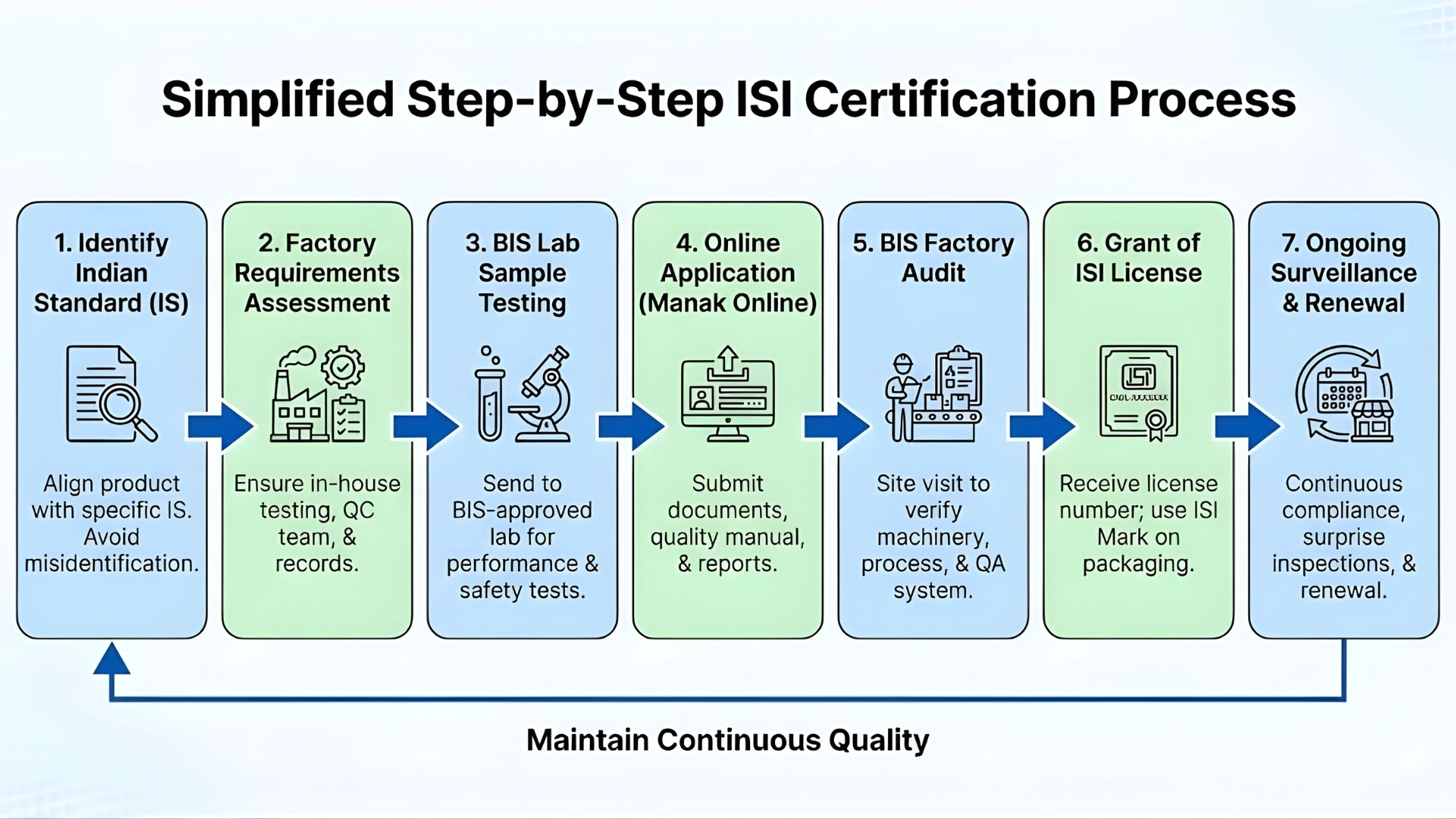
Over the years, Silvereye Certifications has guided hundreds of manufacturers through the ISI Mark process. Each case varies slightly, but the core process remains structured.
A misidentified standard is the most common cause of license rejection.
Minor non-conformities must be corrected before approval.
CM/L-XXXXXXX
You can now use the ISI Mark on product packaging, marketing, and labels.
Brands must maintain quality and testing consistency.
Non-compliance with BIS ISI Mark requirements is not just a regulatory inconvenience. The BIS Act, 2016 treats it as a criminal matter — and enforcement in 2025 and 2026 has become considerably more active than the years before. Here is the full picture of what non-compliance actually costs.
| Consequence | What It Means in Practice |
|---|---|
| Customs Rejection at Indian Ports | Shipment refused clearance. Container sits at port. Demurrage charges accumulate every single day. The clock starts from the moment the consignment arrives — not from when you find out about the hold. |
| Seizure of Goods | BIS market surveillance officers and customs can physically seize non-compliant products — from ports, warehouses, retail shelves, or distribution centres. Seized goods rarely come back. |
| Criminal Prosecution Under BIS Act | Section 29, BIS Act, 2016: imprisonment not less than 6 months, extendable to 2 years, and a fine of not less than Rs. 2 lakh. This applies to the manufacturer, importer, distributor, and retailer in the chain — not just the original producer. |
| Mandatory Product Recall | BIS can order you to recall non-compliant products from the market at your own expense. Recall logistics, destruction costs, and replacement logistics fall entirely on the non-compliant party. |
| Import Blacklisting | Repeat non-compliance can result in BIS-level or customs-level blacklisting of the entity — barring future imports of the non-compliant product category. |
| E-commerce Delisting | Amazon India, Flipkart, and other platforms remove listings for products without valid ISI Mark CM/L numbers. Account-level penalties apply for repeated violations. |
| Government Tender Disqualification | Products without valid ISI certification are disqualified from government and PSU tenders for regulated categories — regardless of price, quality, or relationship history. |
| Supply Chain Liability Cascade | When a non-compliant product is flagged, liability does not stop at the importer. Distributors and retailers who stocked the product face their own enforcement exposure under the BIS Act. |
Manufacturers planning for ISI Certification must understand the expected timeline, associated costs, and the validity period of the licence. These factors help in budgeting, production planning, and market entry strategy. BIS follows a structured process, and the approval duration or fees may vary depending on the product category, testing cycle, and factory readiness.
| Category | Details |
|---|---|
| Processing Timeline | Normal Procedure: 60–120 days, depending on audit and lab test duration.
Simplified Procedure: 30–45 days, depending on test report and factory readiness. |
| Cost Structure | Application Fee: Payable per licence. Inspection Charges: As per BIS officer visit (travel + audit). Testing Charges: Based on BIS-recognized lab rates (varies by product). Annual Licence Fee (ALF): Mandatory yearly charge. Marking Fee: Based on annual production volume. |
| Validity of Licence |
Initial ISI Licence is granted for 1–2 years. After renewal, validity can extend up to 5 years depending on compliance history. |
| Renewal of Licence | Renewal of Licence Renewal requires updated test reports, quality records, and timely payment of fees. Processing timeline: 30–45 days. Must apply at least 3 months before expiry to avoid interruption. |
Silvereye Certifications is trusted by manufacturers because the team delivers fast, accurate, and compliant BIS approvals. The process is handled end-to-end, reducing delays and eliminating documentation errors that commonly lead to rejections.
Silvereye Certifications is trusted by manufacturers because the team delivers fast, accurate, and compliant BIS approvals. The process is handled end-to-end, reducing delays and eliminating documentation errors that commonly lead to rejections.
This makes Silvereye a dependable partner for manufacturers seeking a reliable and hassle-free path to ISI Certification.
The BIS ISI Certification remains one of the most important compliance requirements for manufacturing in India. Whether the product is electrical, mechanical, chemical, or safety-critical, the ISI Mark demonstrates that it meets the quality and safety parameters set by the Bureau Of Indian Standards. For manufacturers, this approval is not just a legal obligation—it is a strong market advantage that improves consumer trust, reduces product failures, and ensures access to organized retail and government procurement.
Obtaining ISI Mark Certification requires careful documentation, precise testing, and timely communication with BIS. We understand that many manufacturers struggle with these steps, which is why partnering with a knowledgeable compliance team is essential for timely success.


























































Official BIS approval confirming a product meets Indian safety and quality standards; mandatory for many high-risk products.
Electrical appliances, wiring cables, PVC pipes, cement, steel, helmets, gas stoves, and other regulated goods.
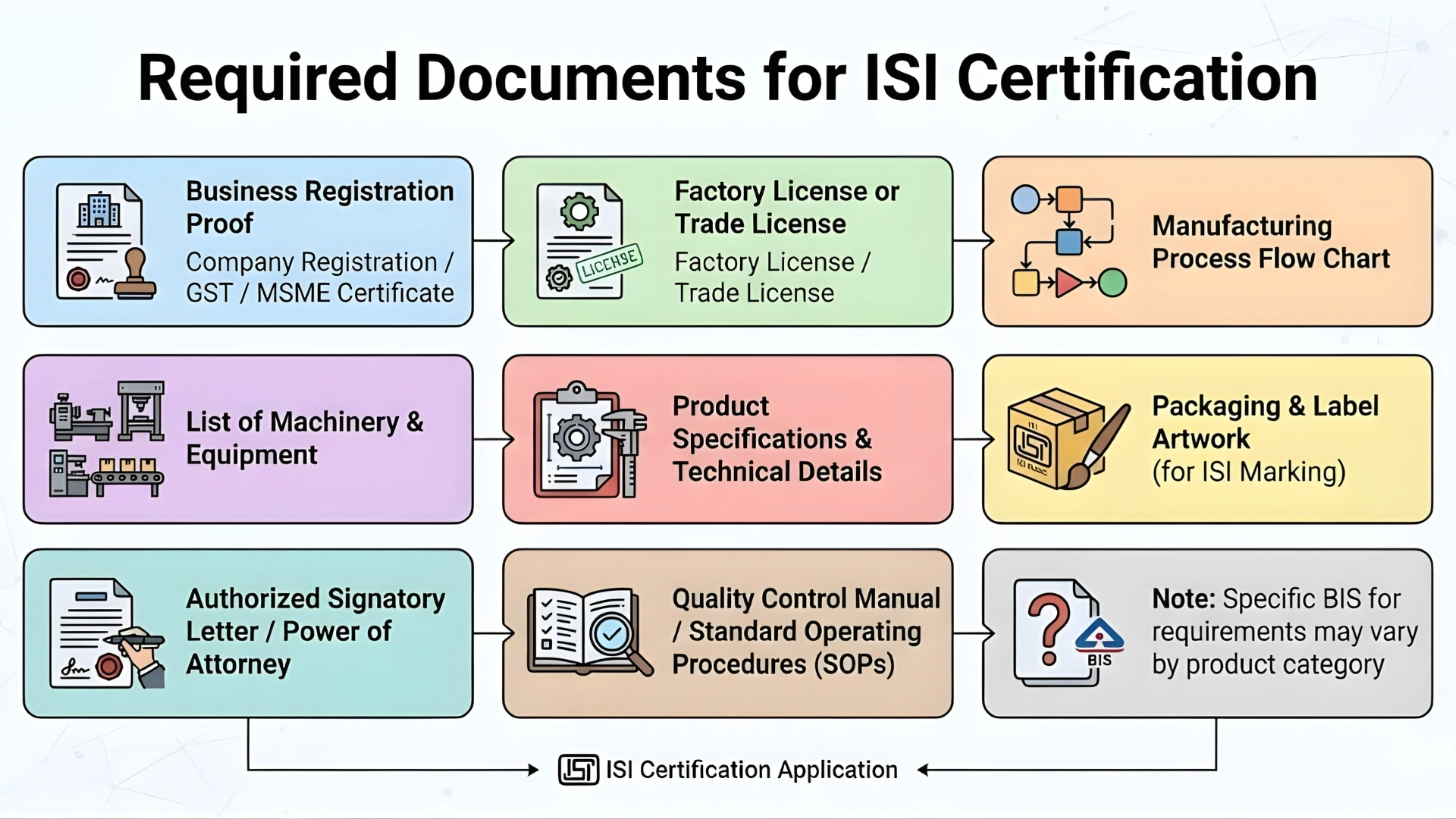
Key documents required are :
Business registration, factory license, manufacturing process, equipment lists, QC manuals, test reports, and ISI marking artwork.
BIS is the overall compliance authority; ISI is a specific certification scheme under BIS for mandatory products.
Includes application fee, testing charges, inspection fee, annual licence fee, and marking fee; varies by product and volume.
Initial validity: 1–2 years; renewal can extend up to 5 years with updated test reports and compliance.
No. Selling mandatory products without ISI is illegal and can lead to fines, product seizure, or legal action.