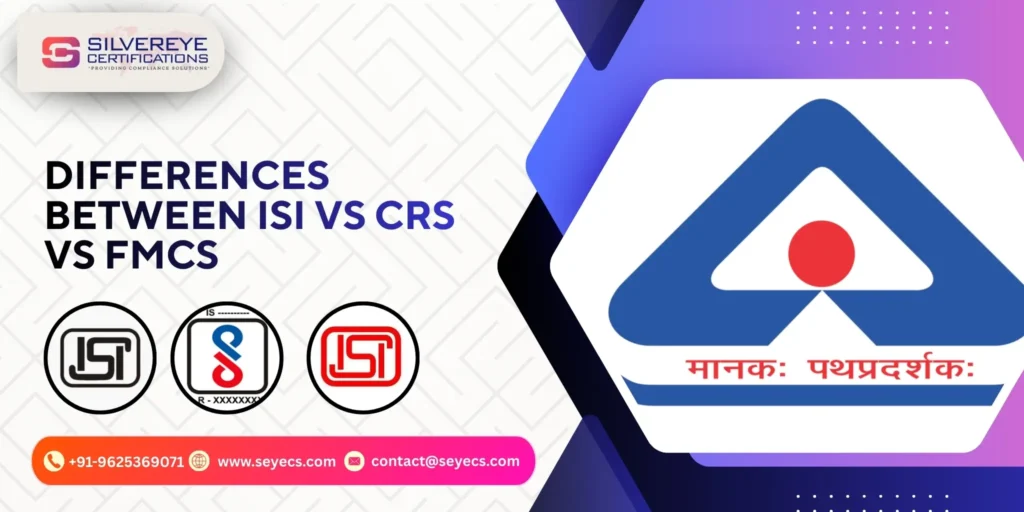
- Difference Between ISI vs CRS vs FMCS are not interchangeable; they refer to different schemes under the Bureau of Indian Standards (BIS) based on product risk and manufacturer location.
- ISI Mark (Scheme-I): The "Gold Standard" for high-risk products (Steel, Cement, Toys). It is the strictest scheme, requiring mandatory factory audits and lab testing. Timeline: 3–4 months.
- CRS (Scheme-II): A simplified "Registration" scheme for Electronics & IT (Laptops, Phones). It relies on NABL lab reports and usually requires no factory visit. Timeline: 20–30 days.
- FMCS: The specific license route for Foreign Manufacturers to obtain the ISI Mark. It requires appointing an Authorized Indian Representative (AIR) in India.
- Eligibility Rule: Licenses are granted only to the factory (manufacturing unit). Importers and traders are not eligible.
Introduction
You have just imported a high-value consignment of LED display screens from Shenzhen to Nhava Sheva port. Your duties are paid, and your logistics are set. But the Customs officer halts the clearance. Why? Your product box carries a "CE" mark, but it is missing the specific R-Number mandated by the Bureau of Indian Standards (BIS).
This is a nightmare scenario we frequently resolve at Silvereye Certifications. The Indian regulatory landscape is aggressive, with Quality Control Orders (QCOs) being updated almost monthly. For manufacturers—both domestic and foreign—compliance is no longer optional; it is the fundamental license to operate.
However, the confusion runs deep. You hear terms like "ISI Mark," "CRS Registration," and "FMCS" used interchangeably. Are they the same? Absolutely not. Applying under the wrong scheme guarantees rejection.
In this guide, we strip away the bureaucratic jargon. We will explain the precise difference between ISI, CRS, and FMCS, helping you identify exactly which certification your product needs to legally enter the Indian market in 2025.
Why are the Difference Between ISI vs CRS vs FMCS?
The Bureau of Indian Standards (BIS) operates different certification schemes because not all products carry the same risk profile. You wouldn't test a bag of cement the same way you test a laptop charger.
Safety vs. Performance: The Core Objective
- Scheme-I (ISI): Focuses on structural safety and raw material quality. It is designed for products where failure could be catastrophic (e.g., a pressure cooker exploding or a steel beam collapsing).
- Scheme-II (CRS): Focuses on performance safety in controlled environments. It ensures your electronics won't electrocute you or catch fire during use.
What is ISI Mark Certification? (Scheme-I Explained)
When people say "BIS Certification," they are usually picturing the ISI Mark. Technically known as Scheme-I under the BIS Conformity Assessment Regulations, 2018, this is the most rigorous quality standard in India.
Full Form of ISI :- ISI Stands for Indian Standards Institution
Which Products Require ISI Mark?
This scheme covers "high-risk" or "core infrastructure" goods. If you manufacture any of the following, you fall under Scheme-I:
- Construction Materials: Cement, Structural Steel, Copper Wire rods.
- Consumer Safety: Pressure Cookers, Helmets, Toys, Tyres.
- Chemicals: Caustic Soda, Boric Acid, Methanol.
Documents Required for ISI Certification
Incomplete documentation is the #1 reason for rejection. BIS requires two sets of documents: Legal (Proof of Existence) and Technical (Proof of Quality).
| Document | Purpose |
| Proof of Address | Factory License, DIC Registration, or Certificate of Incorporation showing the manufacturing address. |
| Proof of Identity | Aadhar Card & PAN Card of the Managing Director or Authorized Signatory. |
| Premises Proof | Rent Agreement or Electricity Bill of the factory. |
| Trademark | Trademark Registration Certificate (or an affidavit if the brand is unregistered). |
ISI Certification Process (Scheme-I): Step-by-Step
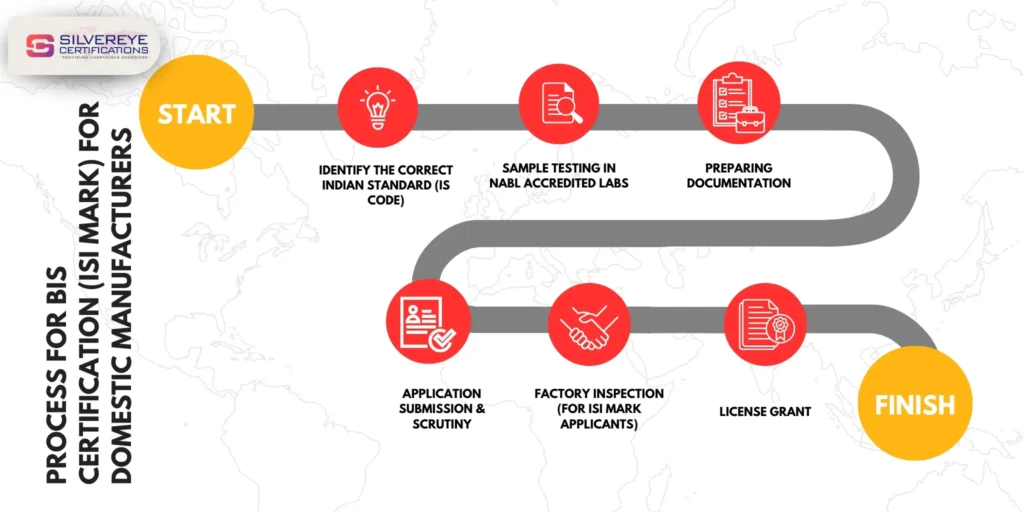
Obtaining the ISI Mark is significantly harder than CRS registration because it involves a mandatory Factory Audit. The Bureau of Indian Standards (BIS) needs to verify that your factory is capable of manufacturing safe products consistently.
Here is the 5-step roadmap we follow at Silvereye Certifications:
1. Application Submission: Identify the correct IS Code for your product and submit the application with documents on the Manak Online portal.
2. Factory Audit: A BIS scientist visits your manufacturing unit to inspect your machinery and verify your in-house Quality Control (QC) Lab.
3. Sample Sealing: During the audit, the officer draws a random sample from your production line and seals it for independent testing.
4. Lab Testing: The sealed sample is sent to a BIS-recognized NABL laboratory to ensure it meets all safety parameters.
5. Grant of License: If both the factory audit and lab test report are successful, BIS grants the license and issues your CM/L Number.
2. What is CRS Registration? (Scheme-II Explained)
Launched by MeitY (Ministry of Electronics and IT), CRS Certification is a modern, streamlined scheme designed for the fast-paced technology sector. It operates on the principle of "Conformity based on Self-Declaration."
Full Form of CRS : CRS Stands for Compulsory Registration Scheme
Which Products Fall Under CRS?
This scheme is almost exclusively for the Electronics and IT sector, along with some renewable energy products:
- IT Hardware: Laptops, Tablets, Printers, Scanners.
- Consumer Electronics: Mobile Phones, Bluetooth Speakers, Smart Watches, TWS Earbuds.
- Power Components: Power Adapters, LED Drivers, Batteries (Cells and Packs).
- Renewables: Solar PV Modules and Inverters.
Documents Required for CRS Registration
| Document Category | Specific Requirements |
| Business Proof | Factory License, Certificate of Incorporation, or ISO Certificate (must show manufacturing address). |
| Trademark | Mandatory: Valid Trademark Registration Certificate. (If you are not the owner, you need an Authorization Letter). |
| Technical Docs | PCB Layout & Circuit Diagram: Schematics of the device.User Manual: English manual with technical specs.CCL (Critical Component List): List of internal parts (PCB, Battery, Fuse) with their certification details. |
| Test Report | Original Test Report from the NABL Lab (valid for 90 days). |
| Legal Forms | Undertaking: Self-declaration signed by the CEO/MD. AIR Nomination: (For Foreign Manufacturers only) Appointment of an Authorized Indian Representative. |
The Process: How CRS Differs from ISI
Unlike the ISI mark, BIS officers rarely visit CRS factories.
- Digital Registration: Create a profile on the official CRS Portal (www.crsbis.in) and generate a specific "Test Request" for your product.
- Sample Testing: Send product samples to a BIS-recognized NABL Laboratory in India. The lab tests them against the relevant Indian Standard (e.g., IS 13252).
- Submit Application: Once the lab issues the Test Report, submit the full application (Form-I) online along with the "Self-Declaration" undertaking.
- BIS Scrutiny: BIS officers review the test report and documents. If there are no errors, the application is processed without a factory visit.
- Grant of License: BIS issues the Registration Number (R-Number). You can now print the Standard Mark on your product and start selling.

Result: CRS Certification is significantly faster (20-30 days) and less expensive than ISI.
3. What is FMCS Certification? (For Foreign Manufacturers)
This is the area where 90% of our clients encounter confusion.
FMCS Meaning: Is It a Separate Mark?

No. FMCS (Foreign Manufacturers Certification Scheme) is not a separate product mark. You will never see a product labeled "FMCS."
- The Reality: FMCS is simply the administrative route that a foreign factory takes to obtain the ISI Mark.
- Example: If a factory in Mumbai applies for ISI, they use the "Domestic Scheme." If a factory in China or Vietnam applies for ISI, they use the "FMCS Scheme." The end result is identical: The ISI Mark on the product.
Full Form of FMCS : FMCS Stands for Foreign Manufacturers Certification Scheme.
The Mandatory Requirement: Authorized Indian Representative (AIR)
Since a foreign factory falls outside Indian jurisdiction, BIS requires a local legal representative. You must appoint an Authorized Indian Representative (AIR) who:
- Is a resident of India.
- Consents to be liable for the compliance of your products.
- Often, the importer or a specialized agency (like Silvereye Certifications) acts as the AIR.
Documents Required for FMCS Certification
Foreign applications face stricter scrutiny. The documentation must be precise and translated into English if necessary.
| Document | Purpose |
| Factory Registration | Business License or Certificate of Incorporation issued by your local government. |
| AIR Nomination Form | Form-VI: Legal nomination of your Authorized Indian Representative. |
| Director's ID | Passport copy of the CEO or Authorized Signatory. |
| Process Flowchart | Detailed diagram of the manufacturing process (Raw material to Finish). |
| Bank Guarantee | Mandatory: A Performance Bank Guarantee (PBG) of $10,000 USD (submitted after approval). |
FMCS Certification Process (For Foreign Manufacturers)
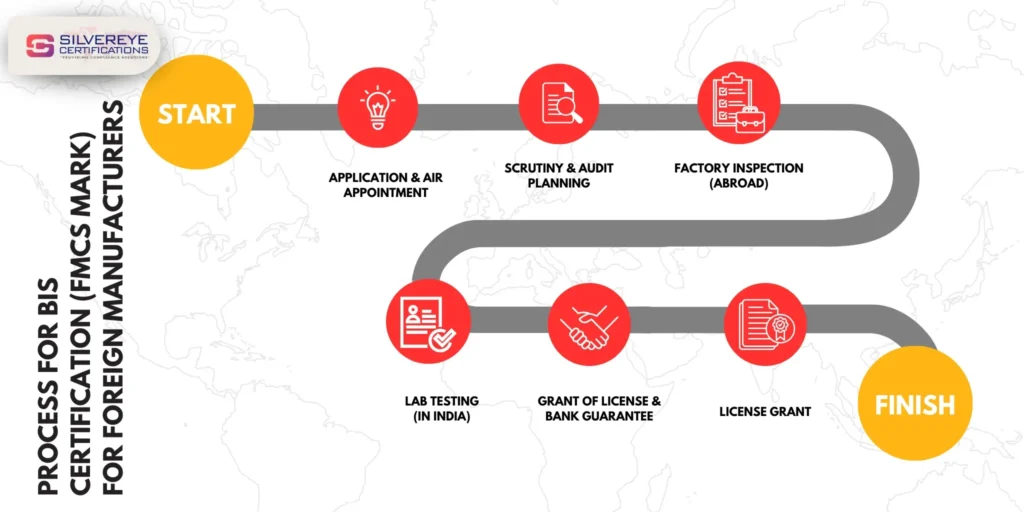
The FMCS process mirrors the domestic ISI process but involves international logistics and higher costs. The key difference is that the BIS Officer travels to your country for the audit.
Here is the 5-step roadmap we follow at Silvereye Certifications for foreign applicants:
Step 1: Application & AIR Appointment- Submit the application online via the BIS portal and send physical copies to the FMCD (Foreign Manufacturers Certification Department) in Delhi.
Step 2: Scrutiny & Audit Planning- BIS reviews the documents. If approved, they calculate the inspection fee.
Step 3: Factory Inspection (Abroad)- The BIS Scientist visits your foreign factory.
Step 4: Lab Testing (In India)- The sealed samples arrive in India and are tested at a BIS-recognized Lab.
Step 5: Grant of License & Bank Guarantee- Once the test report passes, you must submit a Performance Bank Guarantee (PBG) of USD 10,000 to BIS.
ISI vs CRS vs FMCS
Here is the "Cheat Sheet" to help you settle the debate instantly:
| Feature | ISI Mark (Domestic) | CRS (Registration) | FMCS (Foreign ISI) |
| Product Categories | Steel, Cement, Chemicals, Toys | Electronics, Solar, Batteries | Imported ISI Goods (e.g., Imported Steel) |
| Primary Focus | Structural Safety & Quality | Performance Safety | Safety (Imported Goods) |
| Factory Audit | Mandatory | Not Required (Usually) | Mandatory (Officer travels abroad) |
| Testing Requirement | In-house Lab + Independent Lab | Independent Lab Only | In-house Lab + Independent Lab |
| Marking Format | ISI Logo + CM/L Number | Standard Mark + R-Number | ISI Logo + CM/L Number |
| Local Representative | Not Required | AIR (if foreign mfg) | AIR Mandatory |
Eligibility & Requirements: Who Can Apply?
Regardless of the scheme, BIS has non-negotiable eligibility rules:
- Manufacturers Only: Traders, dealers, or retailers cannot apply. The license is granted to the physical manufacturing unit (the factory address).
- Importers: You are not eligible to hold the license directly. You can only act as the AIR for your foreign supplier.
- Separate Licenses: If you have two factories (Unit A and Unit B), you need two separate licenses, even if they manufacture the exact same product.
Why the Distinction Matters: 4 Strategic Benefits
Confusing ISI (Scheme-I) with CRS (Scheme-II) isn't just a terminology error—it is a financial risk. Accurately identifying the correct scheme offers immediate business advantages:
- Accurate Budgeting (Avoid Surprise Costs)
- The Risk: Mistaking an FMCS (ISI) project for a CRS project can destroy your budget.
- The Reality: CRS requires only lab fees. FMCS/ISI demands heavy expenses like Auditor Travel (Business Class + Hotel) and a USD 10,000 Bank Guarantee. Knowing the difference ensures your financial forecasting is precise.
- Realistic Launch Timelines
- The Risk: Promising stakeholders a "quick launch" for a product that requires a factory audit.
- The Reality: CRS is fast (20–30 days). ISI is slow (3–4 months due to audits). Correct classification prevents missed launch dates and contract penalties.
- Zero Customs Delays (Demurrage Protection)
- The Risk: Customs officers are trained to look for specific codes.
- The Reality: Electronic goods need an R-Number; Industrial goods need a CM/L Number. If your packaging bears the wrong marking format, the shipment will be seized, leading to heavy demurrage charges at the port.
- Legal Immunity
- The Risk: Misusing the prestigious ISI Logo on a standard electronic device.
- The Reality: It is a criminal offense to print the ISI Mark on a product meant for CRS Registration (like a laptop). Correct classification protects your brand from legal prosecution and market blacklisting.
BIS Certification Cost & Timeline Breakdown
We believe in transparency regarding costs. Here is what you should budget for:
| Scheme | Estimated Timeline | Cost Factors |
| CRS (Electronics) | 20 – 30 Days | Lab Testing (₹25k - ₹60k) + Gov Fee (approx ₹50k for 5 years). |
| ISI (Domestic) | 3 – 4 Months | Lab Testing (Variable) + Application Fee + Marking Fee (Volume based). |
| FMCS (Foreign) | 4 – 6 Months | High cost due to USD 10,000 Performance Bank Guarantee + Auditor Travel Expenses (Business Class/Hotel). |
Validity and Renewal: Is BIS Certification Permanent?
- ISI / FMCS: Typically granted for 1 year initially. Renewal is annual and depends on your production volume and payment of marking fees.
- CRS: Typically granted for 2 years. Renewal is simpler—just pay the fee and submit documents; usually, no re-testing is required unless the standard has changed.
Choosing a BIS Consultant: Why Expertise Matters
Can you file this yourself? Technically, yes. The official government portal is open to everyone. However, the technical nuance is where applications fail.
- Lab Failures: If your sample fails because of a minor packaging error, you pay the full testing fee again. We pre-check samples to prevent this.
- Customs Liability: We act as the AIR for foreign brands, handling the legal liability so you don't have to.
- Audit Prep: A single mismatch in your "Process Flowchart" vs. "Machinery List" can delay your file by months.
At Silvereye Certifications, we specialize in navigating these complexities. Whether it is hosting a BIS auditor for an FMCS visit or expediting a CRS test report, we handle the friction so you can focus on sales.
Conclusion
Understanding the difference between ISI, CRS, and FMCS is critical for your India market strategy.
- Selling Laptops? You need CRS (Fast, No Audit).
- Selling Steel? You need ISI (Rigorous, Factory Audit).
- Manufacturing in China? You need FMCS (The route to get ISI).
Compliance is not just about avoiding fines; it is about building a brand that Indian consumers trust. Don't let a missing document halt your supply chain.
Ready to certify your product?
Stop guessing which scheme applies to you.
Contact today for a free assessment of your product category.
Frequently Asked Questions
What is the main difference between ISI and CRS?
The main difference is the audit requirement. ISI (Scheme-I) requires a mandatory physical factory audit for high-risk goods like steel. CRS (Scheme-II) is for electronics and relies on lab reports with no immediate factory visit.
Is FMCS a separate mark from ISI?
No. FMCS is just the administrative route for foreign manufacturers. The final product will bear the standard ISI Mark, identical to products made in India.
Which scheme requires a mandatory factory audit?
A physical audit is mandatory for ISI and FMCS to verify machinery and in-house labs. CRS generally skips this step to speed up approvals for IT goods.
Why does FMCS take longer than CRS?
FMCS takes 4–6 months because BIS officers must travel abroad for inspections. CRS takes only 20–30 days as it bypasses the audit queue.
Can I choose CRS instead of FMCS?
No. The scheme is determined by your product, not your preference. Laptops must go through CRS; Steel valves must go through FMCS.
Which certification is the most expensive?
FMCS is the most expensive. You must pay for the officer's business-class travel, hotel, and a USD 10,000 Bank Guarantee. CRS is cheaper, costing mainly lab fees.
Do I need an in-house lab for all schemes?
For ISI/FMCS, a fully functional in-house lab is mandatory for the audit. For CRS, it is recommended but not strictly enforced for the license grant.
Who needs an Authorized Indian Representative (AIR)?
All foreign applicants (under FMCS or CRS) must appoint an AIR. This local representative accepts legal liability since the factory is outside Indian jurisdiction.
How long is the license valid?
ISI/FMCS licenses are valid for 1 year initially. CRS is valid for 2 years. Both are renewable.
What is the penalty for using the ISI mark on a CRS product?
It is a criminal offense ("Misuse of Standard Mark"). Using the ISI logo on electronics (which need an R-Number) can lead to stock seizure and fines, even if you have a valid license.