
- CDSCO Registration Certificate is mandatory for manufacturing, importing, or selling medical devices and cosmetics in India under the Medical Device Rules, 2017.
- The process involves classifying your product (Class A-D), appointing an Authorized Indian Representative (AIR), and submitting technical dossiers via the SUGAM portal.
- Non-compliance leads to immediate regulatory bans, shipment seizures at customs, and heavy fines.
Introduction
Imagine your shipment of high-end diagnostic kits arrives at the Nhava Sheva port. You have buyers waiting, purchase orders lined up, and the market is ready. But the Customs officer halts the consignment. Why? You are missing a valid CDSCO Registration Certificate.
We see this scenario play out far too often. In India, the regulatory landscape for medical devices and cosmetics has shifted dramatically. Gone are the days when you could import freely and worry about paperwork later. Today, if your product falls under the purview of the Central Drugs Standard Control Organization (CDSCO), you need approval before you hit the market.
Whether you are a domestic manufacturer in Gujarat or an importer bringing in tech from Germany, navigating the DCGI Guidelines is not optional—it is the foundation of your business survival. This guide cuts through the bureaucratic noise to explain exactly how to secure your CDSCO Approval efficiently.
What is a CDSCO Registration Certificate?
Think of the CDSCO Registration Certificate as your legal passport to India’s healthcare market.
Understanding the Central Drugs Standard Control Organization (CDSCO)
The Central Drugs Standard Control Organization (CDSCO) is India’s equivalent to the FDA in the USA. It is the National Regulatory Authority (NRA) of India. While the Drug Controller General of India (DCGI) heads the department, the CDSCO is the body that actually processes your applications, reviews your technical data, and grants the CDSCO Certificate.
A CDSCO Registration Certificate is a regulatory license granted by India's Central Drugs Standard Control Organization. It authorizes the manufacture, import, or sale of medical devices, IVDs, and cosmetics, certifying that the products meet the safety and quality standards defined in the Medical Device Rules, 2017.
The Role of CDSCO in Ensuring Product Safety
The primary goal of the CDSCO registration certificate is patient safety. The Indian government wants to ensure that a pacemaker implanted in a patient in Mumbai performs just as safely as one in New York. The registration process acts as a filter. It forces manufacturers to prove that their quality management systems (like ISO 13485) are active and that the clinical data supports the product's claims. Without this gatekeeping, the Indian market would be flooded with substandard goods.
Who Needs CDSCO Registration?
Domestic manufacturers, importers of foreign goods, and traders dealing in notified medical devices require CDSCO registration.
Domestic Manufacturers
If you manufacture medical devices—from simple cotton gauze to complex MRI machines—within India, you cannot operate without a license. Depending on the risk class of your device, you will need to apply to either the State Licensing Authority (SLA) or the Central Licensing Authority (CLA).
Importers of Foreign Goods
This is where we see the most confusion. If you are bringing foreign-made cosmetics or medical devices into India, you are technically the "applicant." The foreign manufacturer cannot apply directly; they need you (or an authorized agent) to hold the CDSCO Registration on their behalf. You need an Import License (Form MD-14 or Form 42/43) to clear customs.
Traders and Whole-sellers
Even if you don't make the product, if you are selling it, you need a registration number to put on the label. Under the new rules, traders dealing in notified medical devices must also ensure they are sourcing only from entities holding a valid CDSCO Certificate.
Is CDSCO Registration Mandatory?
Yes. If you intend to manufacture, import, or sell medical devices or cosmetics in India, CDSCO Registration is not a voluntary certification—it is a legal requirement.
The Legal Implications under the Medical Device Rules, 2017
The introduction of the Medical Device Rules (MDR), 2017, changed everything. Before this, many devices were unregulated. Now, the CDSCO Registration process covers almost every category of medical device and cosmetic. Operating without it is a violation of the Drugs and Cosmetics Act, 1940.
Penalties for Non-Compliance (Bans and Fines)
The risks are financial and reputational.
- Customs Seizures: Your goods will be detained at the port, racking up demurrage charges.
- Market Bans: The CDSCO publishes lists of non-compliant firms. Being on this list means hospitals and distributors will stop doing business with you.
- Legal Action: You could face prosecution, fines, or imprisonment under Indian law for selling spurious or unregulated drugs/devices.
Which CDSCO Registration Do You Need? A Guide to All License Types
Not all licenses are the same. A lipstick requires different paperwork than a heart valve.
What is the Cosmetic License?
In India, a Cosmetic License is the regulatory approval required to ensure that beauty and personal care products are safe, free from heavy metals (like lead and arsenic), and label-compliant before they hit the shelves.Whether it’s a herbal shampoo or a luxury lipstick, the CDSCO regulates them under the Cosmetics Rules, 2020.
This license is not just about paperwork; it is a safety clearance. It proves your product does not contain banned ingredients (like hexachlorophene) and meets the Bureau of Indian Standards (BIS) norms for pH and microbial load.
Import Registration (Form 42 / Form 43) for Foreign Brands
If you are bringing international beauty brands into India (e.g., from Korea, France, or the USA), you need an Import Registration Certificate.
- The Forms: Historically known as applying via Form 42 to get Form 43, under the new Cosmetics Rules, 2020, the application is now filed as Form COS-1, and the approval is granted as Form COS-2.
- The Requirement: You must submit a Free Sale Certificate (FSC) from the country of origin to prove the product is already being sold legally there.
- Key Insight: This registration is valid for 5 years. Without it, your shipment will be blocked at Indian Customs under "Prohibited Goods."
Manufacturing License (Form 32) for Indian Units
For those manufacturing cosmetics within India, the license is issued by the State Licensing Authority (SLA) but often coordinated with CDSCO standards.
- The Forms: You apply using Form 31 (or COS-5) to receive your manufacturing license in Form 32 (or COS-8).
- The Requirement: This involves a physical inspection of your factory. Drug inspectors will check your facility’s hygiene, water systems, and laboratory capabilities to ensure Good Manufacturing Practices (GMP).
- Key Insight: You can manufacture products yourself or use a "Loan License" to manufacture your brand at a third-party factory that already holds a valid Form 32.
What is the Medical Device License?
In India, the term "Medical Device License" isn't a single document. Under the Medical Device Rules, 2017 (MDR 2017), the type of license you need depends entirely on two factors: what you do (Manufacture, Import, or Outsource) and the risk class of your device.
The CDSCO issues specific forms for each activity. Using the wrong form is the #1 reason for application rejection. Here is the complete breakdown of the licenses available:
Manufacturing License (MD-3, MD-5, MD-9)
- Form MD-3/MD-4: Application for Loan License.
- Form MD-5: License to manufacture for sale or distribution (Class A & B).
- Form MD-9: License to manufacture (Class C & D).
- Note: The form numbers depend on whether you are applying to the State or Central Authority.
Import License (MD-14, MD-15)
- Form MD-14: This is the application form for importing medical devices.
- Form MD-15: This is the actual license granted to you. This is the holy grail for importers. Without MD-15, you cannot file a Bill of Entry at customs for medical devices.
Loan License for Manufacturing
If you want to market a product under your brand but don't own a factory, you can use a "Loan License." You effectively "rent" the manufacturing capacity of an already licensed factory.
Classification of the Medical Device License
Your fees and timeline depend entirely on this classification. The Central Drugs standards control organization categorize devices based on risk.
Class A: Low Risk (e.g., Thermometers, Cotton)
These are the easiest to register. They often require a simple self-declaration and upload to the portal.
- Examples: Absorbent cotton, surgical dressings, alcohol swabs.
Class B: Low-Moderate Risk (e.g., Hypodermic Needles)
Slightly more scrutiny. You need to submit a Device Master File.
- Examples: BP monitors, glucometers, surgical needles.
Class C: Moderate-High Risk (e.g., Lung Ventilators)
These require a comprehensive audit and review by the Central Licensing Authority (CLA).
- Examples: Dialysis machines, patient monitors, orthopedic implants.
Class D: High Risk (e.g., Heart Valves, Pacemakers)
The highest scrutiny. These products sustain life. Clinical investigation data is strictly reviewed.
- Examples: Stents, cardiac pacemakers, angiographic catheters.
Who Can Apply for the CDSCO Registration Certificate?
To apply for a CDSCO Registration Certificate, the applicant must be a registered legal entity based in India.
Registered Indian Companies
You must be a legal entity in India. A foreign company cannot directly log into the SUGAM portal and apply. You need a valid PAN, GST, and a registered address in India.
The Role of the Authorized Indian Representative (AIR) for Foreign OEMs
This is critical for international brands. If you are a manufacturer in the USA or China, you must appoint an Authorized Indian Representative (AIR). The AIR must hold a valid wholesale drug license (Form 20B/21B).
- Warning: The AIR is legally responsible for your product in India. If there is a recall or a safety alert, the AIR is the one the CDSCO will summon. Choose a partner who understands regulatory compliance, not just a logistics provider.
What are the Benefits of the CDSCO Registration Certificate?
Why go through the hassle? Because it unlocks the market.
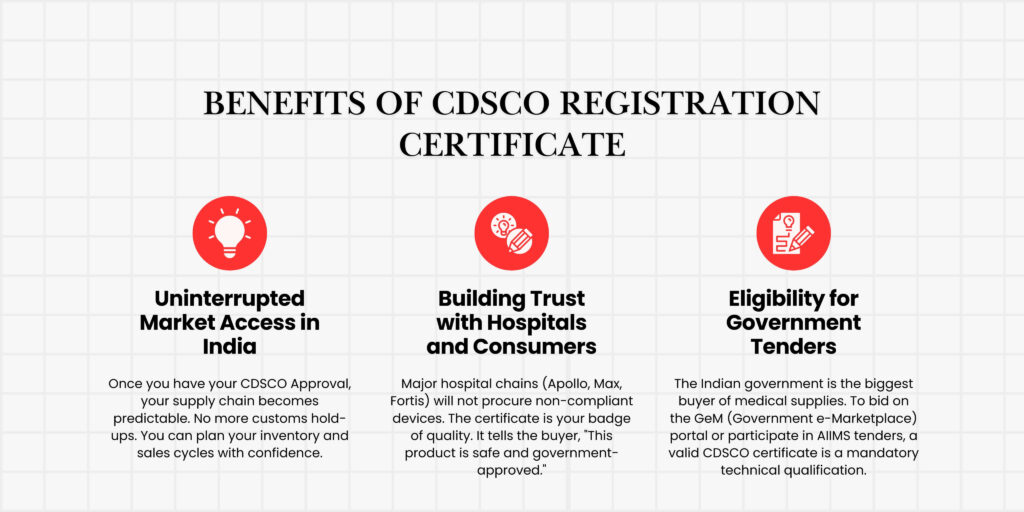
Uninterrupted Market Access in India
Once you have your CDSCO Approval, your supply chain becomes predictable. No more customs hold-ups. You can plan your inventory and sales cycles with confidence.
Building Trust with Hospitals and Consumers
Major hospital chains (Apollo, Max, Fortis) will not procure non-compliant devices. The certificate is your badge of quality. It tells the buyer, "This product is safe and government-approved."
Eligibility for Government Tenders
The Indian government is the biggest buyer of medical supplies. To bid on the GeM (Government e-Marketplace) portal or participate in AIIMS tenders, a valid CDSCO certificate is a mandatory technical qualification.
Which Documents Are Required for CDSCO Registration Certificate?
Documentation is where 70% of applicants fail. The DCGI Guidelines are strict.
Corporate Legal Documents (KYC, PAN, GST)
- Certificate of Incorporation.
- PAN Card and GST Registration.
- A valid Wholesale Drug License (Form 20B/21B) for the applicant.
Technical Documents (Device Master File & Plant Master File)
- Plant Master File (PMF): Details about the factory, layout, sterility, and water systems.
- Device Master File (DMF): Details about the product design, raw materials, biocompatibility reports, and shelf-life studies.
- ISO 13485 Certificate: Mandatory quality standard for medical devices.
Free Sale Certificate (FSC) from Country of Origin
For importers, you must prove the device is sold in your home country (GHTF countries like USA, EU, Canada, Japan, Australia get preference). You need a legalized/apostilled Free Sale Certificate.
What is the Process of the CDSCO Registration Certificate?
The CDSCO Registration process is entirely online, but it requires precision.
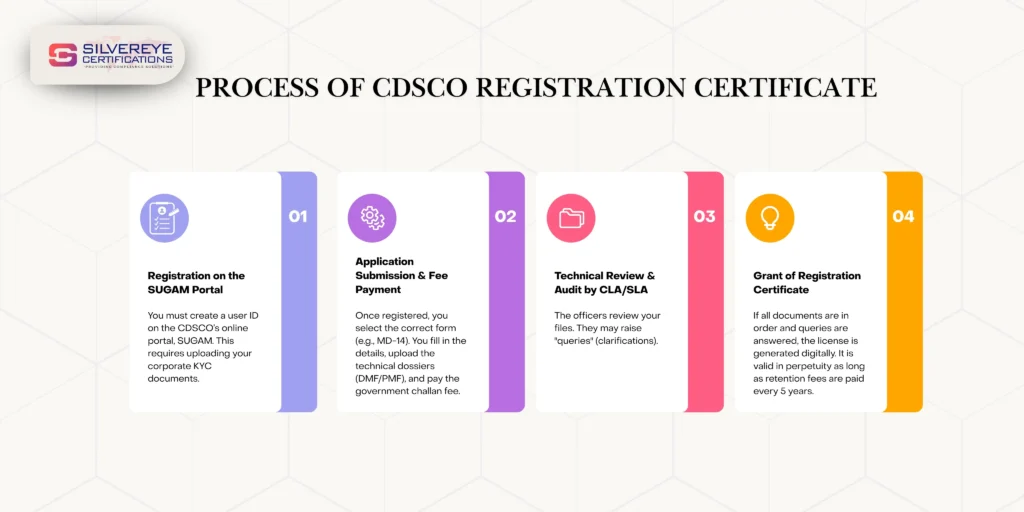
Step 1: Registration on the SUGAM Portal
You must create a user ID on the CDSCO’s online portal, SUGAM. This requires uploading your corporate KYC documents.
Step 2: Application Submission & Fee Payment
Once registered, you select the correct form (e.g., MD-14). You fill in the details, upload the technical dossiers (DMF/PMF), and pay the government challan fee.
- Fee Structure: Fees vary. For example, a Class B import license might cost $1000 for the site and $50 per product (approximate values in USD equivalent, payable in INR).
Step 3: Technical Review & Audit by CLA/SLA
The officers review your files. They may raise "queries" (clarifications).
- For Manufacturers: This step often involves a physical audit of your factory by Medical Device Officers.
- For Importers: The audit is usually a desk review of the documents provided by the foreign OEM.
Step 4: Grant of Registration Certificate
If all documents are in order and queries are answered, the license is generated digitally. It is valid in perpetuity as long as retention fees are paid every 5 years.
Why Do Applications Get Rejected?
Incomplete or Incorrect Documentation
Uploading a blurred PDF, missing the apostille on the Power of Attorney, or submitting an expired ISO certificate will lead to instant rejection or long delays.
Misclassification of Medical Devices
Trying to register a Class C device (High risk) as a Class B (Low risk) to save fees is a common mistake. The CDSCO officers are technical experts; they will catch this and reject the application.
Failure to Respond to CDSCO Queries on Time
When the CDSCO raises a query, you usually have a specific window (often 45 days) to respond. If you miss this deadline, your application is considered "Withdrawn," and you forfeit the government fees.
Here is the detailed Timeline and Cost breakdown for CDSCO Registration (Medical Devices & Cosmetics), formatted as requested.
CDSCO Registration Costs & Timelines
The following tables outline the official government fees and estimated regulatory timelines as per the Medical Device Rules, 2017 and Cosmetics Rules, 2020.
A. For Medical Device Import (Form MD-14) Applicable to foreign manufacturers and Indian importers.
| Medical Device Class | Risk Level | Govt. Site Fee (Per Site) | Govt. Product Fee (Per Device) | Regulatory Timeline |
| Class A | Low Risk | $1,000 | $50 | 30–60 Days |
| Class B | Low-Moderate | $2,000 | $1,000 | 3–6 Months |
| Class C | Moderate-High | $3,000 | $1,500 | 6–9 Months |
| Class D | High Risk | $3,000 | $1,500 | 6–9 Months |
Note: Fees are payable in USD equivalents via the Bank of Baroda. Class A (Non-Sterile/Non-Measuring) devices are self-declared but still require listing.
B. For Medical Device Manufacturing (Indian Manufacturers)- Applicable to domestic manufacturing units in India.
| Medical Device Class | License Authority | Govt. Site Fee | Govt. Product Fee | Regulatory Timeline |
| Class A | State (SLA) | ₹5,000 | ₹500 | 30–45 Days |
| Class B | State (SLA) | ₹5,000 | ₹500 | 3–5 Months |
| Class C | Central (CLA) | ₹50,000 | ₹1,000 | 6–8 Months |
| Class D | Central (CLA) | ₹50,000 | ₹1,000 | 6–9 Months |
C. For Cosmetics Import Registration (Form COS-2)- Applicable to importers of beauty and personal care products.
| Category | Govt. Fee (USD) | Remarks | Regulatory Timeline |
| Per Category | $1,000 | Covers one brand/category (e.g., "Skin Care") | 3–6 Months |
| Per Variant | $50 | For each shade, flavor, or pack size | — |
| Per Mfg Site | $500 | If sourcing from multiple factories | — |
Renewal and Validity
Understanding the difference between "Renewal" and "Retention" is critical to maintaining your license status.
A. Medical Devices (Perpetual Validity with Retention)
Under the Medical Device Rules, 2017, the concept of "Renewal" has been replaced by "License Retention."
- Validity: The CDSCO Registration Certificate (Import or Manufacturing) is valid in perpetuity (indefinitely) unless suspended or cancelled.
- Retention Fee: To keep the license active, you must pay a License Retention Fee every 5 years from the date of issue.
- Cost: The Retention Fee is equivalent to the original license fee (e.g., $3,000 for Class C site).
- Timeline: The fee must be paid before the due date.
- Late Fee: If paid after the due date, a late fee of 2% per month applies for up to 180 days. After 180 days, the license is deemed cancelled.
B. Cosmetics (Fixed Validity)
Under the Cosmetics Rules, 2020, the registration is not perpetual.
- Validity: The Import Registration Certificate (Form COS-2) is valid for a period of 5 Years from the date of issue.
- Renewal Process: You must apply for a fresh registration (often called renewal) before the expiry of the current certificate to ensure business continuity. The fees remain the same ($1,000 per category).
Struggling to Get Your CDSCO Registration Certificate? We Simplify the Process.
Regulatory compliance shouldn't slow down your business growth. At Silvereye Certifications (SEYECS), we understand that you want to focus on sales, not paperwork.
Expert Guidance on Regulatory Compliance
We don't just file forms; we strategize. We help you classify your products correctly to optimize costs and timelines. We review your technical dossiers before submission to minimize queries.
End-to-End Support: From AIR Service to Final Approval
From acting as your Authorized Indian Representative (AIR) to handling the final query response, we manage the entire lifecycle. We ensure your CDSCO Registration Certificate arrives on time so your product launch stays on schedule.
Conclusion: Do You Want a License or a Liability?
The Indian market is lucrative, but it is also strictly regulated. A valid CDSCO Registration Certificate is the difference between a thriving medical device business and a seized container at the port. Don't treat compliance as an afterthought.
If you are ready to navigate the CDSCO Registration process without the headaches, let's talk. Secure your approval, protect your brand, and start selling with confidence.
Contact Silvereye Certifications Today for a Free Compliance Assessment
Frequently Asked Questions
Can a foreign company apply for CDSCO Registration directly?
No. Foreign manufacturers cannot directly access the SUGAM portal. You must appoint an Authorized Indian Representative (AIR)—a local entity with a valid wholesale license—to submit the application and hold the license on your behalf.
How long is the CDSCO Registration Certificate valid?
Under the Medical Device Rules, 2017, the certificate is valid in perpetuity (indefinitely). However, you must pay a License Retention Fee every 5 years to keep it active. Failure to pay leads to automatic suspension.
What is the difference between a "Loan License" and a "Manufacturing License"?
A standard Manufacturing License applies when you own the factory. A Loan License allows you to "rent" manufacturing capacity from an already licensed third-party factory to produce goods under your own brand name.
Is ISO 13485 mandatory for CDSCO Registration?
Yes. For medical devices, submitting a valid ISO 13485 certificate is non-negotiable. It proves your Quality Management System (QMS) meets international standards for safety and efficacy.
How long does the approval process take?
Timelines vary by risk. Class A (Low Risk) devices can often be registered immediately or within 30 days. Class C and D (High Risk) devices typically take 6 to 9 months due to mandatory technical audits and expert committee reviews.
What happens if I import devices without a CDSCO license?
Your shipment will be seized by the Assistant Drug Controller (ADC) at Indian Customs. You will face heavy demurrage (storage) charges, potential fines, and may be forced to re-export or destroy the goods.
Does US FDA or CE approval exempt me from CDSCO Registration?
No. While US FDA (510k) or CE certification expedites the technical review and builds trust, it does not replace the need for Indian registration. You must still file for CDSCO Approval to sell legally in India.
What is the SUGAM Portal?
SUGAM is the single-window online platform run by the CDSCO. All applications, document uploads, query responses, and fee payments for medical device and cosmetic registration must be done digitally through this portal.
Who classifies the risk level (Class A-D) of my device?
The CDSCO has a published list of "Notified Medical Devices" with their risk classifications. If your device isn't listed, you must apply for a classification request (Form MD-13) to the Central Licensing Authority before registering.
Do cosmetics need the same license as medical devices?
No. Cosmetics are regulated under the Cosmetics Rules, 2020. Importers need a Registration Certificate (Form 43/COS-2), while manufacturers need a Manufacturing License (Form 32/COS-8). The technical requirements (heavy metal testing) differ significantly from medical devices.