
- WPC Certificate for Import is a legal necessity under the Department of Telecommunications (DoT) for any business importing wireless products (like Bluetooth speakers, smartwatches, or Wi-Fi routers) into India.
- Holding a valid WPC import license ensures your shipment clears Indian Customs smoothly, saving you from expensive demurrage charges and the risk of confiscation.
- The WPC import approval process involves submitting a valid RF Test Report (from an accredited lab) via the Saral Sanchar portal and paying a government fee of ₹10,000 per model.
- Mandatory DoT approval required for importing Bluetooth, Wi-Fi, and RFID devices.
- The process involves RF testing (NABL/ILAC), Saral Sanchar registration, and ETA issuance.
Introduction
You’ve just ordered 5,000 smartwatches from a manufacturer in Shenzhen. You’ve paid the vendor, arranged the logistics, and your shipment has finally arrived at the Nhava Sheva or Delhi air cargo terminal. You are ready to distribute.
But then, you get a call from your Clearing Agent (CHA).
"Sir, Customs has put a hold on the consignment. The officer is asking for the WPC Certificate for Import. Do you have it?"
If your answer is "No" or "What is that?", you are in for a rough couple of weeks. We see this happen constantly at Silvereye Certifications. Importers often assume that having an IEC code and GST number is enough. It isn't. If your product talks wirelessly—whether it’s a high-end drone or a cheap Bluetooth speaker—you cannot clear Indian customs without a nod from the WPC Wing.
What is a WPC Certificate?
WPC stands for Wireless Planning & Coordination. It is a wing of the Department of Telecommunications (DoT) in India.
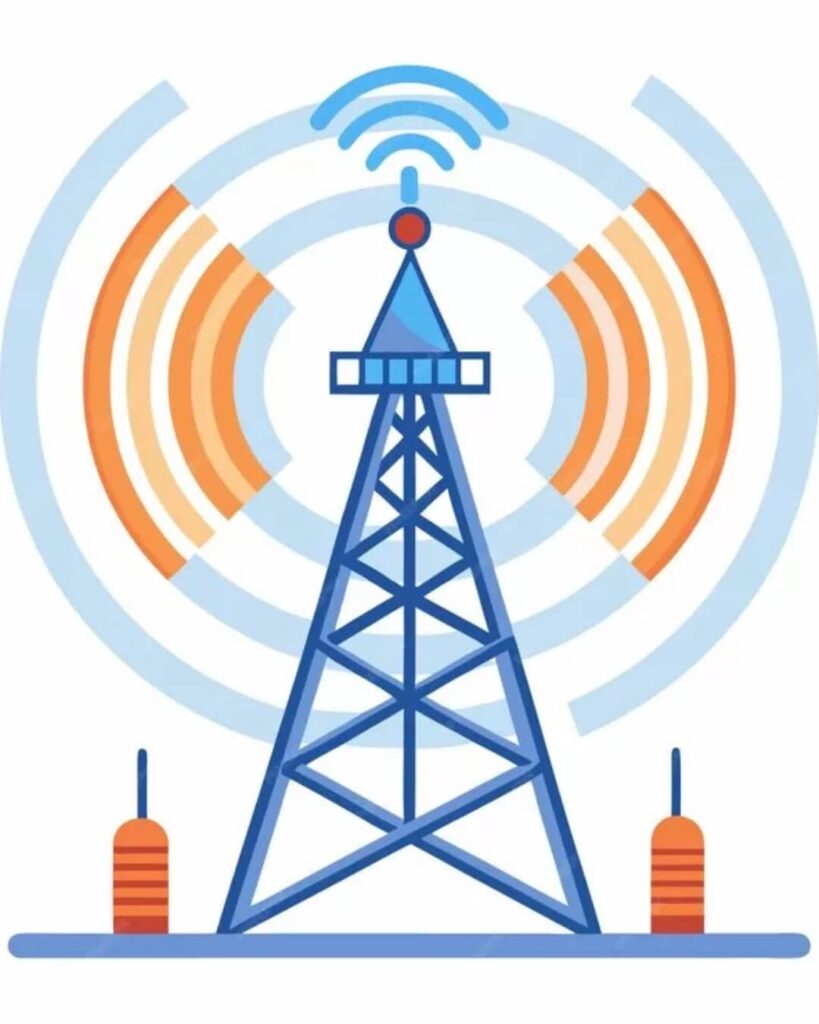
Think of the WPC Wing as the traffic police for radio frequencies. Just like vehicles need lanes to drive without crashing into each other, wireless devices need specific frequency bands to operate without interfering with military comms or airline radios.
A WPC Certificate for Import (often technically referred to as an ETA or Equipment Type Approval) is the document that proves your product operates on "de-licensed" frequency bands (like the common 2.4 GHz or 5 GHz) and is safe to enter the country.
Difference Between ETA & WPC Import License
People confuse these two terms.
- ETA (Equipment Type Approval): This is the technical approval showing your product model is compliant. For most consumer goods (Bluetooth/Wi-Fi), this is your WPC certificate.
- Import License: This is a specific permission required for products that do not operate on de-licensed bands (like specific walkie-talkies or broadcasting equipment). However, in industry speak, importers often use "WPC Import License" to refer to the ETA required for customs clearance.
Why is WPC Certificate Required for Import?
It’s not just about paperwork; it’s about national security and safety.
- Legal Obligation: Under the Indian Wireless Telegraphy Act, possessing wireless equipment without a license is technically illegal unless exempted (which is what the ETA does—it proves exemption).
- Customs Clearance (The Big One): Indian Customs is integrated with the DoT system. If your HS Code hints at a wireless product, the officer will demand the WPC approval. Without it, your goods sit at the port.
- Avoiding Demurrage: Every day your goods sit at the port unauthorized, you pay demurrage (storage) fees. We have seen importers pay storage fees higher than the value of the goods simply because they delayed their WPC application.
Pro Tip: Never ship your goods before you have the WPC ETA in hand. The date on the certificate should ideally precede the date of arrival to avoid scrutiny.
Products Requiring WPC Certificate for Import
Basically, if it sends or receives a signal without a wire, it needs WPC approval.
Here is the checklist of common items we process approvals for daily:
- Consumer Electronics:
- Bluetooth Headphones & TWS Earbuds
- Wireless Speakers (portable and home theatre)
- Smartwatches & Fitness Bands
- Laptops & Tablets (with Wi-Fi/Bluetooth)
- Smart Home & IoT:
- Smart Bulbs & Plugs
- Wi-Fi Routers & Modems
- Wireless CCTV Cameras
- Industrial & Commercial:
- RFID Readers and Tags
- Point of Sale (POS) Machines
- Drones (UAVs) – Note: Drones have extra regulations!
- Remote Controlled Toys
Not sure if your product is on the list? Check the technical spec sheet. If you see "Bluetooth 5.0," "Zigbee," "2.4 GHz," or "Wi-Fi 6," you need the certificate.
Types of WPC Certifications for Import
To keep this simple for importers, there are generally two routes:
1. ETA through Self-Declaration (The Fast Route)
Since 2019, the DoT has simplified the process for products operating in "de-licensed frequency bands" (like standard Wi-Fi and Bluetooth). This is the SARAL SANCHAR WPC portal route.
- Applicable for: 90% of consumer electronics.
- Mechanism: You submit an RF test report from an accredited lab, and the system generates the ETA.
2. Regular ETA (The Older Route)
For products operating in bands that are not fully de-licensed or require specific power limits not covered under the self-declaration scheme. This requires manual scrutiny by a WPC officer.
Why Do You Need a WPC Certificate For Import?
| Key Benefit | Business Impact |
| 1. Zero Customs Delays | Prevents your shipment from getting stuck at the port, saving you from heavy demurrage (storage) fees and penalties. |
| 2. Legal Protection | Protects your business from government fines, product seizure, and legal action under the Indian Wireless Telegraphy Act. |
| 3. Faster Market Entry | Ensures a predictable supply chain, allowing you to launch products on Amazon, Flipkart, or retail shelves before competitors. |
| 4. Brand Credibility | proves your product is legitimate and safe, building trust with corporate buyers and savvy consumers. |
| 5. Technical Safety | Guarantees your device operates on approved frequency bands, preventing interference issues with other networks. |
WPC Import Certificate Eligibility Criteria
Before you start the application, ensure you fit the mold.
- Who can apply? Only an Indian entity can be the applicant.
- Foreign Manufacturers: If you are a factory in China, USA, or Vietnam, you cannot apply directly. You must appoint an Authorized Indian Representative (AIR). This could be your branch office, your importer, or a certification agency like Silvereye Certifications acting on your behalf.
- Importer/Trader: If you are buying goods to sell in India, you can apply using your company credentials.
Step-by-Step Process for Getting WPC Certificate for Import
Navigating the bureaucracy can be tricky. Here is the exact workflow we follow at Silvereye to get clients approved.
Step 1: RF Test Report (The Foundation)
You cannot get a WPC certificate without a Radio Frequency (RF) Test Report.
- The report must be from an ISO/IEC 17025 accredited laboratory.
- For Imported Goods: A report from a foreign lab (ILAC accredited) is usually accepted for the ETA (Self-Declaration) category. You do not necessarily need to send samples to India for testing, provided your factory has a valid report from a recognized lab (like Intertek, SGS, TUV, etc.).
Step 2: Register on SARAL SANCHAR Portal
The DoT uses the SARAL SANCHAR digital platform. You need to create a user profile.
- Note: The profile must be linked to a specific Indian mobile number for OTP verification.
Step 3: Application Submission
We upload the technical documents, the RF test report, and the product specifications.
- We enter details like Frequency Band, Modulation Type, and Output Power. Accuracy here is critical.
Step 4: Payment of Government Fee
There is a nominal government fee (approx ₹10,000 for ETA) that must be paid online via the Bharatkosh portal.
Step 5: Approval & Issuance
Once the system verifies the payment and the test report parameters, the WPC ETA certificate is issued digitally.
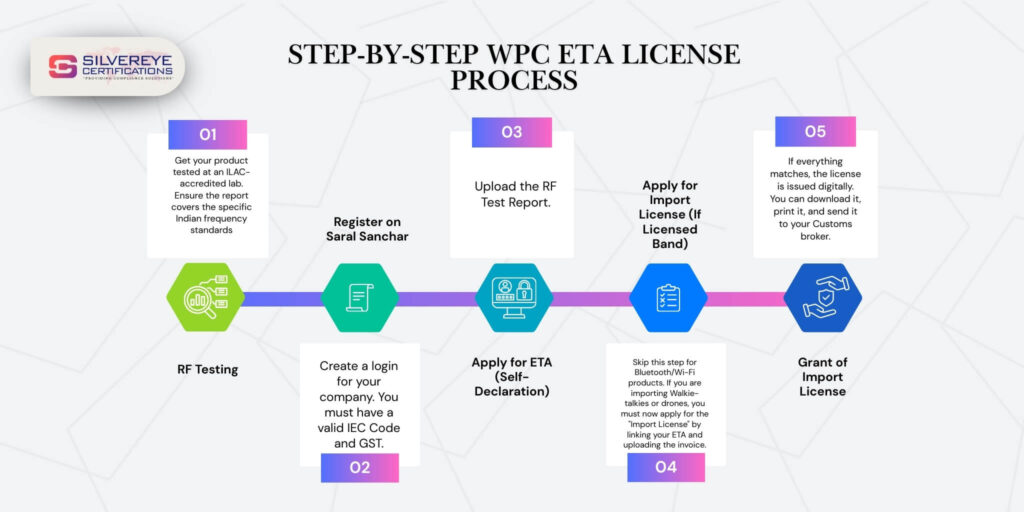
Documents Required for WPC Import License
Gather these before you approach a consultant to save time:
- RF Test Report: (Must cover standard frequencies like 2.4GHz to 2.4835GHz).
- Product Technical Data Sheet: Showing model number and frequency specs.
- Letter of Authorization: If an agent is applying for you.
- Importer KYC: GST Certificate, PAN Card, Company Incorporation Certificate.
- ID Proof: Aadhar/PAN of the authorized signatory.
We recently helped a startup in Bangalore importing smart pet feeders. Their Chinese vendor sent a "CE" report, but it lacked the specific "RF" section required by India. We had to coordinate with the lab to extract the correct data. Lesson: Not all "Test Reports" are the same!
WPC Certificate Processing Time
- Self-Declaration ETA: 1 to 5 working days (if documents are perfect).
- Regular ETA / Import License: 20 to 30 working days (due to manual officer review).
Factors affecting speed:
- NABL RF test report India availability.
- Server uptime of the Saral Sanchar portal.
- Correctness of the frequency band data entry.
WPC Import Certificate Cost in India
Budgeting is key for importers.
| Cost Head / Component | Description & Details | Estimated Cost (INR) |
| 1. Government Fee | The mandatory official fee paid to the DoT (via Bharatkosh) for generating the ETA certificate. | ₹10,000 (per model) |
| 2. Professional Fee | Fees charged by consultants (like Silvereye) for technical review of test reports, documentation, and portal management to ensure approval. | Variable (contact for quote) |
| 3. Testing Fee (Optional) | Required only if you do not have a valid RF report from an accredited foreign lab. Cost depends on device complexity (e.g., Wi-Fi 6 vs simple Bluetooth). | ₹15,000 – ₹50,000+ |
Note: Prices subject to change by DoT policies.
WPC Certificate Timeline & Validity
| Parameter | Details | Important Remarks |
| Processing Timeline | 1 to 5 Working Days(For Self-Declaration ETA) | This timeline applies only if you have all documents ready, including a valid RF Test Report. |
| Certificate Validity | Lifetime Validity | The ETA is valid indefinitely for the specific model approved. It does not expire. |
| Renewal Requirement | No Renewal Needed | Since the certificate has lifetime validity, you do not need to renew it annually. |
| When to Re-Apply? | Only if Model Changes | You must apply for a new certificate if you change the Model Number or hardware specifications (frequency/power). |
Once you get the WPC ETA for a specific model (e.g., "Smartwatch Model X-100"), you can use that same certificate for all future shipments of that exact model, forever. You do not need to pay or apply again for that specific product.
Common Mistakes to Avoid
- Using a Safety Report instead of RF Report: A report testing electrical safety (LVD) is useless for WPC. We need the Radio Frequency report.
- Wrong Model Numbers: If your invoice says "Model X-100" but the certificate says "Model X", Customs will reject it. Exact match is mandatory.
- Importing Before Approval: We cannot stress this enough—get the paper before you load the container.
- Ignoring validity: While ETAs generally don't have an expiry date as long as the model doesn't change, regulations can shift. Always check status before a new bulk order.
Conclusion
Importing electronics into India is lucrative, but regulatory hurdles like the WPC Certificate for Import can break your supply chain if ignored. The process isn't rocket science, but it demands precision. A single typo in your frequency range declaration can lead to a rejected application and a stranded shipment.
Don't gamble with customs. Ensure your wireless products are compliant before they leave the factory floor.
Need help securing your WPC Import Approval?
At Silvereye Certifications, we handle the entire lifecycle—from reviewing your Chinese/foreign test reports to handing you the final WPC certificate.
Contact Us Today for a Free Consultation
Stop worrying about paperwork and start selling.
Frequently Asked Questions
Is WPC Certificate mandatory for all imports?
Yes, but only for wireless products. If your device uses Bluetooth, Wi-Fi, or RFID (like smartwatches or routers), you legally need WPC import approval to clear Indian Customs.
What is the difference between ETA and Import License?
ETA (Equipment Type Approval) is for standard consumer goods on de-licensed bands (Bluetooth/Wi-Fi). An Import License is for specialized equipment (like broadcast gear). Most importers only need the ETA.
Do Bluetooth devices need WPC approval?
Absolutely. Even if the internal Bluetooth chip is famous (e.g., Qualcomm), the final finished product must have its own WPC Certification to prove it operates safely.
What is the official WPC government fee?
The government fee for an ETA (Self-Declaration) is ₹10,000 per model. You should also budget for consultant fees and lab testing if you lack valid foreign reports.
How long is the WPC license valid?
It has lifetime validity. Once issued for a specific model, you can import that device indefinitely without renewals. You only need a new certificate if the hardware or model name changes.
Can foreign manufacturers apply directly?
No. Only Indian entities can apply. Foreign brands must appoint an Authorized Indian Representative (AIR)—like Silvereye Certifications—to file the application on their behalf.
What happens if I import without a WPC certificate?
Customs will detain your shipment. You will face heavy demurrage (storage) charges, potential penalties, and risk having your goods seized or re-exported at your cost.
Can I use a foreign test report?
Yes. For the ETA category, DoT accepts ILAC-accredited foreign test reports. If your factory has a valid RF report, you can save money by skipping local testing in India.
Is a physical sample required for approval?
Usually, no. If you have a valid foreign RF report, we can process the approval digitally. Samples are only needed if your reports are missing or invalid and require local testing.
How fast can I get the certificate?
With perfect documents, we can secure WPC approval in 1 to 5 working days. If local testing is needed, the timeline extends to 2–3 weeks.