
- EPR Registration Process in India is a mandatory CPCB-managed compliance for businesses introducing regulated products into the market.
- The EPR Certificate online is issued only after correct PIBO classification, data verification, and EPR plan approval.
- Errors in sales data, waste category mapping, or recycler tie-ups are the most common reasons for rejection.
Introduction: Why Most Businesses Get EPR Registration Wrong

A consumer electronics importer approached us after their shipment was held at port—everything was ready except one thing: EPR approval. They had assumed EPR was “post-sales paperwork” and could be handled later. The reality was different. Without a valid EPR Certificate, the business could not legally sell or import products in India.
We see this every month. Most businesses know what EPR is — but almost none understand how CPCB actually evaluates an application, what data gets cross-checked, and why so many get rejected on the first attempt.
Overview of EPR Registration Process in India
The EPR Registration Process in India is a legally mandated compliance mechanism that requires certain businesses to take responsibility for the waste generated from their products after consumer use. This obligation arises from the concept of Extended Producer Responsibility (EPR), which shifts waste management accountability from local authorities to the entities that place products in the market.
The EPR Registration Process in India is:
- Fully online
- Data-driven
- Auditable
- Strictly monitored
All applications are submitted through the CPCB EPR portal, administered by the Central Pollution Control Board.
Unlike older consent systems, EPR compliance does not end with certificate issuance. Once registered, businesses must continuously meet EPR targets, file annual returns, and maintain recycler traceability.
Who Should Apply for EPR Registration?
The EPR Registration Process in India applies to any entity that introduces regulated products or packaging into the Indian market. CPCB does not assess EPR liability based on company size or intent—it is determined purely by market placement and responsibility control. If your business puts products into consumers’ hands, EPR compliance is not optional.Below is a clear, role-based explanation to help you identify whether EPR registration applies to you.
Producers Manufacturing EPR-Covered Products in India
If your factory produces plastic packaging, electronics, batteries, tyres, or lubricants — even as a secondary product — EPR registration applies to you from the moment those products enter the Indian market. We've worked with manufacturers who assumed their distributor carried this responsibility. They don't.
For producers:
- EPR targets are calculated based on manufacturing output and sales volume
- Responsibility begins the moment products are released into the domestic market
- Higher production directly increases annual recycling or collection obligations
Many manufacturers assume waste management is the distributor’s responsibility. Under Extended Producer Responsibility, this belief is incorrect. The producer remains legally accountable throughout the product lifecycle.
Importers Bringing Regulated Products or Packaging into India
Importers are treated as producers under EPR regulations, even if manufacturing happens outside India.
Key compliance points for importers:
- EPR registration must be completed before import or sale
- Import quantity data is cross-verified with IEC and customs records
- Importers carry full EPR liability for post-consumer waste in India
This is a common enforcement area. Without a valid EPR authorization, imports can be delayed, restricted, or flagged during compliance audits by the Central Pollution Control Board.
Brand Owners Selling Products Under Their Own Brand Name
Brand owners often assume that outsourcing manufacturing transfers compliance responsibility. Under the process of EPR registration, this is not the case.
If:
- Your brand name or trademark appears on the product or packaging
- You control product placement, pricing, or distribution
E-Commerce Sellers and Online Marketplaces
E-commerce platforms and online sellers fall under increasing regulatory scrutiny.
For sellers:
- Marketplaces may require valid EPR Certificate online for onboarding
- Non-compliance can result in listing suspension or account deactivation
For marketplaces:
- There is growing responsibility to ensure that sellers dealing in regulated products are EPR-compliant
- Failure to enforce this can invite regulatory notices or platform-level action
EPR compliance is now closely linked to marketplace eligibility and continuity.
OEMs and Assemblers Using Batteries, Electronics, or Plastic Packaging
OEMs and assemblers frequently overlook EPR exposure, especially when they do not sell regulated components separately.
EPR obligations may still apply if:
- Your finished product contains batteries, electronics, or plastic packaging
- Components fall under notified EPR waste categories
- You place the final product into the market under your control
CPCB evaluates the final market-facing product, not internal sourcing logic. This makes correct liability assessment essential during the EPR registration process.
Traders, Wholesalers and Stockists — Plastic EPR (New 2025)
This is a category that most compliance advisors are still not flagging — and it catches businesses by surprise.
CPCB has expanded the scope of plastic EPR registration to include traders, stockists, and wholesalers who deal in finished plastic packaging — even if they do not manufacture or brand the product themselves.
You are now required to register if:
- You trade, stock, or wholesale finished plastic packaging in India
- You do not own the brand but handle plastic-packaged goods commercially
- You supply plastic packaging materials to other businesses
What changed: Previously, EPR liability was limited to PIBOs — Producers, Importers, and Brand Owners. The 2025 expansion brings the entire plastic packaging supply chain under the registration framework.
Every trader or wholesaler covered under this expansion must obtain a unique 15-digit CPCB EPR Registration Number. Operating without it is treated as a compliance violation.
If you are in the business of trading plastic-packaged goods and assumed EPR was only the brand owner's problem, that assumption changed in 2025. A pre-registration assessment is the fastest way to determine your exact obligation.
Waste Categories Covered Under EPR Registration
The EPR Registration Process in India is waste-stream specific. CPCB does not issue a single, generic approval for all products. Instead, EPR approval is granted separately for each notified waste category, with distinct targets, reporting formats, and compliance obligations.
Selecting the correct waste category during registration is critical, as EPR targets, costs, and enforcement mechanisms differ significantly across categories.
EPR Registration for Plastic Packaging Waste

Most companies that come to us for plastic EPR are surprised — they're not selling plastic, they're selling a product that happens to be packed in plastic. Doesn't matter. If plastic packaging enters the Indian market under your name, EPR applies
Covered packaging types include:
- Rigid plastic packaging
- Flexible plastic packaging
- Multilayer plastic packaging
- Compostable plastic packaging
Incorrect classification of plastic categories is one of the most common causes of EPR target disputes during CPCB audits.
Important Update — Mandatory from 1 July 2025
All plastic packaging sold in India must now carry a barcode or QR code containing the CPCB EPR Registration Number of the PIBO responsible for that packaging. This requirement was introduced under the Plastic Waste Management Amendment Rules 2025, notified on 23 January 2025, and became enforceable from 1 July 2025.
What this means in practice:
- Every pack, pouch, wrapper, or container made of regulated plastic must be traceable to a registered PIBO
- The barcode or QR code must appear on the packaging itself, on the equipment containing the packaging, or on accompanying product brochures
- Packaging without this marking is non-compliant and cannot legally be sold in India
This rule applies to all plastic categories — rigid, flexible, multilayer, and compostable. It is not limited to large manufacturers. If your plastic packaging is in the Indian market under your name, the traceability requirement applies to you.
Businesses that registered for plastic EPR before July 2025 and have not yet updated their packaging artwork need to do this immediately. New applicants must factor this into their packaging design before market entry.
Note for Food and FMCG Businesses — Recycled Content Relaxation (2025)
Businesses in food contact applications face an additional plastic EPR obligation: mandatory recycled plastic content in packaging. Under a 2025 amendment, CPCB has introduced a carryforward relaxation specifically for this requirement.
If your business cannot meet the mandatory recycled plastic content target for 2025–26 due to supply chain or food-grade material constraints, the shortfall can now be carried forward for up to 3 years starting from 2026–27.
This relaxation applies only to the recycled content requirement — not to the overall EPR collection and recycling targets. Both obligations exist separately and must be tracked and reported independently on the CPCB portal.
EPR Registration for Electronic and Electrical Waste

EPR registration for e-waste is mandatory for entities dealing in electrical and electronic equipment (EEE) placed in the consumer or institutional market.
Covered products typically include:
- Consumer electronics (TVs, mobiles, appliances)
- IT and communication equipment
- Electrical devices and accessories
- Solar PV modules and cells (inventory management mandatory now; recycling targets from 2034)
- Electronic medical devices (all categories except infectious — newly added under Schedule I)
Of all EPR categories, e-waste sees the most active enforcement. CPCB audits in this space are real, penalties are significant, and importers without valid registration are a regular target.
Current E-Waste Recycling Targets (2025–26)
Recycling targets for IT equipment and consumer electronics have now reached 70% of the previous year's sales volume as of 2025–26. This means if you sold 1,000 units last year, you must demonstrate recycling of 700 units' worth of equivalent e-waste this year.
These targets are not static — they increase annually and are tracked directly on your CPCB dashboard once your EPR registration is active. Missing a target does not result in a grace period. Environmental Compensation charges are applied automatically through the portal based on the shortfall.
Key target-related facts:
- Targets are calculated on previous financial year's declared sales
- Shortfalls can be carried forward for up to 3 years
- If unresolved after 3 years, the Environmental Compensation amount is permanently forfeited
- Solar PV modules and cells are now also included under e-waste inventory obligations, with active recycling targets coming into effect from 2034
- Electronic medical devices (excluding infectious category) are now listed under Schedule I of the e-waste rules
EPR Registration for Battery Waste
Battery EPR registration applies to a wide range of battery types used across consumer, industrial, and automotive sectors.
Covered batteries include:
- Lithium-ion batteries
- Lead-acid batteries
- Portable consumer batteries
- Automotive and EV batteries
Battery EPR is more granular than most people expect — targets aren't just based on how many batteries you sell, but on the specific chemistry. Lithium-ion and lead-acid carry different obligations. Getting this mapping wrong at registration creates target disputes later.
EPR Registration for Tyre Waste

EPR registration for tyre waste applies to:
- Tyre manufacturers in India
- Importers of new tyres
- Importers of vehicles fitted with tyres
Use of unregistered recyclers or informal disposal methods is treated as a serious violation under tyre EPR rules.
EPR Registration for Used Oil and Lubricants

Used oil EPR registration applies to businesses dealing in:
- Base oil
- Lubricating oil
- Oil-based automotive and industrial products
Used oil EPR is increasingly monitored due to environmental risks associated with improper disposal and re-use.
EPR Registration for Non-Ferrous Metal Scrap (New — Effective April 2026)
This is the newest EPR category in India — and most businesses dealing in metal-based products don't know it applies to them yet.
From 1 April 2026, the Ministry of Environment, Forest and Climate Change has made EPR registration mandatory for businesses dealing in products containing non-ferrous metals. This framework is notified under the Hazardous and Other Wastes Amendment Rules 2025.
Businesses required to register include:
- Manufacturers and importers of aluminium, copper, zinc products or alloys
- Recyclers and refurbishers of non-ferrous metal scrap
- Bulk consumers handling regulated non-ferrous materials
- Collection agents dealing in non-ferrous scrap
Products commonly affected include:
- Beverage cans and aluminium packaging
- Conductor cables and wiring
- Packaging foils
- Any finished product where aluminium, copper, or zinc is a primary material
Recycling targets under this framework start at 10% of sales volume for 2026–27 and escalate to 75% by 2032–33. All registration is done through a centralised CPCB online portal.
If your product contains non-ferrous metals and you are importing or selling in India from April 2026 onwards, this registration is not optional. Given how recently this was notified, many businesses in affected sectors are not yet aware of their obligation — making early registration a competitive and compliance advantage.
Pre-Registration Preparation (Critical Step Most Businesses Miss)
In the EPR Registration Process in India, most rejections and long delays do not occur because of missing documents—but because of poor preparation before filing. The CPCB EPR portal is designed to cross-verify information automatically. Once incorrect data is submitted, correcting it later becomes time-consuming and, in some cases, expensive.
In our experience, this is the stage that separates a 3-week approval from a 3-month one. The CPCB portal flags inconsistencies automatically — and once your application is stuck in a clarification cycle, getting it unstuck takes far longer than getting it right the first time.
Identifying Correct PIBO Status
The PIBO selection is the first thing CPCB scrutinizes — and the most commonly misclassified. Your role isn't what your company calls itself internally. It's determined by who actually controls market placement. We've seen importers register as brand owners and brand owners register as producers. Both created problems at the review stage.
CPCB evaluates:
- Who decides the product is placed in the Indian market
- Whose name or brand appears on the product or packaging
- Who controls imports, distribution, or branding
Correct Product Mapping and Waste Category Classification
Every product submitted during the process of EPR registration must be mapped accurately to the applicable waste management rule. CPCB does not allow broad or generic classification.
Key aspects CPCB checks include:
- Product function and end use
- Packaging type and material composition
- Whether multiple waste categories apply to a single product
Sales and Quantity Data Assessment for EPR Targets
EPR targets are calculated entirely on the basis of declared sales and import quantities. CPCB actively cross-verifies this data with other government records.
Data sources commonly checked include:
- GST returns
- Import and customs data (IEC)
- Previous EPR or environmental filings
This is not a place to estimate. CPCB cross-checks your declared figures against GST returns and IEC customs data. If the numbers don't align — even by a small margin — the application gets flagged. Correcting targets after registration requires a formal amendment process that can take weeks.
Planning Recycler Tie-Ups or EPR Credit Strategy
Many applicants assume recycler agreements are required only after obtaining the EPR Certificate online. In reality, requirements vary by waste category.
Key planning considerations:
- All recyclers must be CPCB-authorized and category-specific.
- Some categories require recycler or PRO tie-ups at the registration stage
- Others allow compliance planning to be submitted first, with execution later
Documents Required for EPR Registration
Business and Legal Registration Documents
These documents establish the legal identity of the applicant and are mandatory for all entities applying for EPR authorization.
Typically required documents include:
- Certificate of Incorporation or business registration proof
- PAN card of the company or entity
- GST registration certificate
- Import Export Code (IEC), if the applicant is an importer
Product, Model, and HS Code Details
CPCB expects product-level clarity, not broad product descriptions. Each product or product group must be clearly identifiable.
Information generally required includes:
- Product name and model number
- HS code aligned with GST and customs records
- Mapping of products to the applicable EPR waste category
Annual Sales and Import Data Declaration
Sales and import data directly determine EPR obligations. CPCB requires financial-year-wise quantity declarations for all EPR-covered products or packaging.
This data is used to:
- Calculate annual EPR targets
- Monitor year-on-year compliance
- Cross-verify information with GST and customs databases
Authorization Letters and Signatory Proof
Only an authorized person can submit and manage an EPR application on the CPCB portal.
Commonly required documents include:
- Authorization letter on company letterhead
- Identity proof of the authorized signatory
- Board resolution or internal authorization, where applicable
Recycler / PRO Agreements (Where Applicable)
For certain waste categories, CPCB requires proof of engagement with authorized recyclers or Producer Responsibility Organisations (PROs) at the registration stage.
Key requirements include:
- Recycler or PRO must be CPCB-registered and active
- Agreement must clearly mention the waste category and scope
- Validity period should align with the proposed EPR plan
EPR Registration Validity, Renewal and Annual Fees (Plastic Waste)
For plastic EPR specifically, there are validity and fee structures that most applicants are not told about upfront.
Registration validity:
- Initial registration is valid for 1 year
- Renewal is granted for 3 years at a time, subject to compliance verification
- Renewal must be applied before expiry — a lapsed registration creates a gap in compliance that CPCB records
Annual processing fee:
- At the time of filing your annual return, an annual processing fee equivalent to 25% of the original registration fee is payable
- This is separate from the registration fee paid at the time of initial application
- The fee must be paid through the CPCB portal as part of the annual return filing process
Many businesses budget only for the initial registration and are caught off-guard by the annual fee obligation. Factor this into your compliance budget from year one.
Step-by-Step EPR Registration Process on CPCB Portal
The EPR Registration Process in India follows a clearly defined digital workflow on the CPCB EPR portal. While the steps may appear straightforward, each stage involves data validation and regulatory scrutiny. Errors made early in the process often surface later as CPCB queries or delays in issuing the EPR Certificate online.
Below is a practical, stage-wise explanation of how the process of EPR registration actually works.
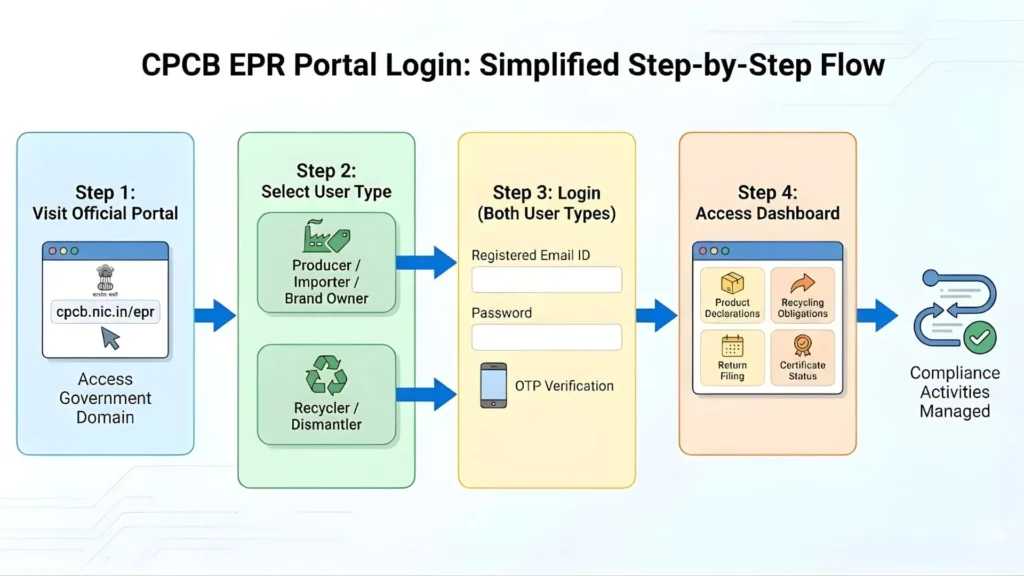
Step 1 – Creating an Account on the CPCB EPR Portal
The first step is creating a user account on the CPCB EPR portal and selecting the correct entity type and role.
Before you start — which portal do you need?
A common source of confusion is that "the CPCB EPR portal" is not a single platform. CPCB operates separate portals for each waste category. If you register on the wrong one, your application has no legal standing.
| Waste Category | Portal |
| Plastic Waste | eprplastic.cpcb.gov.in |
| E-Waste | eprewaste.cpcb.gov.in |
| Used Oil | eprusedoil.cpcb.gov.in |
| Battery Waste | Separate CPCB battery portal |
| Tyre Waste | Separate CPCB tyre portal |
| Non-Ferrous Metals (New) | Centralised CPCB portal — details being notified |
- Choose whether they are registering as a Producer, Importer, or Brand Owner
- Enter basic company details exactly as per legal records
- Designate an authorized signatory
Step 2 – Selecting Applicable EPR Waste Category
After account creation, the applicant must select the applicable EPR waste category.
Key considerations include:
- Each waste stream (plastic, e-waste, battery, tyre, used oil) requires a separate declaration
- Businesses dealing in multiple regulated products may need to apply under more than one category
- Waste category selection directly affects EPR targets and compliance obligations
Step 3 – Entering Product, Packaging, and Sales Details
This is where most applications run into trouble. The portal looks straightforward, but the data you enter here is cross-verified against multiple government databases. Take your time on this step — rushing it is the single most common reason for CPCB queries.
Applicants are required to:
- Declare product details, model numbers, and packaging type
- Enter financial-year-wise sales or import quantities
- Confirm material composition, where applicable
Step 4 – Uploading Documents and Declarations
All supporting documents must be uploaded in the prescribed format and size.
CPCB checks for:
- Consistency between uploaded documents and portal entries
- Validity of registrations and authorizations
- Correct mapping of documents to the selected waste category
Step 5 – Submission of EPR Plan and Compliance Strategy
The EPR plan explains how the applicant intends to fulfil EPR obligations.
A compliant EPR plan should clearly outline:
- Waste collection or take-back mechanism
- Recycling or refurbishment strategy
- Engagement with authorized recyclers or PROs
- Timeline for target fulfilment
Step 6 – CPCB Review, Queries, and Clarifications
Once submitted, the application enters CPCB review.
During this stage:
- CPCB officers may raise clarification queries
- Additional documents or explanations may be requested
- Timely and accurate responses are essential
Step 7 – Approval and Issuance of EPR Registration Certificate
After successful review, CPCB issues the EPR Registration Certificate online through the portal.
Once CPCB issues your EPR Registration Certificate, your compliance calendar starts immediately. The certificate is not the finish line — it is the starting point.
Post-approval obligations include:
- Annual EPR target fulfilment — meet your declared recycling or collection targets for each financial year
- Annual return filing — mandatory by 30 June each year for the previous financial year
- Recycler traceability maintenance — all recycler data must be updated and verified on the portal
- EPR Credit tracking — credits from authorized recyclers must be logged and matched to your targets
- Amendments — any change in sales volume, product details, or company information requires a formal amendment on the portal
On annual return deadlines specifically: The standard deadline is 30 June each year. CPCB has extended certain category deadlines in past years — for example, FY 2024–25 returns were extended to 30 September 2025 for some categories. However, extensions are not guaranteed and should never be relied upon for planning. Missing a deadline without an official extension triggers penalties and can lead to suspension of your EPR registration.
Set an internal reminder 60 days before 30 June every year. That is enough time to gather recycler data, verify credits, and file accurately without rushing.
Common Reasons for EPR Registration Rejection
After handling hundreds of EPR applications, the pattern is consistent — rejections almost never happen because a document is missing. They happen because of wrong PIBO classification, mismatched data, or a copy-pasted EPR plan that CPCB has seen too many times. Here's what actually gets applications rejected.
Understanding the most common rejection reasons helps businesses avoid preventable delays and compliance risks.
Incorrect PIBO Classification
One of the most frequent reasons for rejection is incorrect selection of PIBO status—Producer, Importer, or Brand Owner.
CPCB evaluates:
- Who controls product placement in the Indian market
- Whose brand or name appears on the product or packaging
- Who handles imports, pricing, or distribution
Wrong Waste Category Mapping
Each product must be mapped to the correct waste management rule during registration.
Rejections commonly occur when:
- Products are placed under an incorrect EPR category
- Packaging waste is ignored while registering only the product
- Multiple applicable waste categories are not declared
Inconsistent or Inflated Sales Data
Sales and import data directly determine EPR targets, making accuracy critical.
CPCB cross-verifies declared data with:
- GST returns
- Import records (IEC and customs data
- Previous regulatory submissions
Invalid Recycler Tie-Ups
For waste categories requiring recycler engagement, CPCB accepts only authorized recyclers registered on the EPR portal.
Common issues include:
- Agreements with non-authorized or expired recyclers
- Mismatch between recycler authorization and waste category
- Incomplete or unclear agreements
Weak or Generic EPR Plan
The EPR plan is a key evaluation document. CPCB does not accept generic, copy-pasted plans.
A weak EPR plan is easy to spot — and CPCB spots it immediately. We've reviewed rejected plans that were clearly written once and reused across multiple applications with only the company name changed.
CPCB reviewers see these patterns. Your EPR plan needs to reflect your actual business — your product, your volume, your recycler network.
Penalties for EPR Non-Compliance in India
One of the most common questions we receive is: what actually happens if I don't comply? The answer is no longer vague. CPCB has published specific Environmental Compensation (EC) rates, and the consequences of non-compliance are quantified, enforceable, and increasingly being acted upon.
Environmental Compensation (EC) Charges
Environmental Compensation is the financial penalty applied when a registered business fails to meet its annual EPR targets or files inaccurate data.
| Violation | Penalty |
| Plastic EPR shortfall | ₹5,000 per ton of unrecycled plastic |
| E-waste target shortfall | Automated EC via CPCB portal based on shortfall volume |
| Carrying forward shortfall beyond 3 years | Full EC amount permanently forfeited — no refund |
| False or inflated data submission | 1-year ban on business operations + blacklisting from future EPR registration |
| Missing annual return deadline | Late filing penalties + possible suspension of EPR Certificate |
| Operating without EPR registration | Regulatory notices, import restrictions, marketplace deactivation |
How Environmental Compensation is Calculated
EC is calculated on the polluter pays principle. For plastic waste:
- Base cost of managing plastic waste: approximately ₹2,000 per ton
- Deterrent factor applied by CPCB: 2.5x
- Resulting EC rate: ₹5,000 per ton of unrecycled or uncollected plastic
For e-waste and battery categories, EC rates are calculated based on the specific waste stream and volume of shortfall. CPCB applies these charges directly through the portal — there is no separate notice or hearing in most cases.
The 3-Year Carryforward Rule
If you miss an annual EPR target, CPCB allows the shortfall to be carried forward for up to 3 consecutive years. During this period, Environmental Compensation is held — not immediately charged.
However:
- If the shortfall is resolved within 3 years, the EC is returned
- If it is not resolved within 3 years, the full EC amount is permanently forfeited
- Interest may apply depending on the category and quantum of shortfall
This rule sounds lenient but it is not. Businesses that carry forward shortfalls across multiple years often discover the cumulative EC amount is significant enough to affect operations. Staying on target annually is always the lower-cost outcome.
Blacklisting and Business Ban
Submission of false data — including inflated recycling claims, incorrect sales figures, or fabricated recycler agreements — can result in:
- A one-year ban on business operations
- Permanent blacklisting from the CPCB EPR registration system
- Inability to import, sell, or list products on marketplaces
CPCB actively cross-verifies recycler data. Recyclers who appear in multiple EPR applications beyond their actual processing capacity are flagged — and the businesses associated with them face the consequences.
How Silvereye Certifications Helps in EPR Registration Process
The EPR Registration Process in India is not just about submitting an application on the CPCB portal. It requires correct legal interpretation, accurate data handling, and staying compliant year after year. This is where Silvereye Certifications adds practical value—by reducing risk at every stage of the EPR lifecycle.
Our approach is built around real regulatory experience, not assumptions or generic templates.
Pre-Application Compliance Assessment
Before initiating the application, we conduct a detailed compliance assessment to determine:
- Whether EPR registration is applicable to your business
- The correct PIBO status (Producer, Importer, or Brand Owner)
- Applicable waste categories and regulatory exposure
- Potential compliance risks based on your business model
Accurate Data Preparation and Portal Filing
EPR targets are calculated entirely on declared data. Any inconsistency can result in higher targets or CPCB objections.
Our team ensures:
- Alignment between GST, IEC, sales records, and portal declarations
- Accurate product, packaging, and quantity mapping
- Proper formatting and validation of all documents before upload
End-to-End Handling of CPCB Queries
CPCB review often involves clarification requests or additional documentation.
Silvereye Certifications:
- Monitors the application status continuously
- Prepares and submits detailed responses to CPCB queries
- Handles revisions and resubmissions professionally and promptly
Post-Registration Support
EPR compliance does not end with certificate issuance. Once the EPR authorization is granted, ongoing obligations begin.
We provide structured post-registration support, including:
- Annual return filing on the CPCB portal
- EPR target tracking and fulfilment planning
- Coordination with authorized recyclers or PROs
- Amendments, renewals, and compliance updates
Conclusion
The EPR Registration Process in India has evolved into a stricter system than most businesses expect that directly affects how businesses manufacture, import, sell, and scale their products. What was once seen as an environmental formality is now a core regulatory requirement monitored continuously through the CPCB portal.
From identifying the correct PIBO status to mapping products accurately, declaring verified sales data, and submitting a realistic EPR plan, every step in the process of EPR registration carries real business consequences — delayed imports, penalties, or blocked listings. Errors at the registration stage often lead to higher compliance costs, delayed approvals, or enforcement action later.
EPR registration is genuinely more straightforward than most businesses expect — but only when the groundwork is done properly. Get the PIBO classification right, make sure your sales data aligns with GST and IEC records, and submit an EPR plan that actually reflects how your business operates. Do those three things and the process moves quickly.
The businesses that struggle are the ones who treat EPR as an afterthought — something to sort out after the product is already in the market. By that point, the port hold, the CPCB query, or the marketplace suspension has already happened.
If you're about to import, launch, or scale a product that falls under any of the five EPR categories, the right time to start is before any of that begins. We've helped companies get this done in under three weeks when they came prepared. Ready to find out where you stand?
Frequently Asked Questions
What is the EPR Registration Process in India?
The EPR Registration Process in India is the online procedure through which producers, importers, and brand owners obtain approval to comply with Extended Producer Responsibility (EPR) rules via the CPCB portal.
Is EPR Registration mandatory in India?
Yes. EPR registration is mandatory for businesses dealing in plastic packaging, electronics, batteries, tyres, or lubricants placed in the Indian market.
Who issues the EPR Certificate in India?
The EPR Certificate is issued by the Central Pollution Control Board (CPCB) after successful review of the application submitted on its EPR portal.
Can EPR Registration be completed online?
Yes. The entire EPR Certificate online process, including application, review, and approval, is completed digitally through the CPCB EPR portal.
How long does the EPR Registration process take?
Approval timelines vary based on data accuracy and CPCB queries. Applications with correct classification and verified data are generally processed faster.
Can a company apply for more than one EPR waste category?
Yes. If a business deals in multiple regulated products, it must apply separately for each applicable EPR waste category.
What happens after an EPR Certificate is issued?
After issuance, businesses must fulfil annual EPR targets, work with authorized recyclers, and file annual returns to maintain ongoing EPR compliance.
What are the consequences of not obtaining EPR Registration?
Non-compliance may result in environmental compensation charges, regulatory notices, import restrictions, or disruption of business operations.
Can EPR Registration details be amended later?
Yes. Amendments for product details, sales data, or company information can be submitted through the CPCB portal, subject to review.
Is professional support necessary for EPR Registration?
While not mandatory, professional support helps avoid incorrect role selection, data mismatch, and rejection during the process of EPR registration.