- BIS migration to IS/IEC 62368-1 2023 replaces IS 13252 (Part 1):2010 and IS 616:2017 across 38 product categories — laptops, TVs, mobile phones, routers, SMPS, power adapters, CCTV, and more — under a mandatory MeitY notification dated 09 March 2026.
- All existing BIS CRS licensees must submit fresh test reports from BIS-recognized labs and an undertaking for series models, completing migration no later than 1 November 2028 or risk licence cancellation.
- New applicants may still apply under the old standards during the concurrent running period, but must commit in writing to implement IS/IEC 62368-1:2023 before the deadline; post-November 2028, no licence will be granted under IS 13252 or IS 616.
Introduction

A client who manufactures wireless headphones called us last December — slightly anxious, slightly confused. Their BIS CRS licence was valid, their product was selling without issues, and now their testing lab was asking them to retest under a standard they had never come across: IS/IEC 62368-1:2023. Was it compulsory? Did it apply to headphones? And what exactly would happen if they ignored it?
That call turned out to be the first of many. Within weeks, the same questions started coming from laptop importers, SMPS manufacturers, TV brands, CCTV system suppliers, and even an AR headset startup that had just started its BIS registration process. The pattern was clear — the BIS migration to IS/IEC 62368-1:2023 had caught most of the industry off guard.
On 9 March 2026, the Bureau of Indian Standards issued formal implementation guidelines (Ref: Reg/ IS/IEC 62368-1:2023 /Guidelines/01), following MeitY's notification S.O. 4997(E) dated 29 October 2025. This article covers everything in those guidelines — who it affects, what the process requires, what the deadlines mean, and what happens if you do not act. Nothing is left vague.
Why IS/IEC 62368-1:2023 Is Replacing IS 13252 and IS 616?
Indian electronics safety compliance under BIS CRS has run on two parallel tracks for years. IS 13252 (Part 1):2010 governed IT equipment — laptops, printers, scanners, servers, and similar products. IS 616:2017 governed audio and video apparatus — TVs, amplifiers, Bluetooth speakers, cameras. In theory, the split made sense. In practice, modern products laughed at it.
A smart speaker is an IT device, an audio device, and a wireless product simultaneously. A laptop running a 4K display and a built-in amplifier straddles both old standards. AR and VR headsets combine computing, display, wireless, and audio in ways neither standard anticipated. The industry was being asked to fit 2024-era products into frameworks designed for the technology of 2010 and 2017.
IS/IEC 62368-1 solves this structurally. Rather than categorizing products by type, it uses a Hazard-Based Safety Engineering (HBSE) approach — identifying energy sources (electrical, thermal, mechanical, radiation, chemical) and requiring safeguards that prevent that energy from harming a person. The framework accommodates existing products and future ones without needing revision every time a new product category emerges. It is already the safety standard of reference in the EU, the US, Japan, and most major electronics markets. BIS adoption aligns Indian certification with global practice — which matters enormously for manufacturers who also export.
IS/IEC 62368-1:2023 does not just replace two old standards — it introduces a fundamentally different philosophy for how safety is engineered and tested. Manufacturers cannot treat migration as a paperwork exercise.
What IS/IEC 62368-1:2023 Actually Does Differently
- Uses Hazard-Based Safety Engineering (HBSE) — identifies energy sources (electrical, thermal, mechanical, radiation, chemical) and requires safeguards that prevent harm, rather than prescribing specific design rules.
- Covers IT, AV, and Communication equipment under a single framework — eliminating the IS 13252 vs IS 616 ambiguity permanently.
- Accommodates new product categories — including AR/VR devices, wearables, smart home products — without requiring the standard to be rewritten every cycle.
- Aligns India with CE, UL, and global markets — critical for any manufacturer who also exports. The same test regime, largely the same lab infrastructure.
- Introduces more detailed battery safety requirements — particularly around lithium cell thermal runaway, fire enclosures, and single-fault condition testing.
Old Standard vs New Standard — At a Glance
| Feature / Aspect | IS 13252 / IS 616 (Old) | IS/IEC 62368-1:2023 (New) |
| Approach | Category-based (IT vs AV) | Hazard-Based Safety Engineering (HBSE) |
| Product Scope | Separate standards for IT and AV | Single standard for all AV/IT/Communications |
| Technology Coverage | Limited to defined product types | Accommodates emerging & convergent tech |
| International Alignment | India-specific | Aligned with CE, UL, global markets |
| Safety Logic | Prescriptive design rules | Energy source → Safeguard → Risk reduction |
| Battery Requirements | Basic lithium cell provisions | Detailed thermal runaway protection |
| Validity After Nov 2028 | Withdrawn — no longer operative | Mandatory for all 38 categories |
IS/IEC 62368-1:2023 is not a reformatted version of the old standards — it is a structural change in how safety is evaluated. Manufacturers cannot treat migration as a paperwork exercise.
Key Dates: The Migration Timeline You Cannot Afford to Miss
| Date / Milestone | Event | What It Means for You |
| 29 October 2025 | MeitY Notification S.O. 4997(E) | Migration officially triggered. Concurrent running period begins. |
| 9 March 2026 | BIS Implementation Guidelines Issued | Binding procedural framework published. Guidelines in force immediately. |
| Now → Nov 2028 | Concurrent Running Period | Both old and new standards valid. Use this window to complete migration. |
| 1 November 2028 | Last Date — Concurrent Running Ends | IS 13252 and IS 616 withdrawn. No licence operative without IS/IEC 62368-1:2023 compliance. |
| Post Nov 2028 | Old Standards Withdrawn | Any non-migrated licence subject to cancellation. New licences only under IS/IEC 62368-1:2023. |
Three years sounds comfortable. In practice, it is not. BIS-recognized labs for IS/IEC 62368-1:2023 testing have limited capacity, and bookings are already building. A complex product — a smart speaker, a multi-function printer, a power bank — can take 8 to 12 weeks to complete testing. Add any test failures requiring product modification, then BIS portal submission and review time, and a manufacturer with 15–20 models needs to start planning now.
The concurrent running period is a compliance window — not a grace period. BIS's cancellation language in the guidelines is unambiguous: non-migration by 1 November 2028 risks removal from the register.
Which Products Are Affected? — All 38 Categories in Full
BIS has listed every product category under this migration. If your CRS registration references IS 13252 (Part 1):2010 or IS 616:2017, you are on this list. The table below is taken directly from the official BIS implementation guidelines:
| S.No | Product Category | Applicable Old Standard → New Standard |
| 1 | Electronic Games (Video) | IS 616:2017 → IS/IEC 62368-1:2023 |
| 2 | Laptops / Notebooks / Tablets | IS 13252 (Pt 1):2010 → IS/IEC 62368-1:2023 |
| 3 | Plasma / LCD / LED Television | IS 616:2017 + IS 18112:2025 → IS/IEC 62368-1:2023 + IS 18112:2025 |
| 4 | Optical Disc Players (Built-in amplifier, ≥200W input) | IS 616:2017 → IS/IEC 62368-1:2023 |
| 5 | Visual Display Units / Video Monitors | IS 13252 (Pt 1):2010 → IS/IEC 62368-1:2023 |
| 6 | Printers / MFDs / Plotters | IS 13252 (Pt 1):2010 → IS/IEC 62368-1:2023 |
| 7 | Scanners / USB Barcode, Iris, Fingerprint Scanners | IS 13252 (Pt 1):2010 → IS/IEC 62368-1:2023 |
| 8 | Wireless Keyboards | IS 13252 (Pt 1):2010 → IS/IEC 62368-1:2023 |
| 9 | Telephone Answering Machines | IS 13252 (Pt 1):2010 → IS/IEC 62368-1:2023 |
| 10 | Amplifiers (≥2000W input power) | IS 616:2017 → IS/IEC 62368-1:2023 |
| 11 | Electronic Musical Systems | IS 616:2017 → IS/IEC 62368-1:2023 |
| 12 | Set Top Boxes | IS 13252 (Pt 1):2010 → IS/IEC 62368-1:2023 |
| 13 | Automatic Data Processing Machines (incl. Servers, Routers) | IS 13252 (Pt 1):2010 → IS/IEC 62368-1:2023 |
| 14 | Power Adaptors for IT Equipment | IS 13252 (Pt 1):2010 → IS/IEC 62368-1:2023 |
| 15 | Power Adaptors for Audio, Video & Similar Equipment | IS 616:2017 → IS/IEC 62368-1:2023 |
| 16 | Mobile Phones | IS 13252 (Pt 1):2010 + IS 16333 (Pt 3):2022 → IS/IEC 62368-1:2023 + IS 16333 (Pt 3):2022 |
| 17 | Cash Registers | IS 13252 (Pt 1):2010 → IS/IEC 62368-1:2023 |
| 18 | Point of Sale Terminals | IS 13252 (Pt 1):2010 → IS/IEC 62368-1:2023 |
| 19 | Copying Machines / Duplicators | IS 13252 (Pt 1):2010 → IS/IEC 62368-1:2023 |
| 20 | Smart Card Readers | IS 13252 (Pt 1):2010 → IS/IEC 62368-1:2023 |
| 21 | Mail Processing / Postage / Franking Machines | IS 13252 (Pt 1):2010 → IS/IEC 62368-1:2023 |
| 22 | Passport Readers | IS 13252 (Pt 1):2010 → IS/IEC 62368-1:2023 |
| 23 | Power Banks (Portable Applications) | IS 13252 (Pt 1):2010 → IS/IEC 62368-1:2023 |
| 24 | CCTV Cameras / CCTV Recorders | IS 13252 (Pt 1):2010 + IP CCTV Essential Req. → IS/IEC 62368-1:2023 + IP CCTV Essential Req. |
| 25 | Smart Watches | IS 13252 (Pt 1):2010 → IS/IEC 62368-1:2023 |
| 26 | Keyboards (Wired) | IS 13252 (Pt 1):2010 → IS/IEC 62368-1:2023 |
| 27 | ATMs / Automatic Cash Dispensing Machines | IS 13252 (Pt 1):2010 → IS/IEC 62368-1:2023 |
| 28 | USB External Hard Disk Drives | IS 13252 (Pt 1):2010 → IS/IEC 62368-1:2023 |
| 29 | Wireless Headphones and Earphones | IS 616:2017 → IS/IEC 62368-1:2023 |
| 30 | USB External Solid-State Storage (above 256 GB) | IS 13252 (Pt 1):2010 → IS/IEC 62368-1:2023 |
| 31 | Standalone SMPS (Output Voltage ≤48V) | IS 13252 (Pt 1):2010 → IS/IEC 62368-1:2023 |
| 32 | Televisions (Non Plasma/LCD/LED types) | IS 616:2017 + IS 18112:2025 → IS/IEC 62368-1:2023 + IS 18112:2025 |
| 33 | Wireless Microphones | IS 616:2017 → IS/IEC 62368-1:2023 |
| 34 | Digital Cameras | IS 13252 (Pt 1):2010 → IS/IEC 62368-1:2023 |
| 35 | Video Cameras | IS 616:2017 → IS/IEC 62368-1:2023 |
| 36 | Webcams (Finished Product) | IS 616:2017 → IS/IEC 62368-1:2023 |
| 37 | Smart Speakers (With and Without Display) | IS 616:2017 → IS/IEC 62368-1:2023 |
| 38 | Bluetooth Speakers | IS 616:2017 → IS/IEC 62368-1:2023 |
Key Points to Note in the Product List
- Servers, routers, and network switches fall under 'Automatic Data Processing Machines' in IS 13252. IT infrastructure importers often miss this — the migration applies to them exactly as it does to a laptop brand.
- Mobile phones carry a dual obligation: IS/IEC 62368-1:2023 for safety AND IS 16333 (Part 3):2022 for radio. The radio standard does not disappear after migration.
- All television categories (plasma, LCD, LED, and other TVs) require both IS/IEC 62368-1:2023 and IS 18112:2025. These cannot be handled separately.
- SMPS coverage is specific: standalone SMPS units with output voltage up to 48V. If your SMPS exceeds 48V output, verify the applicable category separately.
- AR and VR devices are not listed as a standalone category, but fall within IS/IEC 62368-1:2023's scope through the hazard-based framework. New registrations for AR/VR products should reference this standard.
BIS Certification for ICT Equipment
The ICT category is the largest in the migration list — covering everything from laptops and tablets to scanners, smart watches, ATMs, and passport readers. If you import or manufacture any IT equipment for the Indian market under BIS CRS, you are in this group. Check your current registration standard first.
BIS Certification for Audio Video Equipment
Wireless headphones, Bluetooth speakers, smart speakers, digital and video cameras, webcams, and all television sets are squarely within scope. For TV manufacturers in particular, the dual-standard requirement with IS 18112:2025 means the migration submission is more involved — both test reports must land together.
BIS Certification for Power Adapters and SMPS
Power adapters for IT equipment (previously IS 13252) and for AV products (previously IS 616) now fall under one standard. This simplifies the framework for manufacturers who supply both segments — but fresh testing is still required. Standalone SMPS up to 48V output is included. The IS/IEC 62368-1:2023 test requirements for power conversion products differ from IS 13252 in meaningful ways, particularly around insulation and thermal testing.
BIS CRS Certification for Routers and Servers
Network infrastructure products registered as Automatic Data Processing Machines under IS 13252 are in scope. This is consistently the most overlooked segment — IT hardware importers who focus on enterprise sales often assume the notification is consumer-electronics focused. It is not. Check your licence, verify the referenced standard, and plan migration accordingly.
BIS Certification for AR VR Devices
The 2023 edition of IS/IEC 62368-1 is the first safety standard framework that cleanly handles AR and VR product architecture. The hazard-based approach evaluates energy sources — display optics, thermal output, wireless emission, electrical supply — without needing to categorize the product by name. For any brand bringing AR or VR hardware into India, this is the standard your testing lab will test against.
Migration Rules by Applicant Type — Existing Licensees, New Applicants, and Scope Changes
| Applicant Type | What BIS Allows | Key Condition / Deadline |
| Existing Licensee | Continue under old standard during concurrent running period | Must complete migration (test reports + undertaking) by 1 Nov 2028 |
| New Applicant — In-progress testing | Process application under IS 13252 or IS 616 | Samples already at lab or reports issued before guidelines date |
| New Applicant — Fresh | Apply under old or new standard | If old standard chosen: must submit declaration committing to migrate by 1 Nov 2028 |
| Scope Change Request | Process under old standard up to switchover or deadline | Once licensee migrates existing scope, all further changes must reference IS/IEC 62368-1:2023 |
The Concurrent Running Period — What It Is and Why 2028 Is Not as Far Away as It Looks
The phrase 'concurrent running' in the BIS guidelines refers to the transition window during which both the old standards (IS 13252 and IS 616) and the new standard (IS/IEC 62368-1:2023) are simultaneously valid for CRS certification. This period runs from the MeitY notification date — 29 October 2025 — through to 1 November 2028.
After 1 November 2028, IS 13252 (Part 1):2010 and IS 616:2017 stand withdrawn for all 38 product categories. No licence on these standards will remain operative. BIS has not left any ambiguity here — a licensee who has not completed migration by the last date will have their licence flagged for cancellation, or their non-compliant models deleted from the scope of the licence.
Three years sounds comfortable. In practice, it is not. Labs recognized by BIS for IS/IEC 62368-1:2023 testing have limited capacity, and bookings are already building. A product with complex architecture — a smart speaker, for instance, or a multi-function printer — can take 8 to 12 weeks to complete testing, and that is before accounting for any test failures requiring product modification and retest. Add the time for BIS portal submission, review, and confirmation, and a licensee with 20 models across multiple product categories could easily need 18 months to complete the process methodically.
The concurrent running period is a compliance window, not a grace period. BIS's language on cancellation is direct — leaving migration to 2027 or 2028 is a gamble most manufacturers cannot afford to take.
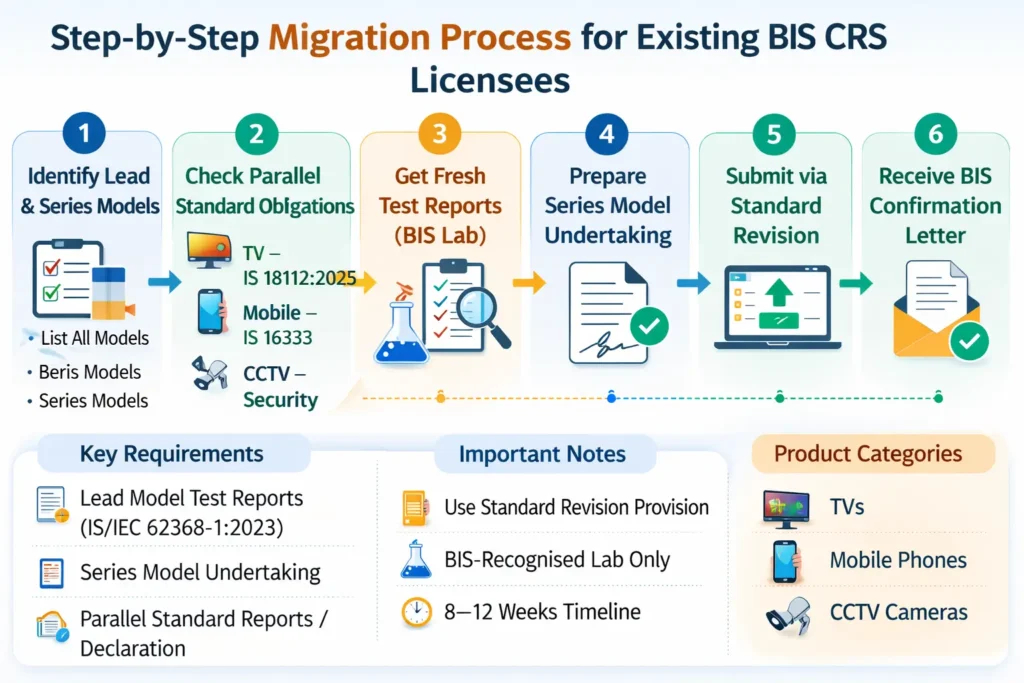
Step-by-Step Migration Process for Existing BIS CRS Licensees
BIS has prescribed the migration process in specific terms. Here is the exact sequence, with nothing condensed or paraphrased away:
Step 1 — Identify All Lead Models and Series Models in Your Licence Scope
- Pull your current BIS CRS licence and list every registered model.
- Identify which models were tested as 'lead models' under IS 13252 or IS 616.
- All lead models need fresh test reports under IS/IEC 62368-1:2023. Series models need a signed undertaking — not individual test reports.
Step 2 — Check for Parallel Standard Obligations (Televisions, Mobile Phones, CCTV)
| Product Category | Parallel Standard | If Migration Affects Parallel Compliance | If No Impact |
| Plasma/LCD/LED TV + Other TVs | IS 18112:2025 | Submit fresh IS 18112:2025 test reports along with IS/IEC 62368-1:2023 reports | Submit signed declaration alongside IS/IEC 62368-1:2023 reports |
| Mobile Phones | IS 16333 (Part 3):2022 | Submit fresh IS 16333 reports along with IS/IEC 62368-1:2023 reports | Submit signed declaration alongside IS/IEC 62368-1:2023 reports |
| IP-Based CCTV Cameras | Essential Requirements for IP CCTV Security | Submit fresh security compliance reports with IS/IEC 62368-1:2023 reports | Submit signed declaration alongside IS/IEC 62368-1:2023 reports |
Step 3 — Get Fresh Test Reports from a BIS-Recognized Lab
- The lab must be BIS-recognized specifically for IS/IEC 62368-1:2023 testing — NABL accreditation alone is not sufficient for migration submissions.
- Verify recognition status on the BIS CRS portal before booking. Recognition lists are updated periodically.
- Share your existing IS 13252 or IS 616 test report with the lab for gap analysis — this helps the lab identify which clauses differ and plan the test programme.
- Build 8–12 weeks into your timeline for complex products. Simpler products may test faster, but do not bank on it during a period of high lab demand.
Step 4 — Prepare the Series Model Undertaking
- Draft a duly signed undertaking confirming that all series models in your licence scope comply with IS/IEC 62368-1:2023, in line with the revised series guidelines to be issued by MeitY.
- This undertaking is mandatory. Submitting only the lead model test report without the undertaking means your migration package is incomplete — BIS will not issue a confirmation letter until it is provided.
- Monitor MeitY and BIS portals for the series guidelines document — it is referenced in the BIS circular but issued separately.
Step 5 — Submit Through the Standard Revision Provision
- Log in to your existing BIS CRS account and use the Standard Revision / Amendment / Essential Requirement provision — not a new application.
- Attach the IS/IEC 62368-1:2023 test reports for lead models
- Attach the signed series model undertaking.
- Attach the parallel standard test reports or signed declaration (whichever applies for TVs, mobile phones, or CCTV).
- Submit and track the status through your CRS login.
Step 6 — Receive BIS Confirmation Letter
- BIS will review the submission and, upon successful validation, issue a confirmation letter.
- The letter lists all models for which IS/IEC 62368-1:2023 compliance has been established. Keep this document as your compliance evidence — it may be requested during BIS market surveillance or enforcement checks.
- If BIS identifies any gaps in the submission, they will communicate the deficiencies through the portal — monitor your account.
Guidance for New BIS CRS Applicants During the Transition Period
Applications Already in Progress
- If samples have already been submitted to a BIS-recognized lab, or test reports have been issued under IS 13252 or IS 616, BIS will process the application under the old standard.
- No need to restart. The in-progress work remains valid for application purposes.
- Once registered, the licensee will still need to migrate by 1 November 2028 like all other licensees.
Fresh Applications from This Point
- BIS permits processing under either IS 13252 / IS 616 or IS/IEC 62368-1:2023 — your choice during the concurrent running period.
- If you choose the old standard: you must submit a written declaration committing to migrate to IS/IEC 62368-1:2023 by 1 November 2028.
- If you choose IS/IEC 62368-1:2023 directly: no declaration needed, no future migration exercise required.
- Practical recommendation: Go straight to IS/IEC 62368-1:2023 unless lab testing is already underway under the old standard. It is future-proof, it aligns with international markets, and it saves a second migration cycle.
Change in Scope of Licence
- Adding new models to an existing licence follows the same rules as fresh applications.
- Once a licensee migrates their existing scope to IS/IEC 62368-1:2023, all further scope additions must also reference IS/IEC 62368-1:2023 — you cannot revert to the old standard for new models post-migration.
- Strategy note: if you plan multiple model additions over 2025–2027, coordinate the existing scope migration and new additions to happen together rather than under different standards.
What New BIS CRS Applicants Must Know During the Transition Period
If you are applying for BIS CRS registration for the first time — or expanding your licence scope to add new product models — the guidelines give you some practical flexibility during the concurrent running period.
Applications Already in Progress
Applications where samples have already been submitted to a BIS-recognised laboratory, or where test reports have already been issued under IS 13252 (Part 1):2010 or IS 616:2017, can be processed under the old standards. You do not need to restart. This is particularly relevant for manufacturers who began lab testing in late 2025 before the new standard's testing infrastructure was fully in place.
Fresh Applications from Now Onwards
For applications being filed fresh from this point, BIS permits processing under either IS 13252 / IS 616 or IS/IEC 62368-1:2023. However, if you choose the old standard, you must provide a written declaration committing to migrate to IS/IEC 62368-1:2023 before the concurrent running period ends. After 1 November 2028, no new licence will be granted under IS 13252 or IS 616 — there are no exceptions in the guidelines.
The practical recommendation is this: unless you have testing already underway under the old standards, go directly to IS/IEC 62368-1:2023. It aligns with what most international markets already require, it avoids a second migration exercise, and it future-proofs your registration against the post-2028 landscape.
How IS/IEC 62368-1:2023 Testing Differs from IS 13252 and IS 616
Manufacturers handling their own compliance engineering need to understand that IS/IEC 62368-1:2023 is not simply a reformatted version of the old standards. The hazard-based approach changes how test cases are structured and evaluated.
- Thermal hazards: IS/IEC 62368-1 includes more detailed requirements for lithium battery thermal runaway protection, fire enclosure ratings, and surface temperature limits under both normal and single-fault conditions. Products with integrated batteries — phones, power banks, smart speakers, laptops — need to pay particular attention here.
- Electrical safety: Touch-current limits, creepage and clearance distances, and reinforced insulation requirements have been restructured. The specific values differ from IS 13252 and IS 616, and a product that met the old standard's electrical requirements is not automatically compliant with IS/IEC 62368-1.
- Acoustic hazard requirements: For audio products — headphones, earphones, speakers — IS/IEC 62368-1:2023 introduces specific provisions around acoustic energy and sound pressure limits. This is genuinely new territory for products that were previously tested only under IS 616.
- LED and optical radiation: Display products and camera devices now face hazard assessments for optical radiation from LEDs and lasers. Products like projectors, webcams, and IR-based scanners may encounter new test requirements they did not face under IS 13252.
Your BIS-recognised lab will conduct a gap analysis between your existing compliance documentation and IS/IEC 62368-1:2023 requirements. Build this into your timeline — it is rarely a zero-change exercise for products that have been tested under the old standards.
Who Issued These Guidelines and When Do They Take Effect?
The BIS implementation guidelines carry reference number Reg/ IS/IEC 62368-1:2023 /Guidelines/01, dated 9 March 2026. They were issued by Sonali Gupta, Sc C / Deputy Director, Head (Registration), DDG (Certification), Bureau of Indian Standards, Registration Department.
The guidelines state explicitly that they 'shall come into force with immediate effect' from the date of issue. The MeitY notification they implement — S.O. 4997(E) dated 29 October 2025 — amended the Electronics and Information Technology Goods (Requirement of Compulsory Registration) Order, 2021. This is delegated legislation under the parent order, meaning it carries the same mandatory force as the original CRO notification.
For all practical purposes: these guidelines are not advisory. They represent BIS's binding procedural framework for how migration must be executed, and non-compliance carries the licence consequences described in the guidelines themselves.
Mistakes Companies Are Already Making — and How to Avoid Each One
Since the MeitY notification came out in October 2025, a consistent set of avoidable errors has emerged from manufacturer and importer enquiries. The table below captures the most frequent ones:
| Common Mistake | Why It Happens | How to Avoid It |
| Treating 2028 as a distant deadline | Assuming testing queues are manageable | Start gap analysis and lab booking now; complex products take 8–12 weeks to test |
| Filing migration as a new application | Confusion between registration types | Use Standard Revision / Amendment provision in existing licensee login only |
| Missing the series model undertaking | Submitting only the lead model test report | Include signed undertaking for all series models in the same submission package |
| Ignoring parallel standard checks (TV, Mobile, CCTV) | Focusing only on the safety standard change | Assess IS 18112, IS 16333, and IP CCTV Essential Req. impact before submission |
| Using NABL-only lab (not BIS recognised) | Assuming NABL = BIS recognition | Verify BIS-recognition status for IS/IEC 62368-1:2023 on the CRS portal first |
| Not tracking MeitY series guidelines | Waiting for one consolidated document | Monitor MeitY and BIS portals — series guidelines are referenced separately in the BIS circular |
How Silvereye Certifications Supports BIS CRS Migration
Managing BIS certification is already time-intensive under normal circumstances. Layering a mandatory standard migration onto that — while managing production schedules, supplier timelines, and sales obligations — is where companies tend to make expensive mistakes. At Silvereye Certifications, we have guided manufacturers across laptops, SMPS, power adapters, wireless audio products, networking equipment, and CCTV systems through their BIS CRS journey.
Our IS/IEC 62368-1:2023 migration support covers gap assessment, lab coordination with BIS-recognised testing partners, preparation of the series model undertaking, portal submission, and tracking through to BIS confirmation. For a detailed overview of CRS certification requirements.
Conclusion: What the BIS Migration to IS/IEC 62368-1:2023 Means for Your Business
The BIS migration to IS/IEC 62368-1:2023 is the most significant structural change to Indian electronics safety compliance in over a decade. It is not a minor amendment. It is not optional. And it covers a wider range of products than most licensees initially realise when they first read the notification.
The 38 product categories affected span nearly every segment of the electronics industry — from the obvious ones like laptops, mobile phones, and televisions, to categories that often go overlooked in first readings of the notification: ATMs, franking machines, passport readers, iris scanners, USB solid-state drives above 256 GB, and IP-based CCTV systems. If your BIS CRS registration references IS 13252 (Part 1):2010 or IS 616:2017, you are within the scope of this migration. Full stop.
The concurrent running period until 1 November 2028 exists to give the industry a realistic transition window — not to signal that urgency can wait. Testing labs have finite capacity. The MeitY series guidelines referenced in the BIS implementation document will take time to absorb and implement. Companies that treat this as a 2027 problem will find themselves competing for lab slots, rushing through submissions, and facing the real possibility of a BIS confirmation letter that does not arrive before the deadline.
The right time to begin is now. Map your licence scope against the 38 categories. Identify your lead models. Confirm which BIS-recognised labs are testing under IS/IEC 62368-1:2023. Book your testing slots. And if your products fall in the TV, mobile, or IP CCTV categories — understand your parallel standard obligations before you start the migration submission.
If you need clarity on what migration means specifically for your products and your licence structure, reach out to Silvereye Certifications. We will map it out for you — no jargon, no unnecessary complexity, and no generic advice that does not account for your actual situation.
Frequently Asked Questions
Is the migration to IS/IEC 62368-1:2023 mandatory for all BIS CRS licensees?
Yes. If your CRS licence references IS 13252 (Part 1):2010 or IS 616:2017, migration is mandatory. The last date is 1 November 2028, after which both old standards are formally withdrawn for all 38 product categories covered under this notification.
My product's BIS CRS licence is currently valid. Do I need to do anything before 2028?
Your licence stays valid during the concurrent running period. But you must complete migration — fresh test reports for lead models, series model undertaking, and BIS portal submission — before 1 November 2028. BIS may cancel licences or delete non-migrated models after that date.
Can I still apply for a new BIS CRS licence under IS 13252 or IS 616 today?
Yes, but with conditions. If your lab testing is already in progress under the old standards, BIS will process your application. For fresh applications, you can still apply under IS 13252 or IS 616, but you must submit a written declaration that you will migrate to IS/IEC 62368-1:2023 before the deadline. After 1 November 2028, no new licence will be granted under the old standards.
Do I need a completely new test report, or can my existing IS 13252 report be updated?
You need a completely fresh test report issued under IS/IEC 62368-1:2023 from a BIS-recognised laboratory. Existing reports under IS 13252 or IS 616 cannot be 'updated' or endorsed — the standard is structurally different and requires a complete test run.
What happens to my series models — do they all need individual test reports?
No. Series models (other than the lead model) do not require individual test reports. You submit a duly signed undertaking stating that all series models comply with IS/IEC 62368-1:2023. This undertaking must be submitted along with the lead model's test report as part of the migration package.
I make LED televisions. Do I need to worry about IS 18112:2025 as well?
Yes. Plasma, LCD, and LED televisions — and the 'other televisions' category — must comply with both IS/IEC 62368-1:2023 and IS 18112:2025. If your IS/IEC 62368-1:2023 migration affects your IS 18112:2025 compliance, both sets of test reports must be submitted together. If it does not, a signed declaration to that effect is required alongside your IS/IEC 62368-1:2023 report.
I import mobile phones. Is there anything beyond IS/IEC 62368-1:2023 I need to handle?
Mobile phones must also continue to comply with IS 16333 (Part 3):2022, which covers radio requirements. Same rule as TVs — if IS/IEC 62368-1:2023 migration affects your IS 16333 compliance, submit fresh reports for both. If not, a signed declaration alongside the IS/IEC 62368-1:2023 report is accepted.
Which lab should I use for IS/IEC 62368-1:2023 testing?
The lab must hold BIS recognition specifically for IS/IEC 62368-1:2023 testing — NABL accreditation alone is not sufficient for migration submissions. Check current BIS-recognised lab lists on the CRS portal (www.bis.gov.in) before booking, as recognition status can change.
My SMPS output voltage is 60V. Does the migration apply to me?
The migration for standalone SMPS specifically covers units with output voltage up to 48V. If your SMPS output exceeds 48V, check whether your product falls under a different product category in the BIS CRS list — the scope may differ. Consult a certified compliance consultant for products at the boundary of stated specifications.
I want to add a new model to my existing CRS licence while migration is underway. Which standard applies?
You can add the new model under IS 13252 or IS 616 until whichever of the following comes first: the date you complete migration of your existing scope to IS/IEC 62368-1:2023, or 1 November 2028. Once you have migrated your existing scope, all subsequent scope changes must reference IS/IEC 62368-1:2023 — you cannot mix standards within the same licence post-migration.
Are AR and VR devices covered under this migration?
AR and VR devices are not explicitly listed as a separate product category in the BIS migration notification, but they are within the scope of IS/IEC 62368-1:2023 through the standard's hazard-based framework. Products being registered fresh for BIS CRS should reference IS/IEC 62368-1:2023. If you are unclear about which BIS CRS category your AR/VR product falls under, take advice before filing.
What does BIS issue after migration is complete?
BIS issues a confirmation letter listing all models in your licence scope for which IS/IEC 62368-1:2023 compliance has been successfully established. This letter is the formal evidence of migration completion. Keep it with your compliance documentation — it may be requested during BIS market surveillance or enforcement actions.