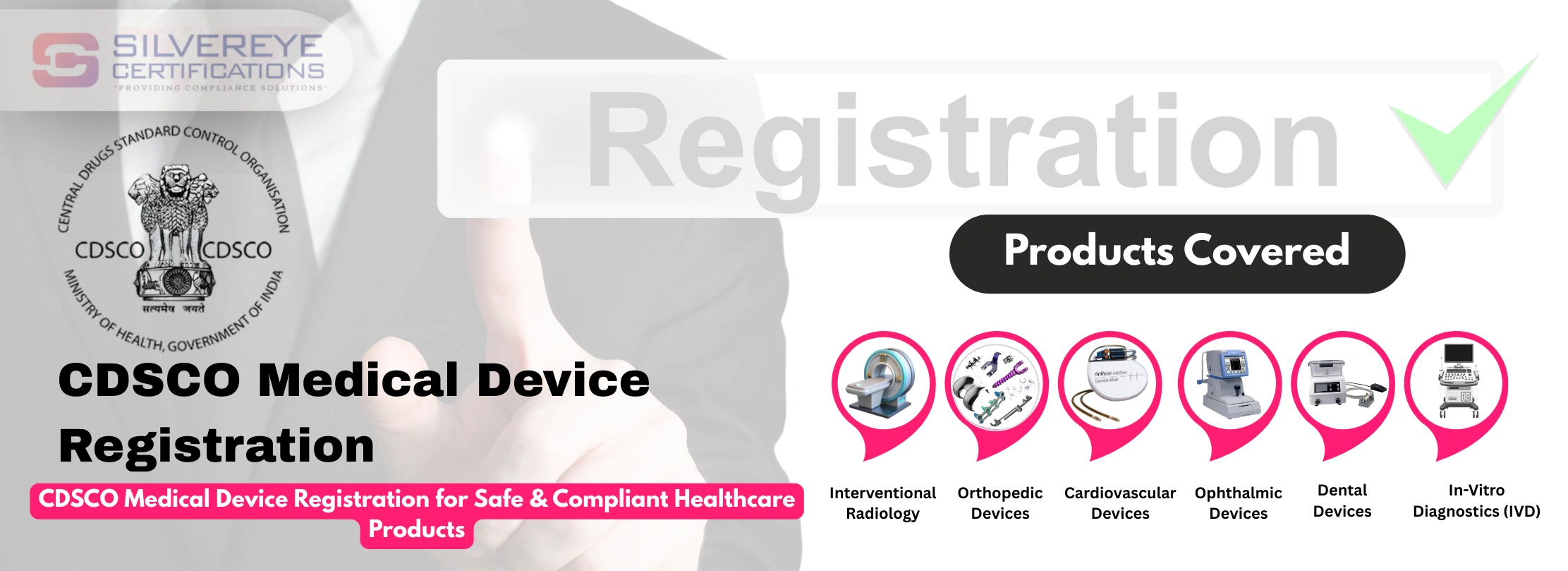
It is the official approval issued by CDSCO that allows a medical device to be legally manufactured, imported, or sold in India. It confirms the device meets national safety, quality, and performance standards.
In early 2024, a Delhi-based orthopaedic manufacturer approached our consulting team with a worrying situation. Their distributors were demanding the CDSCO Medical Device License before placing orders, but the manufacturer was unsure whether their device even required registration. Their internal team had conflicting interpretations of the Medical Device Rules.
Meanwhile, compliance deadlines were approaching and the business was losing opportunities every day.
That case is not unique. Across India, both large and small Medical Device Manufacturers face the same question:
“How do we correctly navigate the Medical Devices Registration process under CDSCO and ensure full compliance without delays?”
This guide is written exactly for those decision-makers — manufacturers, startups, importers, and healthcare suppliers needing a clear, authoritative, consultant-level breakdown of the entire regulatory framework.
The Central Drugs Standard Control Organisation (CDSCO) regulates all Medical Devices in India under the Medical Device Rules (MDR), 2017. Registration is mandatory for any device notified under these rules before it can be sold, marketed, manufactured, or imported
At its core, the purpose of Medical Devices Registration is straightforward: To ensure that every Medical Device in India is safe, effective, and manufactured under a robust quality control system.
Through this registration, manufacturers and importers must:
This process protects patients, supports regulatory accountability, and ensures that only safe and reliable devices reach hospitals and healthcare providers.
Manufacturers often underestimate the importance of a compliant Medical Device License. But CDSCO has tightened enforcement significantly over the last five years.
Common business risks due to non-compliance:On the commercial side, distributors now insist on a valid CDSCO Registration number because healthcare facilities increasingly verify regulatory credentials before procurement.
In other words, compliance is no longer optional — it is a market access prerequisite.
The foundation of every Medical Device Process begins with correct classification. CDSCO follows a risk-based framework similar to international regulations.
Categories| Class | Risk Level | Examples |
|---|---|---|
| Class A | Low risk | Surgical dressings, tongue depressors |
| Class B | Low–moderate risk | Needles, suction equipment |
| Class C | Moderate–high risk | Cardiac stents, ventilators |
| Class D | High risk | Heart valves, implantable devices |
Many delays during CDSCO Registration originate from incorrect classification. Manufacturers frequently misjudge their device risk level or incorrectly refer to foreign classification systems.
CDSCO provides different licensing categories depending on whether the business is a manufacturer, importer, or trader.
| License Type | Applicable Forms | Applicable Devices |
|---|---|---|
| Manufacturing License | MD-5 (Class A/B), MD-9 (Class C/D) |
MD-5 (Class A/B), MD-9 (Class C/D) Devices produced by their own manufacturing facility in India. |
| Import License | MD-15 | Devices manufactured overseas and imported by an Indian Authorized Agent (IAA). |
| Loan License | MD-6 (Class A/B), MD-10 (Class C/D) |
Businesses manufacturing using a third-party facility. |
| Registration Certificate | MD-42 | Mandatory registration for Class A (non-sterile, non-measuring) devices, which are exempt from the full licensing regime but must still be filed. |
A core mandate for Medical Device Manufacturers is maintaining a QMS equivalent to ISO 13485.
However, most clients initially misunderstand this requirement.
A common scenario: A manufacturer believes that having ISO 13485:2016 automatically guarantees regulatory approval. In reality, CDSCO evaluates:
During audits, inspectors frequently reject applications solely because ISO documentation was not aligned with MDR 2017 requirements.
In short, ISO certification is not enough — QMS must match CDSCO’s regulatory expectations.
| S.No | Benefit | Description | Market Impact |
|---|---|---|---|
| 1 | Legal Authorization | Mandatory CDSCO approval to manufacture, import, and sell devices in India. | Required for legal operation. |
| 2 | Market Access | Enables entry into hospitals, clinics, and corporate healthcare networks. | Opens up all major sales channels. |
| 3 | Tender Eligibility | Required for government tenders and GeM listings. | Mandatory for securing public sector contracts. |
| 4 | Higher Trust | Assures buyers of national safety, performance, and QMS standards. | Enhances brand reputation and buyer confidence. |
| 5 | Risk Mitigation | Protects the business from seizures, penalties, and legal action under MDR 2017. | Minimizes financial and legal liabilities. |
| 6 | Distributor Acceptance | Simplifies onboarding with dealers who prefer fully compliant products. | Accelerates distribution network growth. |
| 7 | Quality Management | Ensures alignment with ISO 13485 and improves traceability and validation. | Leads to consistent product quality. |
| 8 | Export Potential | Strengthens eligibility for regulatory approvals in global markets (ASEAN, Middle East) | Facilitates smoother international expansion. |
| 9 | Competitive Edge | Creates a regulatory advantage over non-registered competitors. | Positions the brand as a verified, reliable supplier. |
The Medical Device Process under CDSCO is documentation-heavy. Manufacturers must provide complete technical and administrative files including:
Accuracy matters because any inconsistency leads to screening failures or outright rejection.
Below is the consultant-level explanation that manufacturers often seek.
Step 1: Device Classification & Notification Check
Step 2: Gap Assessment & QMS Alignment
Step 3: Technical File Preparation
Step 4: Online Portal Registration
Step 5: Application Filing
Step 6:Audit / Inspection
Step 7:License Issuance
Step 8:Post-Market Surveillance (PMS)
| Category | Typical Timeline (Post-Submission) | Validity | Retention/Renewal |
|---|---|---|---|
| Class A Devices | Fastest Processing / Self-Declaration | Perpetual* | Mandatory Retention Fee every 5 years. |
| Class B Devices | Moderate Timeline (Document Review + Inspection) | Perpetual* | Mandatory Retention Fee every 5 years. |
| Class C Devices | Longer Evaluation (Technical Review + Inspection) | Perpetual* | Mandatory Retention Fee every 5 years. |
| Class D Devices | Longest Evaluation (Extensive Technical Assessment) | Perpetual* | Mandatory Retention Fee every 5 years. |
Silvereye Certifications has strong regulatory expertise, covering classification, documentation, and licensing requirements for all medical device categories.
The team prepares DMF, PMF, CER, RMF, and QMS documents in the exact formats expected by CDSCO, reducing queries and speeding approvals.
From device classification to SUGAM filing, inspection preparation, and post-market guidance, Silvereye manages the entire registration cycle.
Consultants understand real factory conditions and help manufacturers align processes with ISO 13485 and MDR requirements in a practical, cost-effective way.
Accurate documentation, correct classification, and structured submissions help clients achieve approvals with minimal delays.
Silvereye supports both Indian manufacturers and global companies entering the Indian market, ensuring smooth licensing and compliance.
Silvereye Certifications is a trusted compliance partner for Medical Device Registration in India, known for its strong expertise in CDSCO regulations and MDR 2017 requirements. The team prepares high-quality technical documentation, manages complete licensing workflows on the SUGAM portal, and ensures manufacturers meet ISO 13485 and risk-management standards.
With practical understanding of factory operations and a proven record of fast, accurate approvals across all device classes, Silvereye offers reliable, end-to-end support for both Indian manufacturers and global importers entering the Indian market.
Manufacturers planning to enter or expand in the Indian healthcare industry must treat Medical Devices Registration as a strategic investment rather than a regulatory formality. A valid CDSCO Registration ensures market access, distributor confidence, legal protection, and alignment with global quality expectations. The best outcomes always come when manufacturers approach the registration with a structured plan: correct classification, robust documentation, audit readiness, and continuous compliance.
If you require expert support in completing your Medical Device License or navigating the Medical Device Process, Silvereye Certifications provides end-to-end guidance backed by deep regulatory expertise and a strong track record of successful approvals. With the right consultant, the compliance journey becomes faster, predictable, and fully aligned with CDSCO requirements.
Ready to secure your Medical Device License and ensure compliance?
























It is the official approval issued by CDSCO that allows a medical device to be legally manufactured, imported, or sold in India. It confirms the device meets national safety, quality, and performance standards.
Any manufacturer or importer whose product is listed as a “notified medical device” under MDR 2017 must obtain a CDSCO license before marketing it in India.
Devices are classified into Class A, B, C, and D based on risk. Class A is low risk, while Class D includes high-risk, life-supporting or implantable devices.
Key documents include the Device Master File, Plant Master File, ISO 13485 certificate, risk-management file, performance data, labels, and manufacturing/site details.
Timelines vary by class. Class A devices process fastest, while Class C and D devices require detailed technical evaluation and take longer.
Yes. CDSCO requires a functioning QMS aligned with ISO 13485 for both manufacturers and importers of medical devices.
Most CDSCO licenses are valid for five years, provided QMS and documentation remain compliant.
Class B, C, and D devices generally require inspection. Class A devices may undergo document review without onsite evaluation.
No. They must appoint an Indian Authorized Agent (IAA) to handle submissions and compliance on their behalf.
Unregistered devices can be seized, banned from hospitals, or removed from tenders. Companies may face legal penalties and suspension of operations.