


RoHS Compliance ensures electrical and electronic products do not exceed permitted limits of restricted hazardous substances.
A European buyer recently delayed an electronics shipment from India for one simple reason—missing RoHS Compliance documentation. The product met quality expectations, but without proof of compliance, it could not legally enter the market.
Today, RoHS Compliance and RoHS Certification are critical for selling electrical and electronic products globally. With stricter enforcement and new regulatory updates, RoHS Testing and documentation are no longer optional. They directly impact market access, buyer trust, and business continuity for manufacturers, importers, and exporters
RoHS Compliance means ensuring that electrical and electronic products meet the requirements of the RoHS Regulation (Restriction of Hazardous Substances). It confirms that a product does not contain restricted toxic substances beyond permitted limits and is safe for sale in regulated markets.
The primary objective of RoHS is to limit hazardous materials—such as lead, mercury, cadmium, and certain flame retardants—in electronic equipment to protect human health and reduce environmental pollution. RoHS Compliance applies to a wide range of RoHS products, including consumer electronics, IT equipment, industrial electronics, medical devices, and lighting products.
The objective of the RoHS Regulation is to reduce the use of hazardous substances in electrical and electronic equipment and minimise their impact on human health and the environment throughout the product lifecycle.
Specifically, the RoHS Regulation aims to:
RoHS Compliance is critical for manufacturers, importers, and exporters because it directly determines whether an electrical or electronic product can be legally sold, shipped, or listed in regulated markets.
First, RoHS Compliance is a legal market-access requirement. Without valid RoHS documentation, products can be stopped at customs, rejected by distributors, or removed from online marketplaces in the EU, UK, China, and other RoHS-regulated regions.
Electronic waste is one of the fastest-growing waste streams worldwide. RoHS Compliance limits hazardous substances at the source, reducing toxic materials entering landfills and recycling systems and supporting environmentally responsible manufacturing.
Restricted substances such as lead, mercury, and certain flame retardants pose serious long-term health risks. RoHS protects end users, factory workers, and recyclers from harmful exposure during product use and disposal.
Without RoHS Compliance, businesses face immediate trade barriers, including:
Failure to comply with RoHS regulations can result in:
For manufacturers, importers, and exporters, RoHS Compliance is not optional—it is essential for sustainable operations and uninterrupted global trade.
RoHS Compliance applies to a wide range of electrical and electronic equipment (EEE) that relies on electricity or electromagnetic fields to operate. Any product placed on the market in RoHS-regulated regions must meet the substance restriction requirements.
If a product uses electrical power and is intended for commercial distribution, RoHS Compliance is typically mandatory, regardless of whether it is sold domestically or exported.
The RoHS Regulation restricts the use of specific hazardous substances in electrical and electronic equipment to reduce environmental and health risks. These limits apply to each homogeneous material within a product, not to the finished product as a whole.
| Restricted Substance | Symbol | Maximum Permitted Level |
|---|---|---|
| Lead | Pb | 0.1% |
| Mercury | Hg | 0.1% |
| Cadmium | Cd | 0.01% |
| IHexavalent Chromium | Cr⁶⁺ | 0.1% |
| Polybrominated Biphenyls | PBB | 0.1% |
| Polybrominated Diphenyl Ethers | PBDE | 0.1% |
| Bis(2-ethylhexyl) phthalate | DEHP | 0.1% |
| Butyl benzyl phthalate | BBP | 0.1% |
| Dibutyl phthalate | DBP | 0.1% |
| Diisobutyl phthalate | DIBP | 0.1% |
These restrictions ensure that RoHS-compliant products are safer to manufacture, use, recycle, and dispose of, while meeting legal requirements for regulated global markets.
RoHS Compliance is required for any business involved in placing electrical or electronic products on regulated markets. Responsibility does not rest only with manufacturers—it extends across the supply chain.
If your company’s name is associated with the product or you place it on the market,you are legally responsible for RoHS Compliance, regardless of where the product is manufactured.
To achieve and maintain RoHS Compliance, businesses must demonstrate that their electrical and electronic products meet substance restriction limits through proper documentation and, where required, testing. Compliance is evidence-based and must be defensible during audits or market surveillance.
Meeting these requirements ensures that RoHS-compliant products can be legally sold, imported, and distributed without regulatory or commercial risk.
RoHS Compliance Testing is carried out to verify that restricted hazardous substances in electrical and electronic products are within the limits prescribed by the RoHS Regulation. Testing provides objective, technical evidence to support compliance claims.
Testing should be conducted throughrecognized or accredited laboratories to ensure accuracy, traceability, and acceptance by regulators, customs authorities, and global buyers.
AchievingRoHS Complianceoffers both regulatory and commercial advantages for businesses dealing in electrical and electronic products.
RoHS Compliance not only fulfils legal obligations but also strengthens long-term business growth and market trust.
Recent regulatory changes have made RoHS Compliance more stringent and documentation-focused across major markets..
These updates make proactive RoHS planning essential to avoid last-minute non-compliance, shipment delays, or market withdrawal.
Although often mentioned together, RoHS Compliance and REACH serve different regulatory purposes and apply in different ways.
| Aspect | RoHS Compliance | REACH Regulation |
|---|---|---|
| Primary Focus | Restriction of hazardous substances in products | Registration and control of chemical substances |
| Scope | Electrical & electronic equipment (EEE) | All industries and substances |
| Objective | Limit toxic substances in finished products | Manage risks from chemicals throughout their lifecycle |
| Compliance Approach | Product-level compliance | Substance-level registration and authorisation |
| Testing Requirement | Focused on restricted substances | Based on substance registration thresholds |
| When Required Together | Electronics sold in regulated markets | When substances are present in products or supply chain |
For many manufacturers and exporters, both RoHS and REACH compliance are required to ensure full regulatory acceptance in global markets.
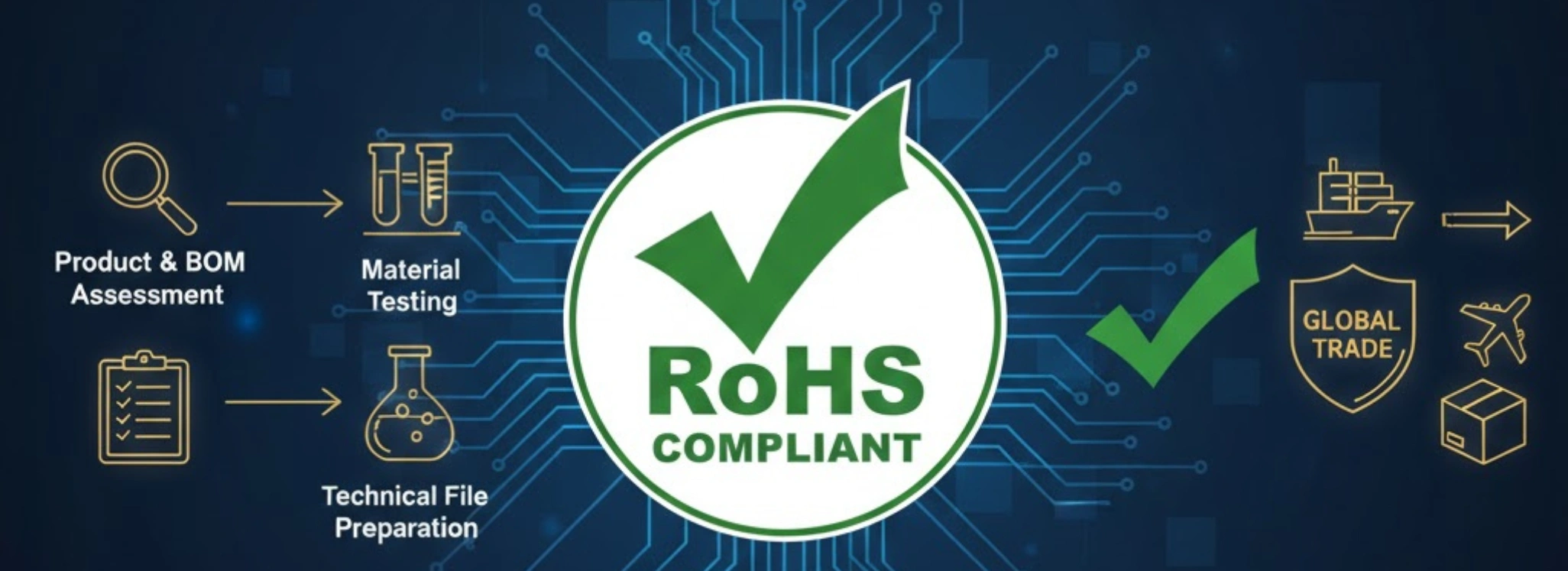
The RoHS Compliance Certification process follows a structured, evidence-based approach to ensure products meet substance restriction requirements and remain audit-ready.
Review the product scope and Bill of Materials (BOM) to identify components and materials subject to RoHS Regulation.
Obtain material composition details and RoHS declarations from component and raw material suppliers.
Conduct XRF screening or chemical testing for high-risk materials or where supplier data is insufficient.
Evaluate compliance risks, exemption applicability, and gaps in documentation or material data.
Compile technical documentation, test reports, declarations, and traceability records.
Issue and sign the RoHS Declaration of Conformity, confirming the product meets all applicable RoHS requirements.
Following this step-by-step process ensures consistent RoHS Compliance, reduces regulatory risk, and supports smooth market access across regulated regions.
To demonstrate RoHS Compliance, businesses must maintain clear, accurate, and traceable documentation. These records are essential during customs checks, customer audits, and market surveillance by regulatory authorities.
Key documents required for RoHS Compliance include:
Well-maintained documentation ensures RoHS-compliant products can be defended legally and commercially throughout their lifecycle.
| Cost Component | Description | Cost Impact |
|---|---|---|
| Product Complexity | Number of components, materials, and assemblies | Low to High |
| Supplier Declarations | Collection and validation of RoHS material declarations | Low |
| RoHS Testing (XRF Screening) | Non-destructive screening for restricted substances | Medium |
| Chemical Testing | Detailed lab analysis for cadmium and phthalates | High |
| Documentation & Technical File | Preparation of compliance documents and DoC | Low to Medium |
| Market-Specific Requirements | EU, UK, China RoHS variations and updates | Medium |
| Consultant Support (Optional) | End-to-end compliance management | Medium |
Note: Actual RoHS Compliance cost varies based on product type, risk level, and target markets. Strategic planning can significantly reduce testing and overall compliance expenses.
| Compliance Stage | Activities Involved | Typical Timeline |
|---|---|---|
| Product & Scope Assessment | Product review and applicability check | 1–2 days |
| BOM & Supplier Data Collection | Collection of material declarations | 7–14 days |
| RoHS Testing (If Required) | XRF screening or chemical analysis | 7–15 days |
| Risk Assessment & Gap Analysis | Review of test results and exemptions | 2–3 days |
| Technical Documentation | Preparation of technical file | 5–7 days |
| Declaration of Conformity | Final review and issuance | Medium |
| Consultant Support (Optional) | End-to-end compliance management | 1–2 days |
| Aspect | Details |
|---|---|
| Validity of RoHS Certification | RoHS certification does not have a fixed expiry date |
| Renewal Requirement | No formal renewal process is prescribed under RoHS regulations |
| Basis of Validity | Certification remains valid as long as the product continues to meet RoHS requirements |
| Design or Material Changes | Re-assessment and possible re-testing required if materials, components, or suppliers change |
| Regulatory Updates | Documentation must be updated if RoHS substance limits or exemptions are revised |
| Market Surveillance | Authorities can verify compliance at any time |
| Ongoing Responsibility | Manufacturer or brand owner must ensure continuous compliance |
Important Note:
RoHS is a continuous compliance obligation, not a one-time approval. While there is no renewal certificate, maintaining updated documentation and testing evidence is essential to keep RoHS certification valid.
Despite clear regulations, many businesses face practical difficulties while achieving and maintaining RoHS Compliance.
Addressing these challenges early helps avoid shipment delays, audit failures, and costly rework.
Choosing the right compliance partner is critical to achieving RoHS Compliance without delays, unnecessary testing, or regulatory risk. Silvereye Certifications delivers practical, audit-ready RoHS solutions tailored to real business needs.
With Silvereye Certifications, RoHS Compliance becomes a structured, reliable process that supports long-term market access and business growth.
RoHS Compliance is no longer just a regulatory requirement—it is a critical business safeguard for manufacturers, importers, and exporters of electrical and electronic products. With expanding substance restrictions, stricter enforcement, and frequent regulatory updates, maintaining RoHS Certification demands continuous attention, accurate documentation, and informed compliance planning.
Businesses that approach RoHS proactively reduce the risk of shipment delays, penalties, and market rejection, while strengthening buyer trust and long-term market access. With the right expertise and a structured compliance approach, RoHS can be managed efficiently and cost-effectively, supporting sustainable growth in regulated global markets
RoHS Compliance ensures electrical and electronic products do not exceed permitted limits of restricted hazardous substances.
RoHS is mandatory for exports to RoHS-regulated markets like the EU, UK, and China; in India, it applies mainly to notified electronic products and exports.
RoHS Compliance is the legal requirement, while RoHS Certification refers to documented proof supporting that compliance.
Most electrical and electronic equipment, including consumer electronics, IT equipment, industrial electronics, lighting, and medical devices.
No. Testing is required when supplier declarations are insufficient or when high-risk materials are involved.
RoHS has no fixed validity period but requires continuous compliance throughout the product lifecycle.
Non-compliant products may be rejected at customs, recalled, delisted from marketplaces, or penalised.
Yes, spare parts and components are covered if they are placed on the market independently.
RoHS restricts substances in electronic products, while REACH regulates chemicals across all industries.
Yes, RoHS allows self-declaration, but it must be backed by valid documentation and testing evidence.