


An Authorized Indian Representative (AIR) is an India-based individual or entity appointed by a foreign manufacturer to represent them before the Bureau of Indian Standards under the FMCS scheme.
A South Korean electrical component manufacturer recently approached us after their Indian buyer refused to clear goods from customs. The issue wasn’t quality, packaging, or pricing. It was straightforward—no BIS FMCS licence. Foreign manufacturers entering the Indian market usually face one decisive question at the customs stage: Is the product certified under BIS FMCS? For regulated products, the answer determines whether goods are released or stopped—there is no middle ground.
The Foreign Manufacturers Certification Scheme (FMCS) is India’s legally enforced mechanism for approving overseas manufacturing facilities. It applies irrespective of global certifications such as ISO, CE, or UL. If a product is notified under a Quality Control Order, BIS FMCS certification becomes mandatory before import, not after.
 BIS FMCS stands for Foreign Manufacturers Certification Scheme, a statutory certification framework administered by the Bureau of Indian Standards for products manufactured outside India but intended for sale, distribution, or import into the Indian market.
BIS FMCS is the mechanism through which India evaluates and approves foreign manufacturing facilities, not just the product. If a product is notified under a mandatory Quality Control Order (QCO), foreign manufacturers cannot rely on international certifications like ISO, CE, or UL. They must obtain a BIS licence under FMCS before the product can legally enter India.
BIS FMCS becomes mandatory when:
For foreign manufacturers, BIS FMCS is not a procedural requirement—it is the legal foundation for accessing the Indian market. When a product is notified under India’s Quality Control Orders, FMCS certification becomes mandatory before import, regardless of global approvals or brand standing From a regulatory and commercial standpoint, FMCS directly influences whether goods move smoothly through customs or remain blocked at te port.
India regulates selected products to protect consumer safety, infrastructure integrity, and environmental standards. The Foreign Manufacturers Certification Scheme is the mechanism through which this control is enforced on overseas factories.
For foreign manufacturers, FMCS ensures:
Many manufacturers evaluate FMCS only as a compliance cost. In practice, it is a commercial safeguard.
FMCS certification:
Indian buyers increasingly demand proof of FMCS licence before finalizing purchase orders.
BIS FMCS protects foreign manufacturers from regulatory uncertainty by providing:
Manufacturers holding a valid BIS licence under FMCS face fewer enforcement actions, audits, and import disruptions.
From the Indian importer’s side, FMCS-certified suppliers are viewed as:
May importers now avoid non-FMCS suppliers entirely due to customs liability exposure.
FMCS certification is mandatory for any foreign manufacturer whose product is regulated under India’s Quality Control Orders (QCOs). The requirement is determined by product category and place of manufacture, not by the importer, buyer, or country of origin.
If a product is notified for compulsory BIS certification and is manufactured outside India, it must be approved under the Foreign Manufacturers Certification Scheme (FMCS) before it can be imported or sold in India.
FMCS certification is required for the following foreign entities:
FMCS certification is required when all the following conditions apply:
In such cases, customs authorities will not clear shipments without a valid BIS licence under FMCS.
FMCS is not required when:
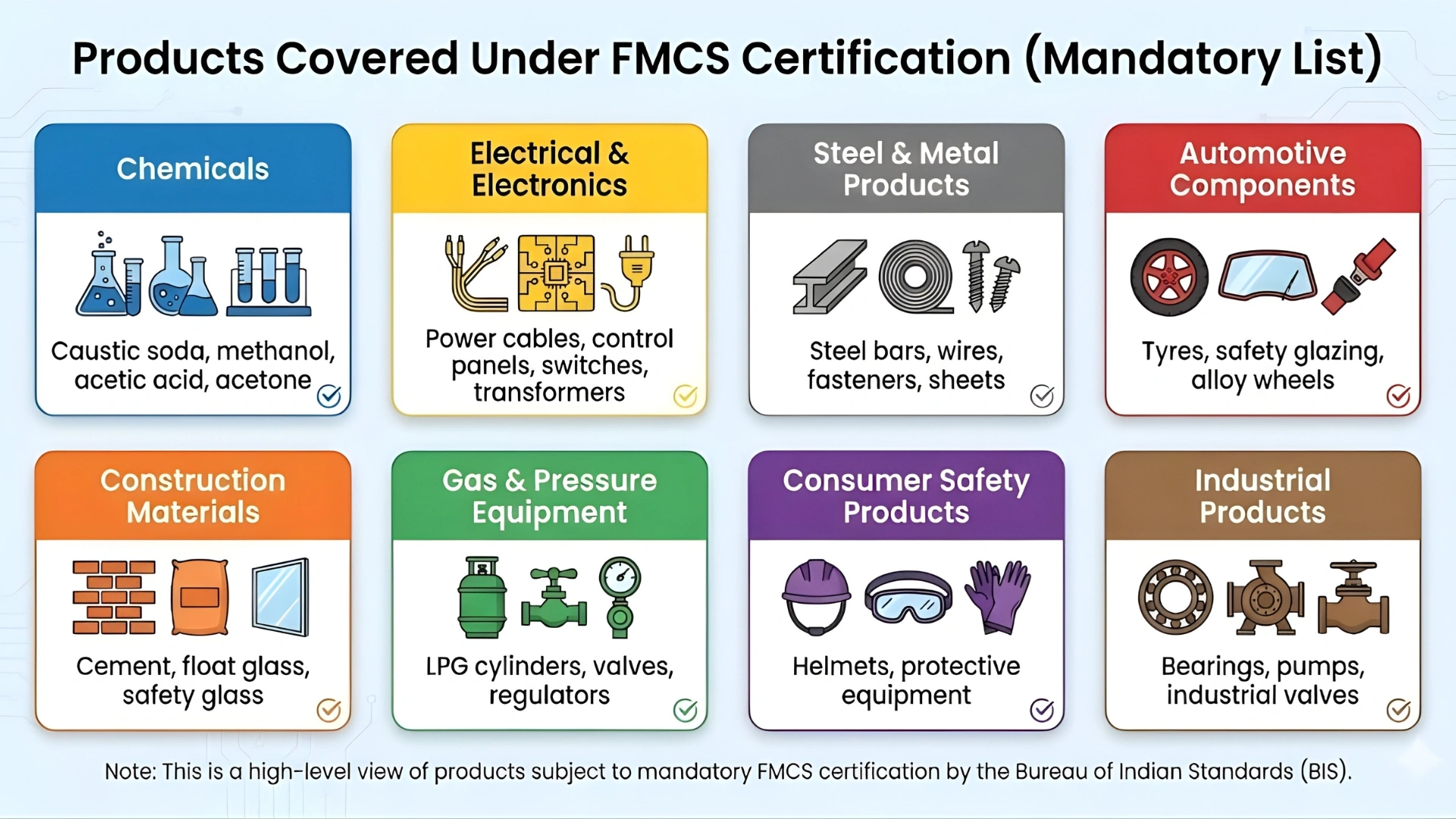
Below is a high-level view of mandatory products under FMCS:
| Product Category | Examples of Products |
|---|---|
| Chemicals | Caustic soda, methanol, acetic acid, acetone |
| Electrical & Electronics | Power cables, control panels, switches, transformers |
| Steel & Metal Products | Steel bars, wires, fasteners, sheets |
| Automotive Components | Tyres, safety glazing, alloy wheels |
| Construction Materials | Cement, float glass, safety glass |
| Gas & Pressure Equipment | LPG cylinders, valves, regulators |
| Consumer Safety Products | Helmets, protective equipment |
| Industrial Products | Bearings, pumps, industrial valves |
Under the Foreign Manufacturers Certification Scheme (FMCS), chemicals and industrial products are subject to heightened regulatory scrutiny. These categories are closely monitored because of their direct impact on human safety, industrial processes, infrastructure integrity, and the environment
For foreign manufacturers, compliance is not limited to product composition. BIS evaluates the entire manufacturing and quality control ecosystem at the factory level.
FMCS standards are enforced by the Bureau of Indian Standards through:
Each chemical or industrial product must conform exactly t the applicable Indian Standard—not an equivalent international specification.
Chemical manufacturers must demonstrate ontrol across the full production lifecycle.
Key compliance requirements include:
For industrial and engineering products, BIS focuses on mechanical performance, dimensional accuracy, and durability.
Typical evaluation parameters include:
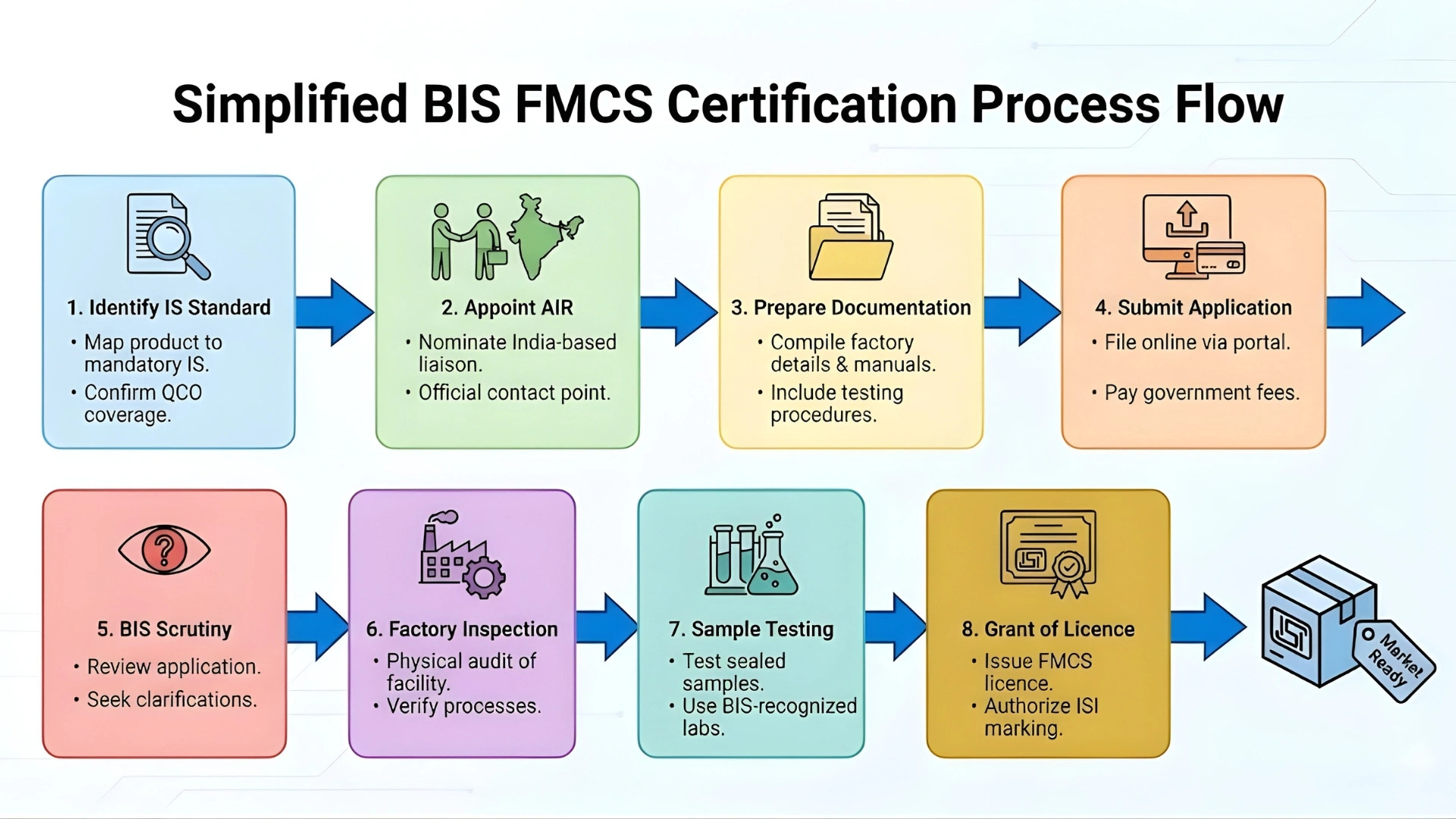
Confirm whether the product is covered under a mandatory BIS Quality Control Order and map the correct IS standard.
Nominate an India-based AIR to act as the official liaison with BIS.
Compile factory details, quality manuals, testing procedures, and calibration records.
File the online application through the BIS portal and pay applicable government fees.
BIS reviews the application and may seek clarifications or corrections.
BIS officials conduct a physical audit of the foreign manufacturing facility.
Sealed samples are tested in BIS-recognized laboratories as per Indian Standards.
Upon successful inspection and testing, BIS issues the FMCS licence authorizing ISI marking.
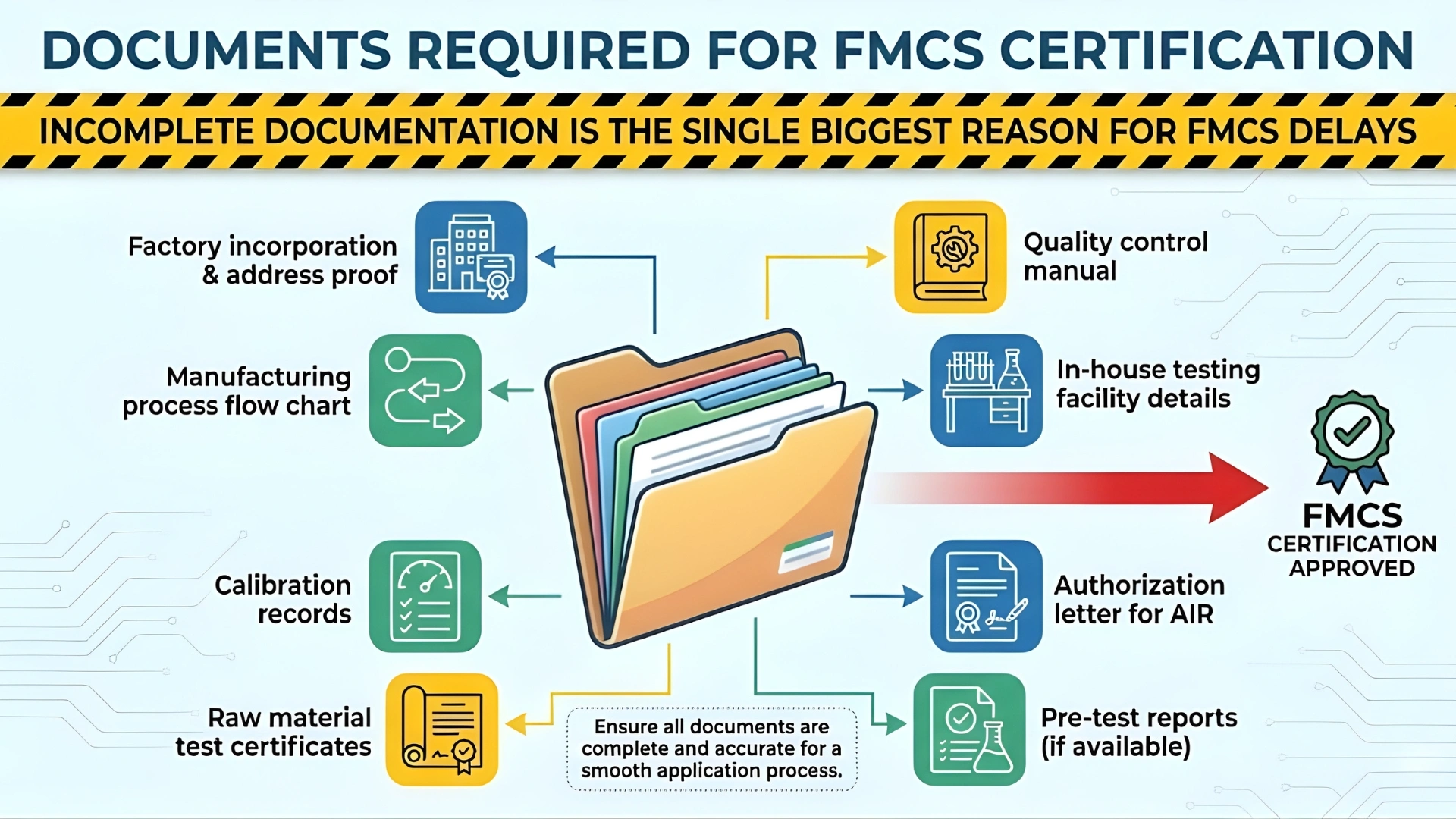
Incomplete documentation is the single biggest reason for FMCS delays.
Under the BIS FMCS framework, appointing an Authorized Indian Representative (AIR) is not optional. It is a mandatory regulatory requirement for all foreign manufacturers seeking BIS certification for products exported to India.
The AIR serves as the official legal and compliance interface between the foreign manufacturer and the Bureau of Indian Standards.
An AIR must be a legal entity or individual based in India. This can include:
The AIR must be formally authorized through a signed declaration submitted to BIS.
The AIR is responsible for managing end-to-end regulatory coordination in India.
Key responsibilities include:
BIS holds the AIR accountable for timely regulatory responses.
The AIR’s role goes beyond communication. From a regulatory perspective, BIS requires a locally accountable entity for every foreign licence holder.
The importance of AIR includes:
Without a competent AIR, FMCS licences are at higher risk of suspension or cancellation.
Even after certification, the AIR remains responsible for:
The Authorized Indian Representative (AIR) plays a critical role in ensuring smooth and continuous BIS FMCS compliance for foreign manufacturers. Choosing the right AIR directly impacts approval speed, regulatory stability, and long-term licence validity.
| Stage | Typical Duration |
|---|---|
| Application & scrutiny | 2–3 weeks |
| Inspection scheduling | 3–5 weeks |
| Factory audit | 1 week |
| Sample testing | 3–4 weeks |
| Licence grant | 2–3 weeks |
Average total timeline: 4 to 6 months
With professional FMCS consultants, delays are significantly minimized.
| Cost Component | Description |
|---|---|
| Application Fee | Fee for submission of FMCS application |
| Inspection Charges | Cost of BIS officers’ factory inspection (including travel) |
| Sample Testing Fee | Testing of sealed samples as per Indian Standards |
| Licence Grant Fee | Fee for issuance of BIS licence under FMCS |
| Surveillance Fee | Annual compliance and monitoring charges |
| Bank Guarantee (PBG) | $10,000 USD (Refundable Security) |
Exact costs vary based on product category, location, and testing scope.
| Aspect | Details |
|---|---|
| Initial Validity | 2 years from the date of licence grant |
| Licence Scope | Product-specific and factory-specific |
| Surveillance Requirement | Annual surveillance audit by BIS |
| Renewal Window | Before expiry of the licence |
Failure to renew on time can lead to licence cancellation and import bans.
Foreign manufacturers often underestimate the practical execution of BIS FMCS requirements. Most difficulties arise not from product quality, but from gaps in regulatory understanding and preparation.
The FMCS certification process is technical, sequential, and closely scrutinized by the Bureau of Indian Standards. For foreign manufacturers, working with an experienced FMCSCertification Consultant significantly reduces regulatory risk and approval delays.
For foreign manufacturers, FMCS certification is not just about filing an application—it requires regulatory clarity, factory-level readiness, and continuous compliance management. Silvereye Certifications is trusted because we approach FMCS from an execution and risk-control perspective, not a checklist-driven one.
Keeping up with government notifications and BIS regulatory changes is essential for foreign manufacturers pursuing FMCS certification or planning to export to India. Below are the key official regulatory developments in 2025 from the Bureau of Indian Standards and related government sources:
The Bureau of Indian Standards maintains an official list of products that are eligible for FMCS certification. This list is regularly updated to reflect new Indian Standards and compliance requirements for compulsory certification. As of November 21, 2025, this list is available on the BIS website.
BIS publishes and regularly updates the Products Under Compulsory Certification list, which includes products governed by Quality Control Orders (QCOs). These products require mandatory compliance—including FMCS for foreign manufacturers—if notified under relevant QCOs. The list was last updated on December 10, 2025 on the official BIS portal.
BIS’s official “Upcoming QCOS – Notified and Due for Implementation” page provides advance information about new QCOs that are scheduled to come into force. This helps manufacturers and stakeholders plan compliance activities well before mandatory enforcement dates.
Recent government notifications in late 2025 have rescinded or withdrawn a number of Quality Control Orders, affecting certain chemical and industrial product categories. These changes are published through official gazette notifications and impact which products require mandatory BIS certification and, by extension, FMCS compliance.
The official BIS portal’s Product Certification Process section was updated in November 2025 to reflect the latest conformity assessment procedures, including how FMCS and other product certification schemes are administered.
BIS continues to maintain up-to-date information on FMCS, including the official description of the scheme, its objectives, and the regulatory basis under the BIS Act 2016 and related conformity assessment regulations.
BIS FMCS certification determines whether a foreign manufacturer can legally, consistently, and profitably operate in India.
With the right FMCS consultant and AIR, the process becomes structured and predictable. Without expert guidance, it becomes expensive and uncertain.
If your products are entering India, FMCS compliance should be planned before production—not after shipment.
Speak with Silvereye Certifications to secure your FMCS approval the right way.
An Authorized Indian Representative (AIR) is an India-based individual or entity appointed by a foreign manufacturer to represent them before the Bureau of Indian Standards under the FMCS scheme.
Yes. BIS does not grant FMCS Certification without a valid Authorized Indian Representative.
An Indian importer, subsidiary, agent, or registered Indian company can act as an AIR.
No. The AIR must be physically located in India.
The AIR handles BIS communication, audits, surveillance, renewals, and compliance actions.
Authorization letter, Power of Attorney, identity proof, and company registration documents.
Yes, but only with prior BIS approval.
Yes. One AIR can represent multiple products or factories of the same manufacturer.
BIS may suspend the FMCS certificate and restrict imports.
Silvereye Certifications assists with AIR selection, documentation, BIS coordination, and ongoing compliance management.