


It is an official energy-efficiency rating issued by the Bureau of Energy Efficiency to show how much electricity a product consumes.
A few months ago, a leading home-appliance brand approached Silvereye Certifications with a simple challenge: their new refrigerator line had failed a compliance review because the BEE Star Label wasn’t aligned with the latest Bureau of Energy Efficiency requirements. The delay meant products worth crores sat in warehouses instead of reaching dealers during peak season.
This situation isn’t unusual. For many Indian manufacturers, BEE Star Rating certification is often misunderstood—seen only as another government formality. In reality, it directly influences consumer trust, operational efficiency, energy-consumption claims, brand reputation, and long-term sales.
This guide explains the BEE Star Rating meaning, registration process, compliance rules, and documentation requirements using real industry practices and regulatory insights.
The BEE Star Rating Programme is India’s official energy-efficiency benchmarking system. Introduced by the Bureau of Energy Efficiency (BEE) under the Ministry of Power, it classifies products based on their power consumption and performance. A higher star rating indicates better efficiency.
Energy labeling allows consumers to compare appliances based on actual power usage rather than marketing claims. It also promotes energy conservation nationwide, reducing power load and helping India achieve climate-energy commitments.
Products are assigned a rating from 1-Star (least efficient) to 5-Star (most efficient). The rating depends on:
This rating must be displayed on an approved BEE Star Label before products can enter the Indian market.
A BEE Star Rating is no longer just a marketing add-on in India. For manufacturers of electrical and electronic appliances, it is a regulatory requirement that determines whether a product can lawfully enter the market, how consumers perceive it, and how sustainably it performs over its lifetime.
The rating serves as an official assurance from the Bureau of Energy Efficiency that the product consumes energy within prescribed limits and complies with national efficiency standards.
For consumers, the star label simplifies decision-making. A product with a 5-Star rating may cost more upfront, but long-term savings on electricity bills justify the investment.
For manufacturers, star ratings directly impact:
India’s residential and commercial energy demand increases every year. BEE ratings encourage the adoption of efficient appliances, significantly reducing national power consumption.
Under the Energy Conservation Act, 2001, many electronic appliances must obtain BEE certification and carry the star label. Selling non-compliant products is a regulatory violation.
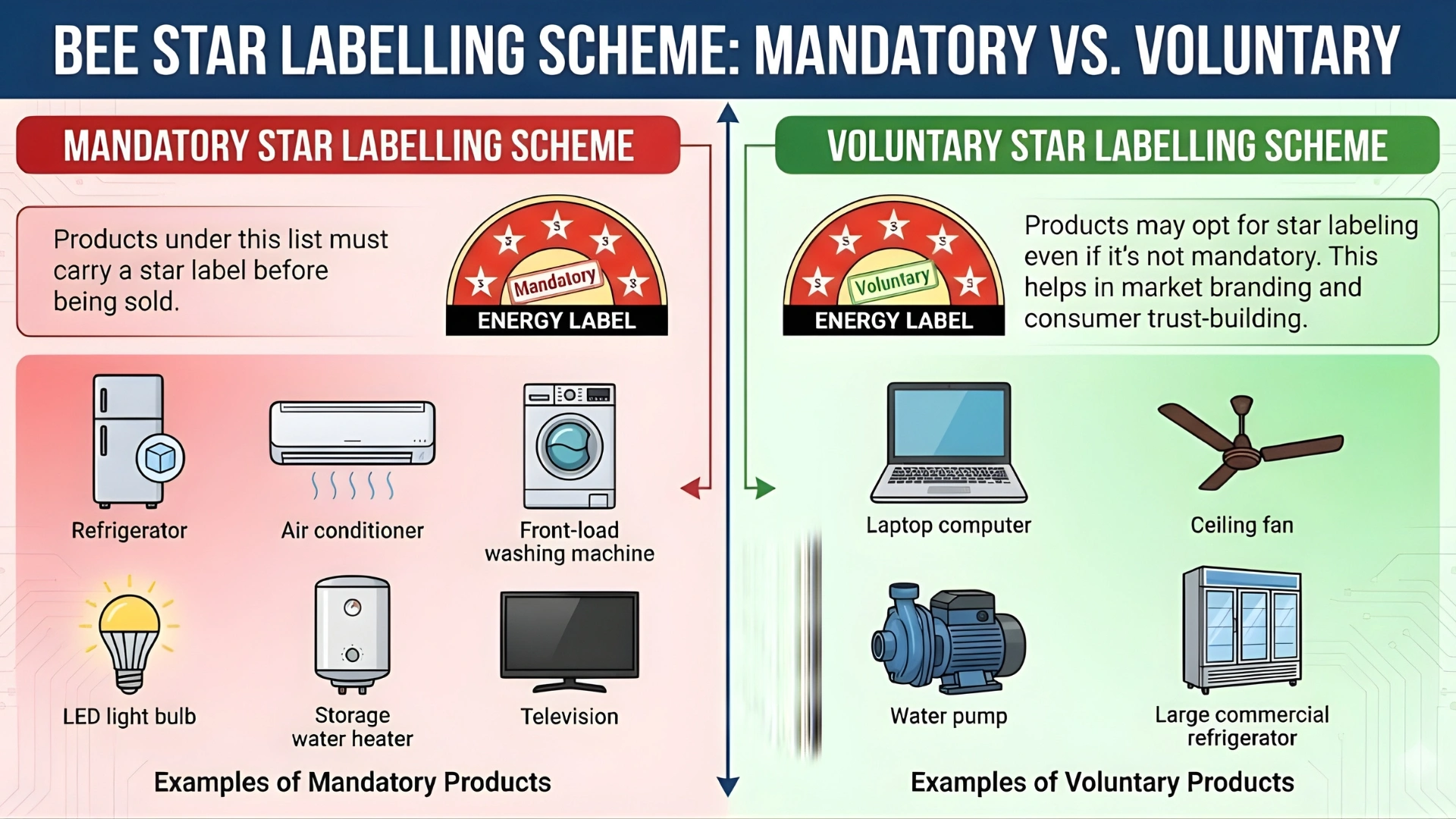
Products under this list must carry a star label before being sold. Examples include:
Products may opt for star labeling even if it’s not mandatory. This helps in market branding and consumer trust-building. Examples include:
Labels range from 1-Star to 5-Star. The rating is based on efficiency thresholds published annually by BEE.
The label displays:
BEE strictly controls label format, colour palette, typography, icons, and layout. Manufacturers must follow the approved template.
Every model undergoes testing at a NABL-accredited laboratory. Tests follow Indian Standards defined by BIS or BEE.
Key points:Each product category is rated on specific technical parameters that influence energy consumption and operational performance. These parameters ensure the star rating reflects real-life usage patterns.
Each category has its parameters. For example:
Only recognized labs can generate test reports used for BEE certification. Reports must match the model configuration being registered.
Key points:BEE updates its performance criteria every 1–2 years. Manufacturers must stay aligned with newer thresholds.
Some products move from voluntary to mandatory based on market penetration and energy-saving potential.
Each year, BEE releases:
Manufacturers must track these updates to prevent compliance lapses.
BEE Star Labelling delivers value at every level—consumer, manufacturer, and national energy management. A higher star rating directly reflects better power efficiency, lower electricity usage, and long-term cost savings. It also strengthens a brand’s position in the market by showcasing verified, government-approved performance standards.
BEE Registration exists to ensure that energy-consuming products sold in India meet defined efficiency and performance standards. The objective is not only regulatory compliance but long-term national energy conservation and improved consumer awareness.
BEE publishes:
Sampling, market inspections, and verification testing ensure that star labels remain accurate.
Manufacturers must:
Includes large household appliances and high-impact energy devices.
| Sr.No. | Equipments Name | Notifications/ Gazette |
|---|---|---|
| 1 | Frost Free Refrigerator | Frost Free (No-Frost) Refrigerator (make Link Open in New Tab) |
| 2 | Stationary Storage Type Electric Water Heater | Electric Geysers (make Link Open in New Tab) |
| 3 | Colour Television | Color TV (make Link Open in New Tab) |
| 4 | Room Air Conditioner (Variable Speed) | IAC Notification/ Gazette (make Link Open in New Tab) |
| 5 | TFL | Tubular Fluorescent Lamps (make Link Open in New Tab) |
| 6 | LED LAMPS | Tubular Fluorescent Lamps (make Link Open in New Tab) |
| 7 | Room Air Conditioner (Fixed Speed) | Room Air Conditioners (make Link Open in New Tab) |
| 8 | RAC (Cassette, Floor Standing Tower, Ceiling, Corner AC) | RAC (Cassette, Floor Standing Tower, Ceiling, Corner AC) (make Link Open in New Tab) |
| 9 | Distribution Transformer | Distribution Transformer (make Link Open in New Tab) |
| 10 | Direct Cool Refrigerator | Direct Cool Refrigerator (make Link Open in New Tab) |
| 11 | Ceiling Fan | Ceiling Fans (make Link Open in New Tab) |
Covers products capable of energy savings but not yet under mandatory enforcement.
| Sr.No. | Equipments Name | Schedules for Equipments |
|---|---|---|
| 1 | Computer | Schedule 14 - Computer (Notebook /Laptops) (make Link Open in New Tab) |
| 2 | Domestic Gas Stove | Schedule 9 -Domestic Liquefied Petroleum Gas(LPG) Stoves (make Link Open in New Tab) |
| 3 | General Purpose Industrial Motor | Schedule 6 - Induction Motors (make Link Open in New Tab) |
| 4 | Submersible Pump Set | Schedule 7 - Agricultural Pump Sets (make Link Open in New Tab) |
| 5 | Washing Machine (Semi/Top Load/Front Load) | Schedule 12 - Washing Machine (make Link Open in New Tab) |
| 6 | Ballast | Schedule 15 - Ballast (Electronic/Magnetic) (make Link Open in New Tab) |
| 7 | Solid State Inverter | Schedule 17 Solid State Inverter (make Link Open in New Tab) |
| 8 | Office Automation Products | Schedule 16 – Office equipment's (Printer, Copier, Scanner, MFD’s). (make Link Open in New Tab) |
| 9 | Diesel Engine Driven MonosetPumps for Agricultural Purposes | Schedule 13-Diesel Engine Driven MonosetPumps for Agricultural Purposes (make Link Open in New Tab) |
| 10 | Diesel Generator Set | Schedule 18 Diesel Generator (make Link Open in New Tab) |
| 11 | Chillers | Schedule 21 Chillers ((make Link Open in New Tab) |
| 12 | Microwave Oven | Schedule 22 Microwave Ovens (make Link Open in New Tab) |
| 13 | Solar Water Heater | Schedule 23 Solar Water Heaters (make Link Open in New Tab) |
| 14 | Deep Freezers | Schedule 25 DEEP FREEZERS ((make Link Open in New Tab) |
| 15 | Light Commercial AC Fixed Speed | Schedule 24 Light Commercial Air conditioners (make Link Open in New Tab) |
| 16 | Ultra-High Definition (UHD) Televisions | Schedule 26 UHD Televisions (make Link Open in New Tab) |
| 17 | Air Compressors | Schedule 27 Air Compressor (make Link Open in New Tab) |
| 18 | Tyres/Tires | Schedule 30 Tyres (make Link Open in New Tab) |
| 19 | High Energy Li-Battery | SCHEDULE-29 Li-ion traction batteries and Systems (make Link Open in New Tab) |
Every model variant requires separate registration, testing, and label approval.
BEE may request additional verification whenever discrepancies arise.
BEE provides a standardised star label format that every manufacturer must use without altering the layout, colours, or technical fields. The label displays the star rating, annual energy consumption, product details, and the official BEE licence number. This ensures complete transparency for consumers and consistent compliance across all product categories.
| Stage | Activity | Estimated Timeline | Cost Components |
|---|---|---|---|
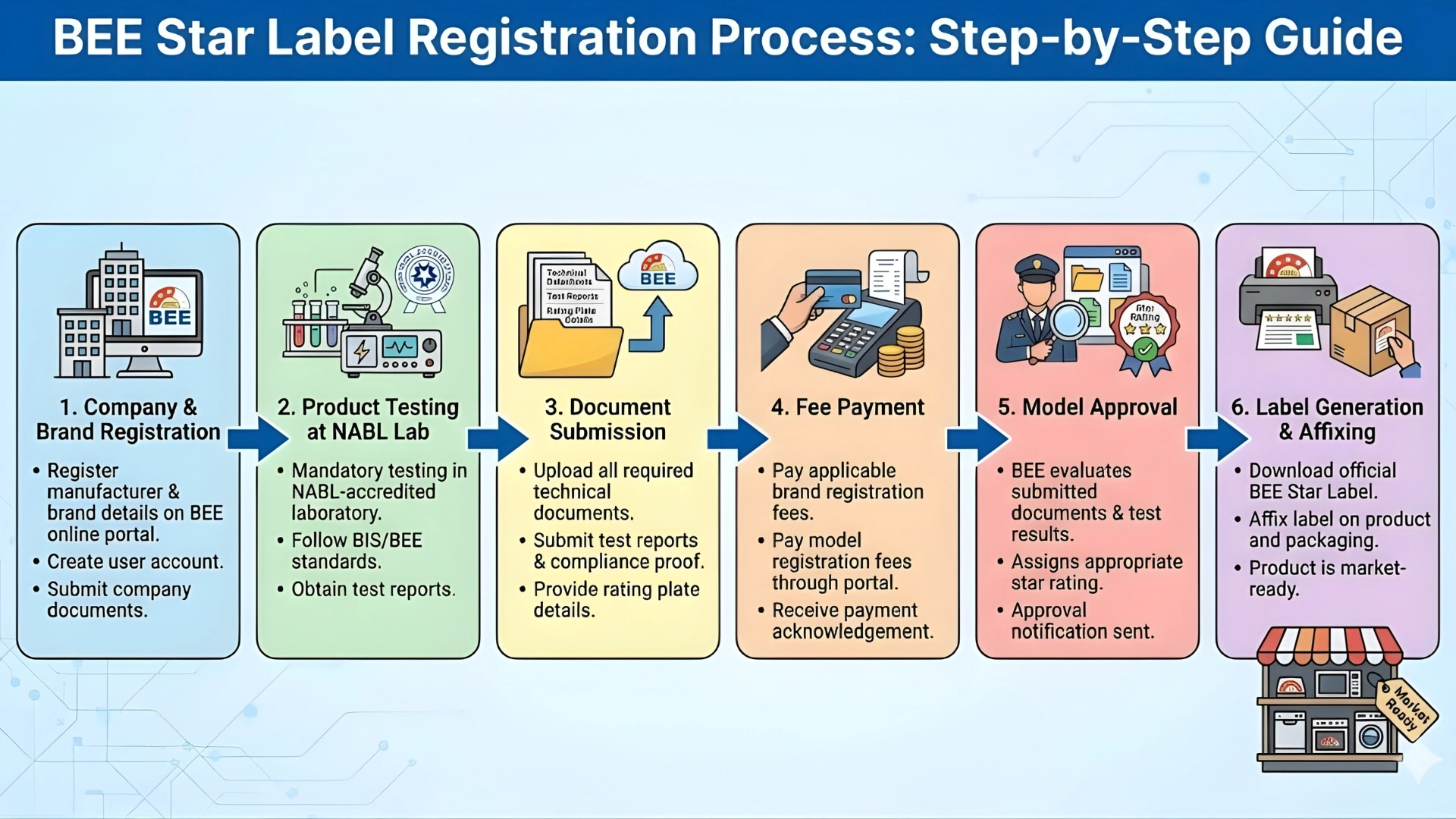
| 1 | Company & Brand Registration | 3–7 working days | Brand registration fee |
| 2 | Product Testing at NABL Lab | 10–25 working days (varies by product) | Lab testing charges |
| 3 | Document Preparation | 2–5 working days | Documentation & compliance support |
| 4 | Model Registration on BEE Portal | 3–7 working days | Model registration fee |
| 5 | BEE Scrutiny & Approval | 10–20 working days | Administrative fee (if applicable) |
| 6 | Label Download & Final Compliance | 1–2 working days | Label generation / printing cost |
| Aspect | Details |
|---|---|
| Validity Period | Star Labels are valid for a fixed duration (usually 1–3 years) based on BEE’s category-specific schedule. |
| Renewal Requirement | Manufacturers must renew the label before the expiry date to continue selling the product. |
| Re-Testing Requirement | Fresh testing may be required if BEE updates performance standards or changes efficiency thresholds. |
| Documents Needed for Renewal | Updated test report (if required), model details, label artwork, and renewal application. |
| Approval Timeline | Renewal approval generally takes less time compared to the initial registration. |
| Compliance Check | BEE may re-verify model performance through market sampling or additional documentation. |
BEE Star Labelling involves technical testing, detailed documentation, and strict compliance checks. Many manufacturers work with experienced consultants to avoid delays and ensure every model meets the Bureau of Energy Efficiency requirements. Silvereye Certifications supports brands with accurate guidance, fast coordination, and complete end-to-end handling of the entire BEE registration workflow.
The BEE Star Rating certification is more than a compliance requirement. It’s a crucial element of product credibility, energy-efficiency performance, and market positioning in India. Whether you manufacture domestic appliances or commercial electronics, aligning with BEE standards ensures smoother approvals, better consumer trust, and stronger long-term sustainability outcomes.
Manufacturers seeking support for testing, documentation, or BEE registration rely on Silvereye Certifications for accurate guidance and seamless execution.
It is an official energy-efficiency rating issued by the Bureau of Energy Efficiency to show how much electricity a product consumes.
Mandatory appliances must carry a BEE label to meet Indian energy-efficiency standards and legally enter the market.
Ratings are based on NABL lab test results compared against BEE’s efficiency benchmarks for each product category.
ACs, refrigerators, LEDs, washing machines, and geysers require mandatory labeling; fans, laptops, and pumps are voluntary.
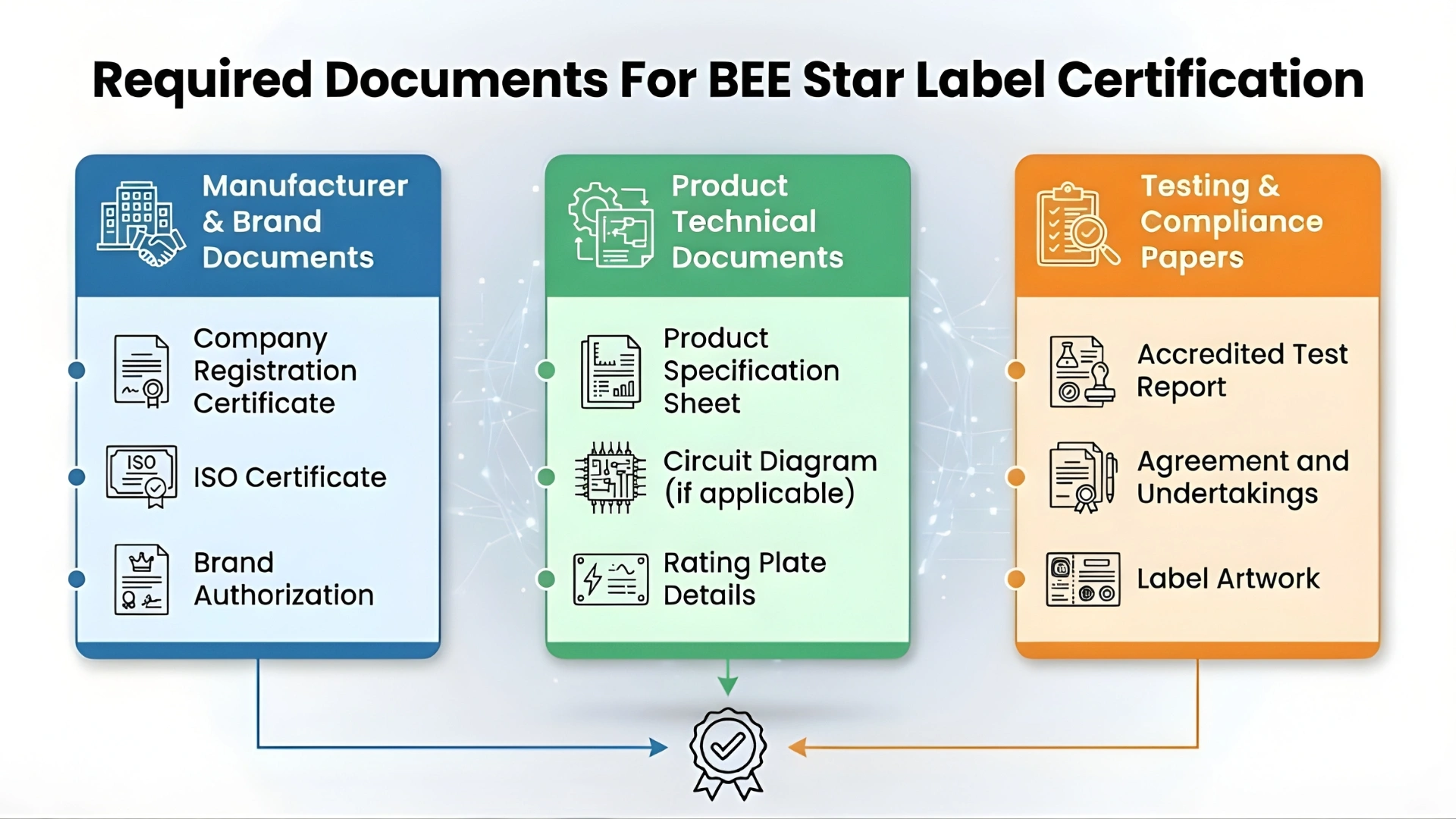
Company details, brand authorization, technical datasheets, test reports, and rating-plate information.
A few weeks, depending on testing duration, document accuracy, and BEE review time.
Costs cover brand registration, model registration, and NABL testing charges; amounts vary by category.
Typically 1–3 years, depending on the product category and BEE’s schedule.
Yes. Any component or performance change requires fresh NABL testing and re-registration.
Silvereye Certifications helps manufacturers with accurate documentation, faster approvals, and full compliance support.