CDSCO Cosmetic License And Registration- Process, Fees, and Validity

CDSCO Cosmetic License is mandatory for manufacturing, importing, or selling notified cosmetics in India.

  • Cosmetic registration in India is regulated by CDSCO under the Drugs & Cosmetics Act, 1940 and Cosmetics Rules, 2020.
  • A cosmetic license is mandatory for manufacturing, importing, distributing, or selling cosmetics in the Indian market.
  • Types of cosmetic registration include Import Registration Certificate (Form COS-2) and Manufacturing Licence (Form COS-8).
  • Cost structure involves government fees (per category/variant), testing charges, document preparation, and consultancy support.
  • Validity: Generally 5 years from the date of issue, requiring timely renewal.

INTRODUCTION

A few years ago, a skincare brand from Pune reached out to Silvereye Certifications with a problem most cosmetic startups face at some point. Their aloe-based moisturiser had strong early demand, but their online marketplace withheld the listing because the product lacked a CDSCO Cosmetic license. The founders were confident about the formulation but were unaware that even herbal-based cosmetics require mandatory registration under India’s regulatory framework.

Their challenge wasn’t unique. Any company placing a cosmetic product on the Indian market—whether imported from Europe or produced in a domestic contract manufacturing facility—must comply with Cosmetic Registration norms prescribed by the Central Drugs Standard Control Organisation. The requirement is not subjective. It applies to new brands, private label units, third-party manufacturers, and large FMCG companies.

During the last decade, Indian consumers have evolved. Retail buyers expect safety transparency, and marketplaces demand compliance before onboarding. As a result, Cosmetic Certification has become as essential as branding or packaging. Without it, import consignments are held at customs, manufacturing approvals are delayed, and distributors hesitate to partner with non-compliant brands.

At Silvereye Certifications, we regularly encounter cases where brands underestimate regulatory details. One manufacturer in Baddi lost nearly eight months because the ingredient list on their product label did not match the formulation submitted for approval. Another client importing premium perfumes saw their consignment seized because the importer’s address on the approval letter didn’t match the customs documentation. These issues sound minor but can stall expansion indefinitely.

This in-depth guide exhibits the full structure of CDSCO Cosmetic Registration in a manner that is friendly to business—addressing issues like compliance, fees, documentation, timelines, and the real-world challenges that both Indian and international brands struggle with.

What Is CDSCO Cosmetic Registration?

The Cosmetics and Drugs Act of 1940 governs the CDSCO's regulation of cosmetics. Every item that belongs to a cosmetic category that has been notified must go through the process of Cosmetic Certification before Indian manufacturing, importing or selling.

CDSCO verifies:
  • Ingredient safety
  • Manufacturing standards
  • Ingredient list used in the product
  • Labeling and packaging compliance
  • Shelf-life data
  • Toxicity parameters
  • Country of origin certification (for imports)

The certification leads to:

  • Form COS-2 Import Registration Certificate (for importers)
  • Manufacturing License under Form COS-8 (for domestic manufacturers)

Types of Cosmetic Registration in India

Depending on whether a product is manufactured in India or imported, one of the following approval routes must be supported by every cosmetic product sold in India:

  • Who needs it?
  • Importers, foreign brands entering India, Indian companies bringing finished products from abroad.

  • Cosmetic Import Registration (Form COS-1 & Form COS-2 Certificate)
  • This applies to imported cosmetics, irrespective of quantity or purpose of sale.

  • Key points: Application filed in Form COS-1 on the SUGAM portal. CDSCO issues the Form COS-2 Cosmetic Registration Certificate.
  • Validity: 5 years.

Domestic Cosmetic Manufacturing License (Form COS-5 & Form COS-8/9)

This registration applies to Indian manufacturers who produce cosmetics within India. (The State Licensing Authority manages this with CDSCO oversight).

  • Types under manufacturing route:
    • Form COS-8 – Manufacturing License (Issued to manufacturers who produce cosmetics in their own facility.)
    • Form COS-9 – Loan License (Issued when a brand uses a third-party manufacturing unit to produce cosmetics.)
  • Who needs it? Private-label manufacturers, contract manufacturers, direct brand-owned factories.
  • Validity: 5 years.

Cosmetic Testing Laboratory Approval (Form 37)

A less-known category but essential for companies running their own testing labs.

Who needs it?

  • Cosmetic manufacturers with in-house labs
  • Third-party testing laboratories
  • R&D labs conducting microbial, stability, or safety testing

Certificate Issued: Form 37

Validity: 3 years

This facility must comply with BIS standards, GMP norms, and maintain equipment calibration logs.

Why A CDSCO Cosmetic License Is Mandatory

  • Regulatory Compliance
    • India’s Drugs & Cosmetics Act requires all notified cosmetic products to be registered. Operating without a valid license can lead to penalties, seizure of stock, and cancellation of business operations.
  • Marketplace & Distributor Approval
    • E-commerce giants, retail chains, and salon networks now insist on Cosmetic Certification as a pre-requisite. Non-compliant brands are delisted immediately.
  • Import Clearance
    • Customs authorities verify the Cosmetic Registration Certificate before permitting any shipment. Without registration, consignments are detained or destroyed.
  • Brand Credibility
    • A CDSCO certificate signals safety, quality, and accountability. This builds long-term consumer trust.

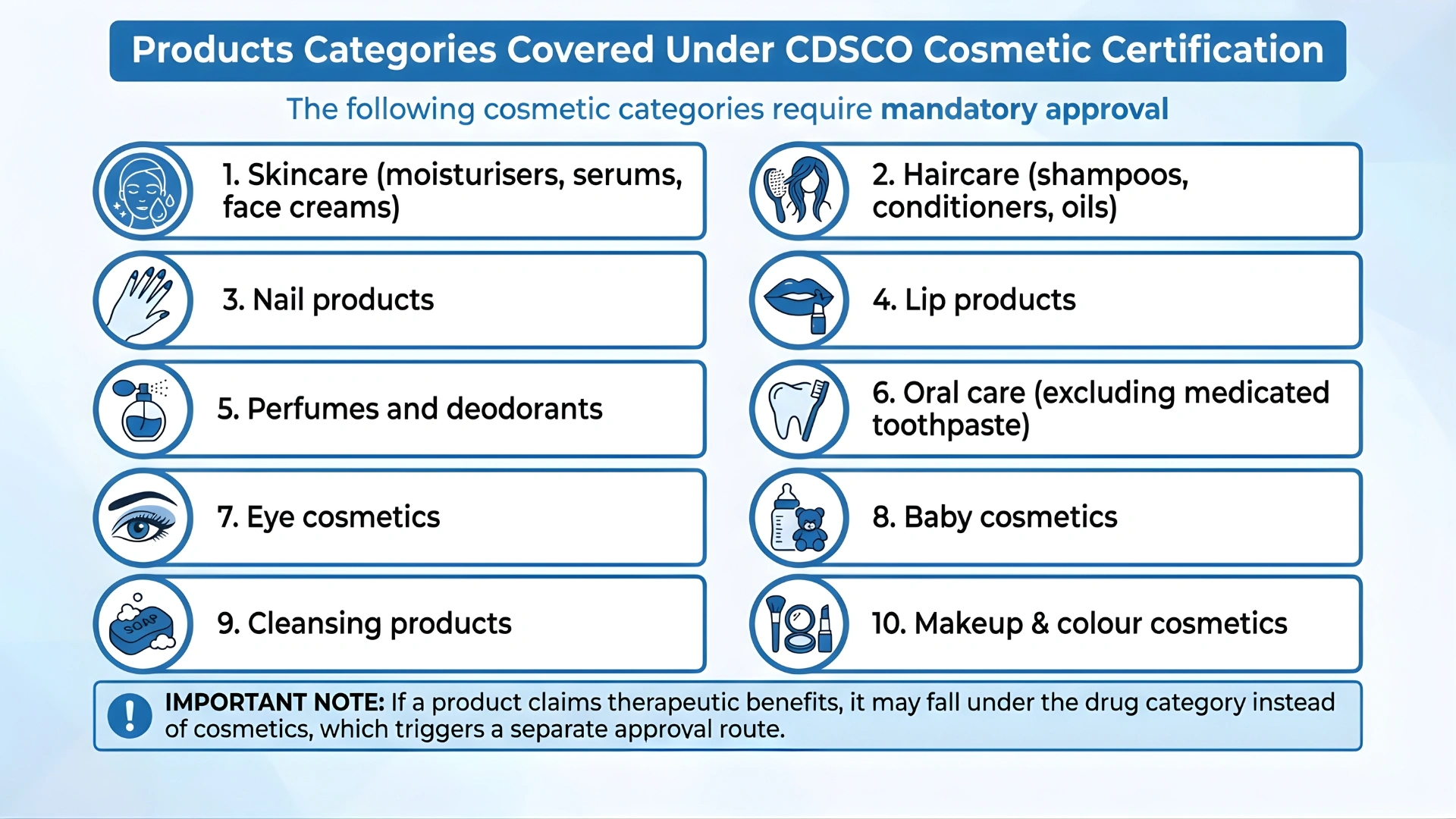
Products Categories Covered Under CDSCO Cosmetic Certification

The following cosmetic categories require mandatory approval:

  • Skincare (moisturisers, serums, face creams)
  • Haircare (shampoos, conditioners, oils)
  • Nail products
  • Lip products
  • Perfumes and deodorants
  • Oral care (excluding medicated toothpaste)
  • Eye cosmetics
  • Baby cosmetics
  • Cleansing products
  • Makeup & colour cosmetics

If a product claims therapeutic benefits, it may fall under the drug category instead of cosmetics, which triggers a separate approval route.

CDSCO Cosmetic Certification Requirements

The CDSCO evaluates each cosmetic product through technical, chemical, and administrative parameters. Businesses must submit:

    Product Ingredient List
  • Ingredient names must follow international terminology. Any banned substance under Schedule S or the BIS standards may lead to rejection.
  • Manufacturing License (for Indian manufacturers)

    Domestic units must obtain either:

  • Form-32 (Finished cosmetics)
  • Form-31 (Loan license)
  • Free Sale Certificate
  • Issued by the regulatory authority of the exporting country.
  • Label Artwork
  • The artwork must show MRP, batch number, manufacturer details, and ingredient declarations.
  • Testing Reports
  • Microbial, stability, and contamination tests from NABL-approved labs.
  • Safety Data Sheets (SDS)
  • Mandatory for products containing fragrance, essential oils, or active components.
  • Product Specification Sheet
  • Details such as appearance, pH value, viscosity, and packaging specifications.
  • Undertaking on Non-Use of Animal Testing
  • Required for certain categories.
  • Ingredient Concentration Proof
  • CDSCO often asks for justification when active ingredients exceed common usage limits.
  • Good Manufacturing Practices (GMP)
  • Indian manufacturers must follow BIS 14649 or ISO 22716.

Benefits of Cosmetic Registration in India

The CDSCO registration offers the brands the right to manufacture, import, and sell the cosmetics in India officially. Besides that, it also protects the products from seizure, blockage at customs, and the imposition of fines.

    Speedy Import & Clearance at Customs
  • The registered cosmetics are facilitated through customs without any delay and they do not incur demurrage charges or undergo document scrutiny.
  • Obligatory for E-Commerce Listings
  • Online platforms such as Amazon, Nykaa, Flipkart, Purplle, and big retail chains insist on the approval of CDSCO before including any beauty product in their list.
  • Increases Consumer Confidence & Brand Trust
  • CDSCO approval confirms the safety of the product to the customers which is mainly very crucial in case of skincare, hair care, baby cosmetics, and personal care products.
  • Business Risks are Minimized
  • The registration can help in getting rid of penalties, import rejections, product recalls, and disputes with distributors or retailers.
  • Opens Up Distributor, Salon & Retail Partnerships
  • The distributors, salons, and professional chains are more inclined towards certified brands which in turn makes it easier for market entry and negotiations.
  • The Global Quality Standards are Matched
  • The CDSCO guarantees the compliance with the BIS, use of safe ingredients, and GMP practices, thus helping the brands to be at par with the international standards and to expand globally.
  • Counterfeit Protection
  • The registered goods possess the official documentation which assists the brands in legally fighting against counterfeit and similar products.
  • Easy Nationwide Expansion
  • After getting registered, the cosmetics can be marketed all over India without the state-level regulatory obstacles.
  • Increased Confidence Among the Investors & Buyers
  • When a brand complies with the regulation, its valuation is increased, and it is therefore more trusted by the investors, distributors, as well as large retail buyers.
  • Increased Confidence Among the Investors & Buyers
  • When a brand complies with the regulation, its valuation is increased, and it is therefore more trusted by the investors, distributors, as well as large retail buyers.
  • Guarantees Product Safety for the Long Term
  • The testing done for the product will be mandatory and will guarantee the product's stability and safety during its shelf life reducing the cases of customer complaints and returns.
  • Constructs a Professional and Compliant Brand Image
  • Getting certifications helps brands to be noticed and to get the attention of retailers, dermatologists, influencers, and salon partners.

What are the Cosmetic Regulations for Cosmetic License in India?

Cosmetics in India are regulated to ensure product safety, quality, and compliance. The key regulations include:

    Drugs & Cosmetics Act, 1940
  • Defines cosmetic standards, safety requirements, and legal compliance rules.
  • Drugs & Cosmetics Rules, 1945
  • Covers licensing procedures, manufacturing requirements (Form 32/33), and import registration (Form 42/43).
  • Cosmetics Rules, 2020
  • The latest regulation outlining mandatory cosmetic registration, ingredient safety, testing, labeling norms, and restrictions on harmful substances.
  • BIS Standards
  • Certain cosmetics must comply with BIS specifications for ingredient purity, labeling, and product safety (e.g., IS 4707, IS 6608).
  • CDSCO as Regulator
  • The Central Drugs Standard Control Organisation oversees all cosmetic licensing, registration, and approvals.
  • Mandatory Testing
  • Microbial, heavy metal, stability, and safety testing required before approval.
  • Labeling Requirements
  • Every cosmetic must include product name, ingredients, batch number, MRP, dates, warnings, and manufacturer/importer details.
  • GMP Compliance
  • Manufacturers must follow Schedule M-II Good Manufacturing Practices to ensure hygienic and controlled production.

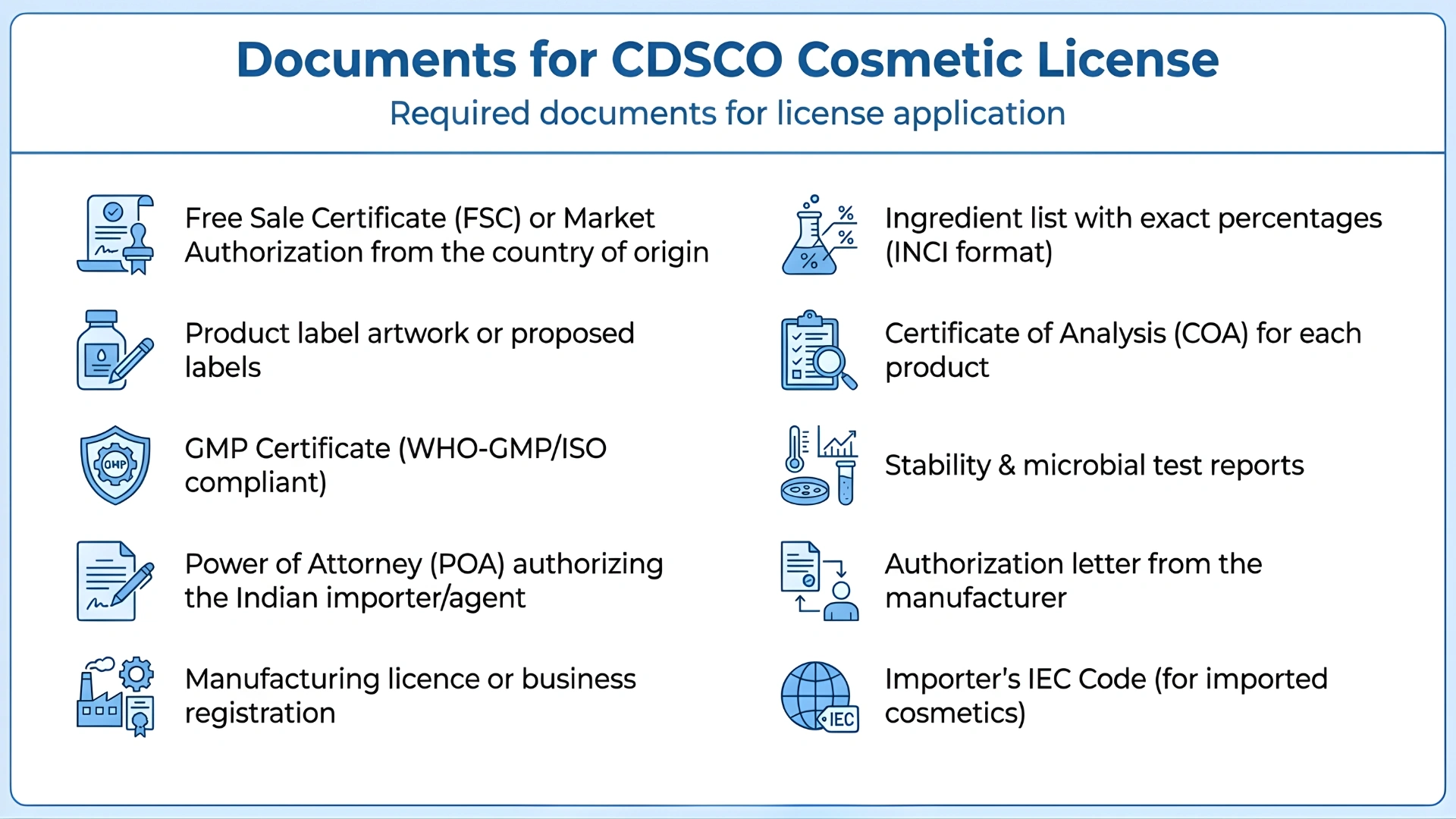
Documents for CDSCO Cosmetic License

  • Free Sale Certificate (FSC) or Market Authorization from the country of origin
  • Ingredient list with exact percentages (INCI format)
  • Product label artwork or proposed labels
  • Certificate of Analysis (COA) for each product
  • GMP Certificate (WHO-GMP/ISO complaints
  • Stability & microbial test reports
  • Power of Attorney (POA) authorizing the Indian importer/agent
  • Authorization letter from the manufacturer
  • Manufacturing licence or business registration
  • Importer’s IEC Code (for imported cosmetics)

Step-By-Step Process For Cosmetic Registration Under CDSCO

The following process summarises how Silvereye Certifications assists manufacturers and importers:

    Step 1 — Product Classification & Regulatory Mapping
  • Before filing, experts examine whether the product qualifies as a cosmetic and whether ingredients comply with the BIS standards. Misclassification leads to rejection.
  • Step 2 — Dossier Preparation
  • A technical file is created containing:
    • Ingredient sheets
    • Toxicology data
    • Manufacturing flowcharts
    • Labels
    • Artwork
    • Packaging details

Brands often underestimate this stage. A single discrepancy between the finished label and the submitted dossier delays approval.

    Step 3 — Portal Registration
  • Businesses create an account on CDSCO’s SUGAM portal. Importers must upload authorised signatory details and Power of Attorney documents.
    Step 4 — Submission of Form COS-1 (Import) or Form COS-5 (Manufacturing Application)
  • Each product requires a separate entry. If a lipstick comes in 12 shades but shares one formulation, it is treated as one product family.
    Step 5 — Scrutiny by CDSCO Officials
  • The authority may raise queries such as:
    • Clarification on ingredient concentration
    • Label corrections
    • Additional stability test reports
    • Manufacturer accountability proof

Brands must respond promptly.

    Step 6 — Grant of Cosmetic Registration Certificate
  • Once approved, importers receive a Form COS-2 certificate valid for 5 years.
  • Manufacturers receive Form COS-8 (manufacturing license).
    Step 7 — Post-Approval Compliance

    This includes:

  • Label updates for new batches
  • Change-of-address notifications
  • New shade approvals
  • Renewal submissions

Requirements for Cosmetic Licence in India

  • A legally registered business (manufacturer or importer).
  • Valid GMP certificate (for manufacturers) as per Schedule M-II.
  • Free Sale Certificate (FSC) or authorization from the country of origin (for imports).
  • Complete ingredient list with percentages and compliance to IS 4707 & Cosmetics Rules, 2020.
  • Label artwork meeting CDSCO and Legal Metrology requirements.
  • Certificate of Analysis (COA) and safety test reports (stability, microbial, heavy metals).
  • Power of Attorney (POA) authorizing the Indian agent/importer (for foreign brands).
  • Premises meeting hygiene, quality control, and storage standards (for manufacturing units).

Eligibility Criteria for Cosmetic Licence in India

  • The applicant must be a manufacturer, authorized importer, or Indian representative of the foreign brand.
  • Must have a licensed manufacturing facility or valid Import Export Code (IEC) for imported cosmetics.
  • Products must comply with Cosmetics Rules, 2020, including safety, labeling, and ingredient restrictions.
  • No banned substances (Schedule S & Schedule Q) should be present in the formulation.
  • The applicant must have qualified technical staff for manufacturing operations (for Form 32/33).
  • All documents must be complete, accurate, and issued by the rightful authority.

CDSCO Cosmetic License Fees In INDIA

Cost Component Description
Government Application Fee Charged per product category for import or manufacturing licence as per CDSCO rules.
Registration Processing Fee Covers file submission, documentation review, and portal processing.
Testing Charges Includes microbial, stability, heavy metal, and safety analysis required for approval.
Document Preparation Cost Drafting of POA, label compliance, COA alignment, and formulation review.
Consultancy Fee Professional support for end-to-end compliance, query handling, and approval follow-up.
Renewal & Modification Charges Applicable for changes in formulation, label updates, or licence extension.

Timeline, Validity and Renewal For CDSCO Cosmetic Approval

Cosmetic License Timeline

Stage Description
Document Preparation Collecting FSC, COA, labels, ingredient list, POA, and testing reports.
Application Submission Filing the application on the CDSCO Sugam portal.
Technical Review by CDSCO Authority checks documents, formulation compliance, and labels.
Query/Clarification Stage Applicant responds to CDSCO objections, if any.
Final Approval Grant of Cosmetic Registration Certificate (Import or Manufacturing).

Cosmetic License Timeline

License Type Validity Period
Import Registration Certificate (COS 1) Valid for several years unless suspended or cancelled by CDSCO.
Manufacturing License (Form 32/33) Long-term validity based on compliance with Cosmetics Rules, 2020.

Cosmetic License Renewal

Renewal Aspect Description
Renewal Timeline Renewal should be initiated before expiry to avoid market disruption.
Documents Needed Updated labels, COA, manufacturing details, and any changes in formulation or packaging.
Additional Requirements Fresh testing or revised FSC may be required in case of reformulation or regulatory updates.
CDSCO Review Authority evaluates changes and issues renewed licence upon compliance.

Labelling Rules Under CDSCO

Cosmetic products must display:

  • Name of the cosmetic
  • Manufacturer or importer details
  • Batch number
  • Net contents
  • Month & year of manufacture
  • Expiry
  • Ingredient list
  • Category of cosmetic
  • Warning labels (if applicable)

Why Choose Silvereye Certifications for Cosmetic Licence?

  • Specialised in CDSCO regulations with strong experience in cosmetic import and manufacturing approvals.
  • Accurate documentation support for FSC, COA, labels, ingredients, and POA—minimising CDSCO objections.
  • Faster approval timelines through direct coordination and continuous follow-up with the authority.
  • End-to-end service, from product evaluation and testing guidance to final licence approval.
  • Trusted by cosmetic brands, private-label manufacturers, salons, and distributors across India.

Conclusion

Many brands do not realize the complexity of the process of CDSCO Cosmetic Registration until they face delays, confiscation by customs, or rejections from the market. Regardless of the fact that you are producing your cosmetics in India or importing them from other parts of the world, a valid CDSCO Cosmetic License would mean that your product is fit for the Indian market and also allows nationwide distribution. Compliance is the only option left as regulatory scrutiny gets tighter.

Silvereye Certifications is the partner for businesses in India that want to eliminate their documentation, testing, and approvals with the highest precision possible.

Ready to launch your cosmetic range without regulatory risk?

FAQ's on CDSCO Cosmetic License

A CDSCO Cosmetic License is the official approval required to manufacture, import, or sell cosmetics in India. It confirms that the product meets safety, labeling, and quality standards under the Cosmetics Rules, 2020.
Any manufacturer, importer, distributor, or brand owner selling cosmetic products in India must obtain a CDSCO licence—whether the products are made locally or imported.

Yes. All imported cosmetics require a CDSCO Import Registration Certificate (Form 43) before entering India. Without it, customs can detain or reject the shipment.

The essential documents include:

  • Free Sale Certificate (FSC)
  • Certificate of Analysis (COA)
  • Ingredient list with percentages
  • Label artwork
  • GMP certificate
  • Stability and microbial test reports
  • Power of Attorney (for foreign brands)

Timelines vary based on document readiness and CDSCO review. Delays mostly occur due to incorrect labels or incomplete ingredient details.

Products must comply with:

  • Ingredient restrictions (Schedule S & Q)
  • Microbial and heavy metal limits
  • BIS standards
  • Mandatory labeling and GMP guidelines

CDSCO cosmetic licences usually carry multi-year validity, subject to ongoing compliance. Renewal must be initiated before expiry to avoid disruption.

Yes, but any change in ingredients, packaging, or labels must be updated with CDSCO. Some changes may require fresh testing or revised documents.

Unregistered products may face:

  • Customs seizure
  • Market ban
  • Penalties and legal action
  • Delisting from e-commerce platforms

Silvereye supports ingredient evaluation, label drafting, testing guidance, documentation, portal filing, and continuous follow-up—ensuring faster, error-free approval.