


No. MSME Registration is not legally mandatory, but it is highly beneficial for loans, tenders, and government schemes.
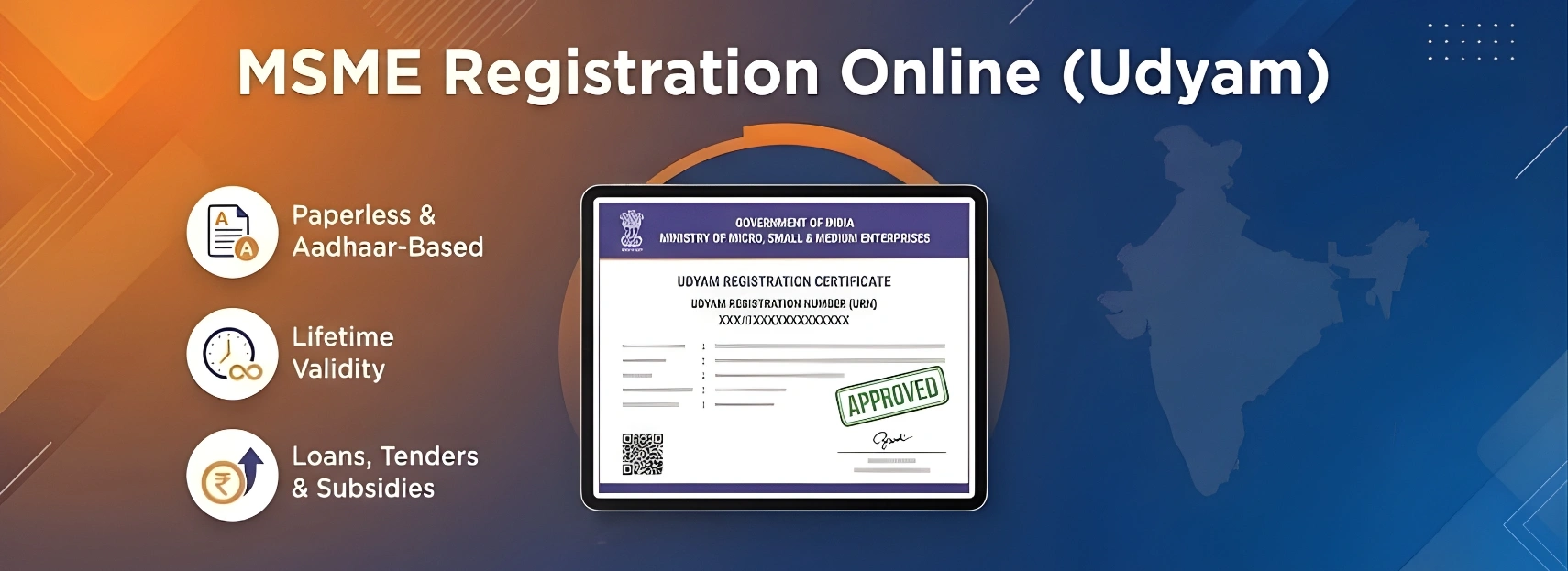
In India, thousands of genuine small businesses operate without realizing that MSME Registration is not just a government formality—it is a strategic business advantage.
Whether you are applying for a bank loan, bidding for a government tender, onboarding with large corporations, or simply trying to build credibility, having an official Udyam Certificate can quietly change how institutions perceive your business.
Introduced and governed by the Ministry of Micro, Small and Medium Enterprises, MSME / Udyam Registration is the government’s way of formally recognising micro, small, and medium enterprises through a fully online, paperless system.
MSME Registration is the official process through which a business in India is recognised as a Micro, Small, or Medium Enterprise by the Government of India.
This registration is carried out under the Udyam Registration system and results in the issuance of an MSME Certificate, also known as the Udyam Certificate.
MSME registration acts as a formal identity for small businesses, allowing government departments, banks, and financial institutions to verify that an enterprise falls within the MSME framework.
Once registered, the business receives a unique Udyam Registration Number (URN), which is used across loans, tenders, subsidies, and compliance portals.
MSME registration is governed and administered by the Ministry of Micro, Small and Medium Enterprises, under the MSME Development Act.
To simplify and standardise business recognition, the government introduced the Udyam Registration portal, replacing older systems. This ensures that:
From a compliance standpoint, Udyam Registration is now the only valid MSME registration recognised by central and state authorities.
Before July 2020, MSMEs were registered under Udyog Aadhaar. That system has now been discontinued and replaced by Udyam Registration, which is more structured and verifiable.
| Parameter | Udyog Aadhaar | Udyam Registration |
|---|---|---|
| Current status | Discontinued | Active & mandatory |
| Verification | Self-declared | PAN & GST linked |
| Data accuracy | Limited | Government-validated |
| Certificate use | Informal | Legally recognised |
Businesses with Udyog Aadhaar must migrate to Udyam Registration.
MSME registration directly impacts how a business is treated by banks, government buyers, and large corporations.
From our experience working with small manufacturers, service providers, and startups, an MSME Certificate helps businesses:
While MSME registration is not legally mandatory, it has become strategically essential for businesses that want structured growth, easier financing, and long-term credibility in the Indian market.
One of the most common misconceptions we hear from business owners is that MSME / Udyam Registration is meant only for factories or traditional manufacturing units.
In reality, the eligibility net is far wider. The government has deliberately designed the system to include almost every form of small and growing business operating in India.
MSME / Udyam Registration is entity-neutral, meaning it focuses on business size and activity—not legal structure. The following entity types are eligible to apply:
As long as the enterprise meets the prescribed investment and turnover limits, it can successfully register MSME online and obtain an MSME Certificate.
Yes, absolutely.
Individual entrepreneurs, freelancers, and early-stage startups are fully eligible for Udyam Registration, even if they are:
We regularly assist first-time founders who assume MSME registration is only relevant after scaling. In reality, registering early helps startups:
If you are running a genuine business activity and expect to grow, applying for an MSME Certificate at an early stage is a strategic move, not a premature one.
Another frequent point of confusion is the role of GST in MSME online registration.
Here’s the practical rule:
If GST is applicable to your business, the Udyam Registration portal will automatically fetch turnover details from the GST database. If GST is not applicable, the system relies on PAN-linked income data.
When business owners ask us whether they are eligible for MSME registration, the real concern is usually not the paperwork—it’s whether their turnover, investment, or business activity fits within the government’s definition of an MSME.
The good news is that the Udyam Registration framework has been deliberately simplified. Eligibility is now determined using objective, data-backed criteria, reducing ambiguity and discretionary interpretation.
Under the current Udyam framework, enterprises are classified solely on the basis of investment in plant & machinery or equipment and annual turnover.
| Enterprise Category | Investment Limit | Turnover Limit |
|---|---|---|
| Micro Enterprise | Up to ₹1 crore | Up to ₹5 crore |
| Small Enterprise | Up to ₹10 crore | Up to ₹50 crore |
| Medium Enterprise | Up to ₹50 crore | Up to ₹250 crore |
A business must satisfy both conditions (investment and turnover) to fall within a specific category.
One of the reasons MSME Registration has seen widespread adoption is because the government intentionally removed paperwork, physical verification, and discretionary approvals from the process.
Today, Udyam Registration is entirely system-driven, relying on existing government databases rather than uploaded documents.
At the core of MSME registration is identity authentication. The following digital elements are mandatory:
Aadhaar-based OTP verification ensures that the person applying is authorised to represent the enterprise. PAN linkage allows the system to validate business income and investment data automatically.
During the MSME online registration process, applicants must accurately provide the following business details:
A key feature of Udyam Registration is that no documents are uploaded at the time of application. Instead, the portal auto-verifies data through:
Business owners often ask a very direct question: “What do I actually gain after MSME Registration?”
The MSME Certificate (Udyam Certificate) is not symbolic. It is a functional business advantage that influences financing, procurement, risk perception, and long-term growth.
One of the most tangible benefits of holding an MSME Certificate is improved access to finance.
Banks and NBFCs are mandated to treat MSMEs under priority sector lending, which translates into:
Many MSME-registered businesses also qualify for:
An MSME Certificate acts as a gateway to multiple central and state government schemes notified from time to time by the Ministry of Micro, Small and Medium Enterprises.
For businesses dealing with government departments, PSUs, or large corporations, MSME registration has direct commercial value.
Once a business successfully completes MSME Registration through the Udyam portal, it is issued a unique identification number. This number is not a reference code or acknowledgement—it is the official identity of your enterprise within the MSME ecosystem.
The MSME Registration Number, formally called the Udyam Registration Number (URN), is a 19-digit alphanumeric code generated after successful submission and verification of the application.
The URN:
It is routinely required for:
While MSME / Udyam Registration is not legally mandatory for every business, in practice, there are clear situations where operating without an MSME Certificate puts a business at a measurable disadvantage.
Based on years of advising small and mid-sized enterprises, the following categories of businesses should strongly consider Udyam Registration.
If your business falls into any of the categories below, MSME registration is not just beneficial—it is often expected by counterparties:
To put this into real-world context, MSME registration plays a decisive role in situations such as:
The MSME Registration (Udyam Registration) process is fully online, paperless, and Aadhaar-based. When filed correctly, businesses can complete MSME online registration and receive the Udyam Certificate quickly without physical documentation.
The MSME / Udyam Registration process is designed to be fast and affordable, especially for small businesses and startups.
| Cost Component | Charges |
|---|---|
| Government Fee | ₹0 (Free of cost) |
| MSME Registration Portal Charges | Nil |
| Professional / Consultant Fees | Varies (based on support & advisory) |
| Modification / Update (via consultant) | Depends on changes required |
The MSME (Udyam) Certificate does not follow a traditional renewal model. Instead, it is linked to dynamic business data and remains valid as long as information is kept up to date. The table below explains validity, renewal, and update requirements clearly.
| Aspect | Details |
|---|---|
| Validity of MSME Certificate | Lifetime validity |
| Renewal Requirement | No renewal required |
| Annual Filing Obligation | Not applicable |
| Classification Review | Automatic, based on PAN/GST data |
| Authority Governing Validity | Ministry of Micro, Small and Medium Enterprises |
| Certificate Expiry Date | Not applicable |
| Re-registration Requirement | Not required |
| Situation | Action Required |
|---|---|
| Change in turnover or investment | Auto-updated via tax data |
| Change in business activity (NIC) | Manual update required |
| Change in business address or contact details | Manual modification |
| Conversion of entity (e.g., Proprietorship to Pvt. Ltd.) | Fresh registration or update |
| Closure of business | Surrender / cancellation |
After submitting your MSME / Udyam Registration application, checking the status is a straightforward online process. The system is designed to be transparent and self-service, allowing business owners to track progress without intermediaries.
The status reflects real-time data validated by systems under the Ministry of Micro, Small and Medium Enterprises.
During status checks, you may see one of the following:
Most rejections occur due to incorrect PAN linkage or mismatched turnover details. These can usually be corrected through modification or re-submission.
Once your MSME / Udyam Registration is approved, the MSME Certificate (Udyam Certificate) is issued digitally. There is no physical copy; the certificate is generated online and can be downloaded anytime using your registered credentials.
The certificate remains available for download at all times and can be retrieved multiple times without restriction.
Completing MSME / Udyam Registration may look simple on the surface, but in practice, small errors at the filing stage often create long-term issues—especially during loan applications, tender verification, or vendor due diligence. This is where professional handling makes a measurable difference.
Our End-to-End filing process — What we handle for you
This reduces the risk of future rejection, reclassification, or verification delays by banks and authorities.
MSME Registration is more than a compliance step—it is a business enabler. A valid Udyam Registration and MSME Certificate strengthen your credibility, improve access to finance, unlock government benefits, and make your business eligible for tenders and institutional opportunities. When done correctly, it becomes a long-term asset that supports growth at every stage.
At Silvereye Certifications, we focus on getting your MSME online registration right the first time—accurate classification, error-free filing, and continued support as your business evolves. If you’re planning to register MSME online or need help with updates, downloads, or verification, our team is here to guide you with clarity and confidence.
No. MSME Registration is not legally mandatory, but it is highly beneficial for loans, tenders, and government schemes.
Yes. Udyam Registration is the official name for MSME Registration issued by the Government of India.
No. MSME / Udyam Registration is completely free of cost at the government level.
In most cases, MSME Registration is completed instantly or within a few hours if details are correct.
Yes. GST is required only if it is applicable to your business under GST law.
Only Aadhaar, PAN, and GSTIN (if applicable) are required. No document uploads are needed.
The MSME (Udyam) Certificate has lifetime validity and does not require renewal.
Yes. Business details like activity, address, or investment can be updated on the Udyam portal.
You can download it online using your Udyam Registration Number (URN) or Aadhaar via the official portal.
The MSME Certificate is issued by the Ministry of Micro, Small and Medium Enterprises through the Udyam Registration system.