
IEC Certificate Registration in India – Process, Documents, Cost & Benefits

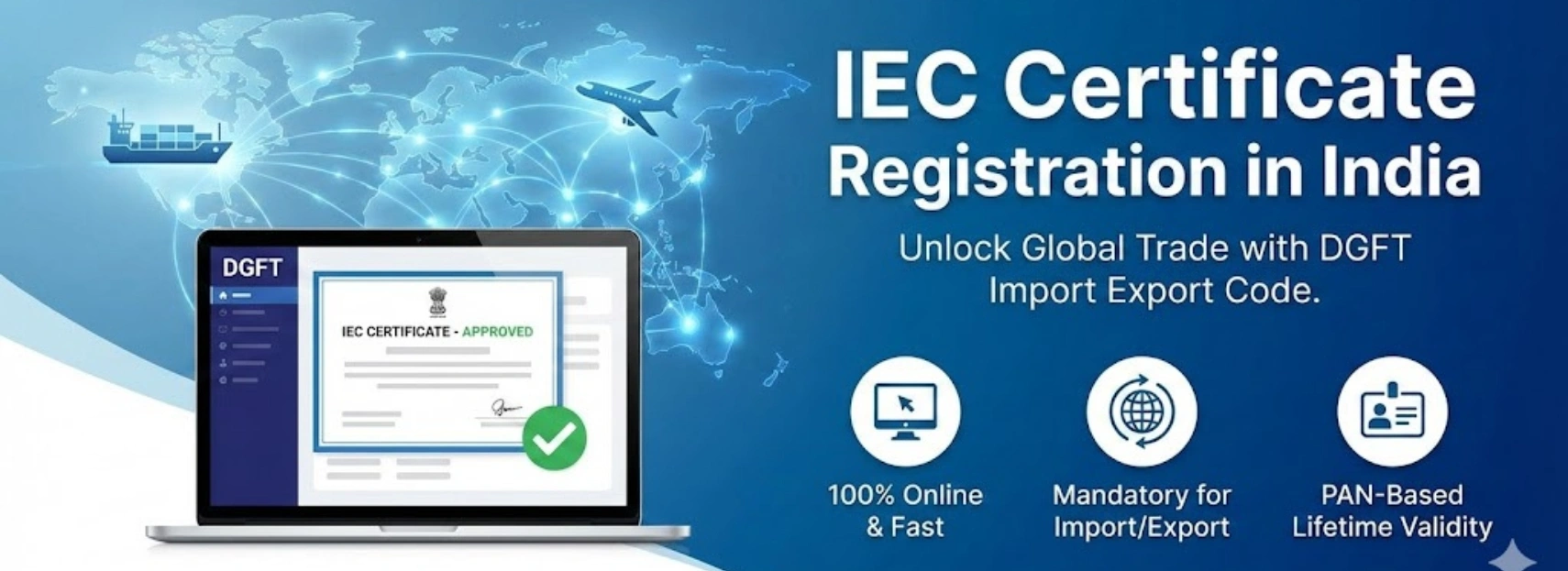
  • IEC Certificate is mandatory to legally import or export goods and services from India.
  • Issued by the Directorate General of Foreign Trade (DGFT), the Import Export Code Certificate enables customs clearance and foreign remittances.
  • IEC Code Registration to clear customs, receive foreign payments, and access government export schemes
  • Import Export Code Certificate application process, eligibility, documents, costs, and compliance requirements under the Directorate General of Foreign Trade regulations.

Introduction

A first-time exporter from Surat once came to us after his shipment was stuck at the port. The goods were ready, the buyer had paid an advance, but customs would not clear the consignment. The reason was simple and common—no IEC Certificate.

The IEC Certificate, also known as the Importer Exporter Code Registration, is the identity of your business in India’s foreign trade ecosystem.

What is an IEC Certificate?

An IEC Certificate is the official authorization that allows an Indian business or individual to legally import goods into India or export goods or services from India. Issued by the Directorate General of Foreign Trade (DGFT), it assigns a 10-digit Import Export Code (IEC).

The DGFT IEC Certificate functions as the legal and operational foundation for customs clearance, foreign remittances, and export incentives.

Is IEC Mandatory for Import & Export Business?

Yes, IEC is mandatory for import and export business in India. Without a valid DGFT IEC Certificate, customs systems and banks will not process trade-related activities.

What is the IEC Code?

The IEC Code is a unique 10-digit identification number issued by the Directorate General of Foreign Trade (DGFT). It serves as the primary trade identity of a business.

Structure of IEC Code (10-Digit PAN Based Code)

  • 10 digits
  • PAN-linked structure
  • Unique to one legal entity
  • Lifetime validity

Difference Between IEC Code and IEC Certificate

  • IEC Code refers to the numeric identifier itself
  • IEC Certificate is the official DGFT-issued document confirming the allotment

Why is an IEC Certificate Required?

An IEC Certificate is the legal and operational foundation for international trade in India. Issued by the Directorate General of Foreign Trade (DGFT), it connects customs, banking, and trade systems.

IEC Requirement for Import of Goods

  • File and process the Bill of Entry
  • Verify the legal identity of the importer
  • Track compliance with import regulations and duties

Role of IEC in Customs Clearance

  • Links shipments to registered importers/exporters
  • Monitors trade volumes and compliance history
  • Enables system-based clearance

Benefits of IEC Certificate Registration

  • Mandatory for import & export
  • Lifetime validity
  • Smooth customs clearance
  • Foreign remittance support
  • Access to export incentives
  • Builds global credibility
  • Low cost, high value compliance

Eligibility Criteria for Import Export Code Registration

Eligibility for Individuals

  • Indian resident
  • Valid PAN
  • Active bank account
  • Engaged in import/export of goods or services
  • One IEC per individual

Eligibility for Businesses

  • Proprietorship firms
  • Partnership firms
  • LLPs
  • Private & Public Limited Companies
  • Trusts, Societies & NGOs

Eligibility conditions for businesses:

  • Valid PAN
  • Active bank account
  • One IEC per legal entity

Required Documents for Import Export Registration

  • PAN Card
  • Cancelled Cheque or Bank Certificate
  • Identity Proof of Applicant / Authorized Signatory
  • Address Proof
  • Email ID & Mobile Number

Step-by-Step Process for IEC Certificate Registration

The IEC (Import Export Code) Certificate is issued through a fully online process by the Directorate General of Foreign Trade (DGFT). When documents are correct, the process is straightforward and time-efficient.

Step 1: Access the DGFT Portal

Visit the official DGFT portal and create a user account using a valid email ID and mobile number linked with Aadhaar.

Step 2: Log in and Select IEC Services

After login, choose the option for Import Export Code (IEC) Registration under the DGFT services section.

Step 3: Fill the IEC Application Form (ANF-2A)

Enter applicant details such as:

  • Name and PAN of individual or entity
  • Business address and contact details
  • Nature of business (import/export of goods or services)

Ensure all details match PAN and official records.

Step 4: Upload Required Documents

Upload scanned copies of mandatory documents, including:

  • PAN Card
  • Cancelled cheque or bank certificate
  • Identity and address proof

Incorrect or unclear documents may delay approval.

Step 5: Complete Digital Verification

Verify the application using:

  • Aadhaar-based OTP or
  • Digital Signature Certificate (DSC) (commonly for companies/LLPs)

Step 6: Pay Government Fees

Pay the prescribed DGFT government fee online through net banking, UPI, or card.

Step 7: Application Review by DGFT

DGFT verifies the submitted details and documents. If everything is accurate, approval is granted without further queries.

Step 8: Issuance of IEC Certificate

IEC (Import Export Code) Certificate is issued electronically.

Timeline and Cost for IEC Certificate

Particular Official Details
Government Fee for IEC Registration ₹500 (one-time)
Fee Prescribed By Directorate General of Foreign Trade (DGFT)
Nature of Fee Mandatory government charge
Processing Time (Normal Cases) 1–3 working days
Processing Time (If Documents Are Correct) Often within 24 hours
Validity After Issuance Lifetime
Renewal Requirement Not required (only annual update, if applicable)

Validity and Renewal for IEC Registration

Particular Details
Validity of IEC Certificate Lifetime validity
Issuing Authority Directorate General of Foreign Trade (DGFT)
Renewal Requirement No renewal required
Annual IEC Update Mandatory confirmation/update on DGFT portal
Update Frequency At least once every financial year
Government Fee for Update Nil (as per current DGFT norms)
Consequence of Non-Update IEC may be deactivated
Reactivation of IEC Possible after updating details on DGFT portal

IEC Modification, Update & Surrender

The IEC Certificate is issued with lifetime validity, but businesses are required to keep their IEC details accurate and up to date.

The Directorate General of Foreign Trade (DGFT) provides a fully online mechanism for IEC modification, annual update, and surrender to ensure continued compliance.

IEC Modification

IEC modification is required whenever there is a change in business or personal details linked to the IEC.

Common modifications allowed under IEC:

  • Change in business address
  • Update of bank account details
  • Change in director / partner / authorised signatory
  • Change in contact details (email, mobile number)

Key points:

  • Modification is done online through the DGFT portal
  • Updated details become effective after DGFT verification

IEC Update (Annual Compliance Requirement)

DGFT mandates annual IEC update or confirmation, even if no changes have occurred.

Important aspects of IEC update:

  • Must be completed at least once every financial year
  • Confirms that existing IEC details are accurate
  • Failure to update may lead to temporary deactivation of IEC

This requirement ensures that only active and compliant entities remain part of India’s foreign trade system.

IEC Surrender (Cancellation of IEC)

IEC surrender is applicable when a business permanently discontinues import-export activities.

When IEC surrender is required:

  • Business closure or winding up
  • Permanent cessation of import/export operations
  • Entity no longer engaged in international trade

Process highlights:

  • Surrender request is submitted online on the DGFT portal
  • Once approved, the IEC becomes inactive and non-usable
  • A surrendered IEC cannot be used for future trade transactions

Common Reasons for IEC Application Rejection

Despite a simple process, errors can lead to rejection.

Rejection Reason Description
PAN Mismatch Name or details in the application do not match PAN records
Aadhaar Verification Failure Aadhaar OTP not completed or details not linked correctly
Incorrect Bank Details Bank account not in applicant’s name or mismatch in IFSC/account number
Invalid / Unclear Documents Blurred uploads, wrong document format, or missing mandatory documents
Address Discrepancies Address does not match PAN or bank records
Wrong Entity Type Selected Individual, proprietorship, or company category selected incorrectly
DSC Issues (Companies/LLPs) Digital Signature not valid or not linked to authorised signatory
Incomplete Application Mandatory fields left blank or incorrectly filled
Duplicate IEC Attempt Applying for a second IEC for the same PAN
System Validation Errors Technical mismatch during DGFT portal verification

Why Choose Us for IEC Certificate Registration?

  • DGFT compliance expertise
    Experienced handling of IEC Registration as per latest DGFT guidelines and system validations.
  • End-to-end online process
    Complete assistance from document review to IEC Certificate issuance, with minimal client effort.
  • Error-free application filing
    Focus on accuracy to avoid rejections due to PAN, bank, or address mismatches.
  • Fast turnaround time
    Streamlined process to ensure quick approval of the Import Export Code Certificate.
  • Transparent pricing
    Clear fee structure with no hidden charges.
  • Post-registration support
    Assistance with IEC updates, modifications, and DGFT compliance after issuance.

Conclusion

The IEC Certificate is more than a regulatory requirement—it is the foundation of India’s import-export ecosystem. Whether you are a startup exporter, an established importer, or a service provider going global, a valid DGFT IEC Certificate ensures legitimacy, smooth operations, and access to global markets.

If you want your Import Export Code Registration completed accurately and without delays, professional guidance can save time and prevent costly mistakes. With the right support, your international trade journey starts on a compliant and confident note.

Frequently Asked Questions (FAQs)

An IEC Certificate is a legal authorization issued by the Directorate General of Foreign Trade (DGFT) that allows an individual or business to import goods into India or export goods and services from India.
Yes. IEC Registration is mandatory for service exporters if they are receiving payments in foreign currency from overseas clients, except in specifically exempted cases.

Yes. Any individual with a valid PAN and bank account can apply for an IEC Certificate without forming a company or firm.

The IEC Certificate has lifetime validity. There is no renewal requirement, but annual updating of details on the DGFT portal is mandatory.

The official government fee for IEC Registration is ₹500, payable online through the DGFT portal.

If documents are accurate, IEC is usually issued within 1–3 working days. In many cases, it is approved within 24 hours.

No. IEC is not required for personal imports or exports that are not connected to trade or business activities.

Yes. IEC details such as address, bank account, or authorised signatory can be modified online through the DGFT portal at any time.

If the annual IEC update is not completed, DGFT may deactivate the IEC, which can block customs clearance and foreign remittances.

No. Only one IEC is allowed per legal entity or PAN, irrespective of the number of branches or business locations.