


No, only for telecom and networking equipment that connects to the Indian telecom network (PSTN) or uses wireless frequencies (e.g., Routers, Smartwatches, IoT sensors). Generic consumer electronics (like washing machines) are exempt.
To sell telecommunication equipment in India, you need more than just a willing buyer; you need strict regulatory compliance. Under the Department of Telecommunications (DoT) mandates, TEC Approval (MTCTE) is not optional—it is a legal necessity for any hardware that connects to the Indian telecom network. Whether you are a domestic manufacturer or an international brand, your product must be tested and certified before it can be sold or imported.
India is currently the world’s second-largest telecommunications market. With the rollout of 5G and the explosion of IoT (Internet of Things) devices, the demand for certified equipment is skyrocketing. But with great opportunity comes strict oversight. The government wants to ensure that every device plugging into the national network is safe and secure.
Navigating Indian regulations can feel like walking through a maze blindfolded. You have BIS for safety, WPC for frequency, and TEC for performance and security. Mixing them up is a rookie mistake that costs millions in delays. At Silvereye Certifications, we turn this complex regulatory web into a simple checklist for you.

TEC Full form stands for Telecommunication Engineering Centre. It is the technical arm of the Department of Telecommunications (DoT), responsible for drawing up standards (called Essential Requirements or ERs) for telecom equipment in India.
The DoT mandates that no telecom equipment can be sold, imported, or used in India unless it has been tested and certified. To enforce this, they launched the MTCTE (Mandatory Testing and Certification of Telecom Equipment) portal. Think of the MTCTE portal as the gateway—if your product doesn't pass through here, it doesn't enter the Indian market.
This is one of the most critical parts of the compliance puzzle. The responsibility isn't just on the factory floor; it extends to everyone in the supply chain.
If you manufacture routers, modems, or IoT sensors in Noida, Bangalore, or anywhere in India, you must get your products tested at a designated lab and certified before you ship them to distributors.
Brands based in the USA, China, Taiwan, or Europe cannot apply directly. You need an Authorized Indian Representative (AIR)—like Silvereye Certifications—to handle the liability and paperwork on your behalf.
Even if you don't make the product, if you are the one bringing it into India to sell, the legal burden of TEC Registration falls on you. You cannot retail uncertified gear.
This is for products that connect to the Public Switched Telephone Network (PSTN). It ensures your device doesn't harm the service provider’s equipment.
This is the most common approval. It certifies that a specific model of equipment (e.g., a specific model of a Cisco router) meets all the technical standards set by the TEC.
This is rarer and applies when a product uses a specific technology that needs validation before being deployed in the network.
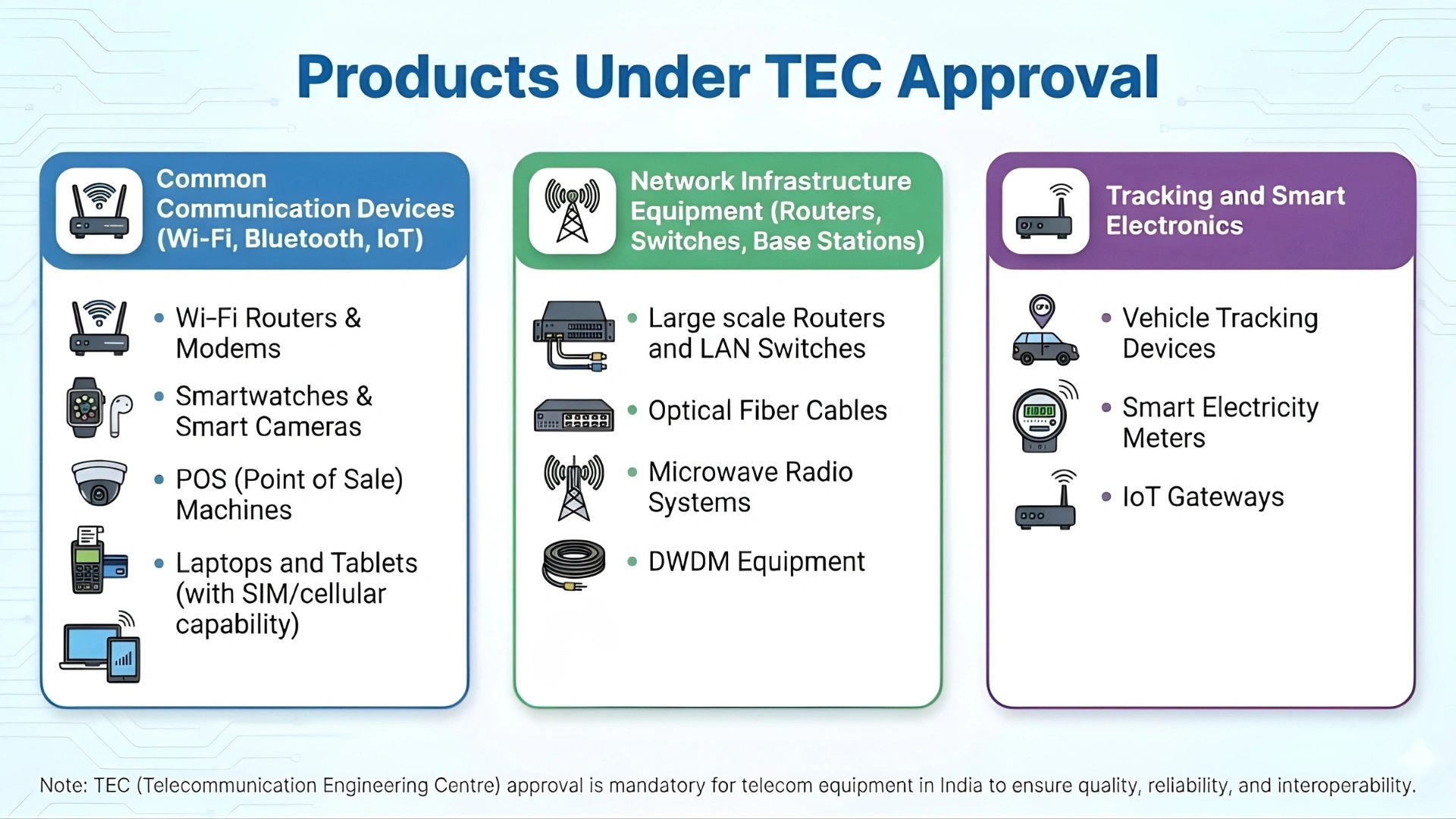
The MTCTE scheme divides products into two categories based on complexity.
| Benefit | Why It Matters |
|---|---|
| Builds Consumer Trust | The TEC logo signals that your product is safe, secure, and compatible with Indian networks, boosting buyer confidence instantly. |
| Unlocks Government Contracts | You cannot bid for lucrative government projects (Smart Cities, Railways, BSNL) without a valid TEC certificate. |
| Ensures Faster Customs Clearance | Certified products avoid seizures and delays at Indian ports, ensuring your supply chain remains uninterrupted. |
| Legal Compliance & Safety | Protects your brand from legal penalties, bans, and fines associated with the Indian Telegraph Amendment Rules. |
| Competitive Advantage | Gives you a distinct edge over non-compliant competitors who risk having their products banned or removed from the market. |
Getting TEC certified isn't just about having a great product; you also need to meet specific administrative criteria to even open an application on the MTCTE portal. The Department of Telecommunications (DoT) has strict rules about who can apply to ensure accountability.
This is the most critical rule for international businesses. If your manufacturing unit is located outside India (e.g., USA, Vietnam, Taiwan), you cannot apply for TEC certification directly.
According to Indian regulations, foreign Original Equipment Manufacturers (OEMs) must appoint an Authorized Indian Representative (AIR).
The MTCTE portal is designed to protect intellectual property. Generally, only the Brand Owner or the OEM is eligible to apply.
MTCTE stands for Mandatory Testing and Certification of Telecom Equipment. It is a regulatory framework notified by the Department of Telecommunications (DoT), Government of India.
Under the Indian Telegraph (Amendment) Rules, 2017 and the Telecommunications Act, 2023, any telecom equipment capable of being used in the Indian telecom network must undergo mandatory testing and certification before it can be sold, imported, or deployed in India.
The scheme is administered by the Telecommunication Engineering Centre (TEC). Its primary goal is to ensure that equipment is safe for end-users, does not degrade the national network, and meets national security standards.
The DoT has rolled out this certification in "Phases" to give manufacturers time to comply.As of late 2025, we are currently navigating Phase VI.
Phase I marked the beginning of the mandatory certification regime, focusing on basic telecommunication equipment that directly interfaces with the PSTN (Public Switched Telephone Network). Implemented in 2019, this phase targeted simpler devices to test the regulatory waters.
| S.NO. | Essential Requirement / Product Name | Product Variant Name | MTCTE Phase |
|---|---|---|---|
| 1 | 2-Wire Telephone Equipment | 2-Line Feature Phone | Phase-1 |
| 2 | 2-Wire Telephone Equipment | CLIP Phone | Phase-1 |
| 3 | 2-Wire Telephone Equipment | Coin Box Telephone | Phase-1 |
| 4 | 2-Wire Telephone Equipment | Coin Box Telephone - Table Top Interface | Phase-1 |
| 5 | 2-Wire Telephone Equipment | Electronic Telephone Instrument | Phase-1 |
| 6 | 2-Wire Telephone Equipment | Executive Telephone Systems | Phase-1 |
| 7 | 2-Wire Telephone Equipment | Key Telephone Systems | Phase-1 |
| 8 | 2-Wire Telephone Equipment | Key Telephone Systems with proprietary interface | Phase-1 |
| 9 | 2-Wire Telephone Equipment | NSD or ISD Payphone | Phase-1 |
| 10 | 2-Wire Telephone Equipment | Terminals for connecting to PSTN | Phase-1 |
| 11 | G3 Fax Machine | Fax machine with handset | Phase-1 |
| 12 | G3 Fax Machine | Fax machine without handset | Phase-1 |
| 13 | Modem | V.90 / V.92 / V.21 to V.34 Modem | Phase-1 |
| 14 | Cordless Telephone | Cordless Telephone | Phase-1 |
| 15 | ISDN Customer Premises Equipment | ISDN Gateway | Phase-1 |
| 16 | ISDN Customer Premises Equipment | ISDN NT-1 Network Termination | Phase-1 |
| 17 | ISDN Customer Premises Equipment | ISDN Terminal | Phase-1 |
| 18 | ISDN Customer Premises Equipment | ISDN Terminal Adapter | Phase-1 |
| 19 | ISDN Customer Premises Equipment | Multipoint Conferencing Server | Phase-1 |
| 20 | ISDN Customer Premises Equipment | PC card based ISDN Terminal | Phase-1 |
| 21 | Private Automatic Branch Exchange | Private Automatic Branch Exchange | Phase-1 |
Phase II expanded the scope to include transmission terminal equipment, which is critical for data transfer over optical networks. This phase brought vital backbone equipment under the compliance umbrella.
| S.NO. | Essential Requirement / Product Name | Product Variant Name | MTCTE Phase |
|---|---|---|---|
| 1 | PON Family of Broadband Equipment | PON OLT | Phase-2 |
| 2 | PON Family of Broadband Equipment | PON ONT | Phase-2 |
| 3 | PON Family of Broadband Equipment | PON ONU | Phase-2 |
| 4 | Feedback Device | Feedback Device | Phase-2 |
| 5 | Transmission Terminal Equipment | Multiplexing Equipment | Phase-2 |
| 6 | Transmission Terminal Equipment | SDH Equipment | Phase-2 |
This was a massive shift that impacted the consumer electronics market significantly. Phase III brought everyday wireless devices and 4G infrastructure into the fold, making TEC certification a household term for importers of smart gadgets.
| S.NO. | Essential Requirement / Product Name | Product Variant Name | MTCTE Phase |
|---|---|---|---|
| 1 | Equipments Operating in 2.4 & 5 GHz Band | PTP / PMP Wireless Access Equipment (2.4 or 5 GHz) | Phase-3 |
| 2 | Equipments Operating in 2.4 & 5 GHz Band | WiFi Access Points & CPE | Phase-3 |
| 3 | Equipments Operating in 2.4 & 5 GHz Band | WLAN Controller Equipment | Phase-3 |
| 4 | End Point Device for Environmental Monitoring | End Point Device for Environmental Monitoring | Phase-3 |
| 5 | Repeater for Cellular Network | GSM & WCDMA Repeater | Phase-3 |
| 6 | Repeater for Cellular Network | GSM Repeater | Phase-3 |
| 7 | Repeater for Cellular Network | GSM, WCDMA & LTE Repeater | Phase-3 |
| 8 | Repeater for Cellular Network | LTE Repeater | Phase-3 |
| 9 | Repeater for Cellular Network | WCDMA & LTE Repeater | Phase-3 |
| 10 | Repeater for Cellular Network | WCDMA Repeater | Phase-3 |
| 11 | Base Station for Cellular Network | BTS for GSM | Phase-3 |
| 12 | Base Station for Cellular Network | BTS with AAS | Phase-3 |
| 13 | Base Station for Cellular Network | BTS with MSR | Phase-3 |
| 14 | Base Station for Cellular Network | eNodeB for LTE | Phase-3 |
| 15 | Base Station for Cellular Network | NodeB for WCDMA | Phase-3 |
Phase IV targeted heavy enterprise and network infrastructure. This phase was crucial for businesses setting up data centers and large corporate networks, as it covered high-capacity switching and processing gear.
| S.NO. | Essential Requirement / Product Name | Product Variant Name | MTCTE Phase |
|---|---|---|---|
| 1 | Mobile Radio Trunking System | MRTS Base Station – Baseband plus Radio | Phase-4 |
| 2 | Mobile Radio Trunking System | MRTS Base Station – Radio Only | Phase-4 |
| 3 | Mobile Radio Trunking System | MRTS Baseband Equipment without Radio | Phase-4 |
| 4 | Mobile Radio Trunking System | MRTS Fixed Station | Phase-4 |
| 5 | Mobile Radio Trunking System | MRTS Handheld Portable Station | Phase-4 |
| 6 | Mobile Radio Trunking System | MRTS Mobile Station | Phase-4 |
| 7 | Conferencing Equipment | Audio Conference Facility Device | Phase-4 |
| 8 | Conferencing Equipment | Multi Line Telephone System | Phase-4 |
| 9 | HF Radio | HF Base Station – Baseband plus Radio | Phase-4 |
| 10 | HF Radio | HF Base Station – Radio Only | Phase-4 |
| 11 | HF Radio | HF Baseband Equipment without Radio | Phase-4 |
| 12 | HF Radio | HF Fixed Station | Phase-4 |
| 13 | HF Radio | HF Handheld Portable Stations | Phase-4 |
| 14 | HF Radio | HF Mobile Stations | Phase-4 |
| 15 | VHF UHF Radio System Equipment | VHF UHF Base Station – Baseband plus Radio | Phase-4 |
| 16 | VHF UHF Radio System Equipment | VHF UHF Base Station – Radio Only | Phase-4 |
| 17 | VHF UHF Radio System Equipment | VHF UHF Baseband Equipment without Radio | Phase-4 |
| 18 | VHF UHF Radio System Equipment | VHF UHF Fixed Station | Phase-4 |
| 19 | VHF UHF Radio System Equipment | VHF UHF Handheld Portable Stations | Phase-4 |
| 20 | VHF UHF Radio System Equipment | VHF UHF Mobile Stations | Phase-4 |
| 21 | PTP PMP Microwave Fixed Radio Systems | PTP or PMP Full Outdoor Microwave Systems | Phase-4 |
| 22 | PTP PMP Microwave Fixed Radio Systems | PTP or PMP Split MW Indoor Unit | Phase-4 |
| 23 | PTP PMP Microwave Fixed Radio Systems | PTP or PMP Split MW Outdoor Unit | Phase-4 |
| 24 | Media Gateway | Line Media Gateway | Phase-4 |
| 25 | Media Gateway | Media Gateway | Phase-4 |
| 26 | Media Gateway | Media Gateway for CPE | Phase-4 |
| 27 | Signalling Gateway | Signalling Gateway | Phase-4 |
| 28 | Session Border Controller | Session Border Controller | Phase-4 |
| 29 | Softswitch | Softswitch | Phase-4 |
| 30 | DSL Equipments | DSL NT Modem | Phase-4 |
| 31 | DSL Equipments | DSLAM COT | Phase-4 |
| 32 | DSL Equipments | OMSAN | Phase-4 |
| 33 | Satellite Communication Equipment | Satellite Amplifier | Phase-4 |
| 34 | Satellite Communication Equipment | Satellite Baseband Mod/Demod/Controller | Phase-4 |
| 35 | Satellite Communication Equipment | Satellite Baseband Modem | Phase-4 |
| 36 | Satellite Communication Equipment | Satellite Baseband Modem Controller | Phase-4 |
| 37 | Satellite Communication Equipment | Satellite BUC | Phase-4 |
| 38 | Satellite Communication Equipment | Satellite IF Transreceiver | Phase-4 |
| 39 | Satellite Communication Equipment | Satellite LNA | Phase-4 |
| 40 | Satellite Communication Equipment | Satellite LNB | Phase-4 |
| 41 | Satellite Communication Equipment | Satellite Optimisation Equipment | Phase-4 |
| 42 | Satellite Communication Equipment | Satellite Radio Frequency Transceiver | Phase-4 |
| 43 | Satellite Communication Equipment | VSAT Terminals | Phase-4 |
| 44 | LAN Switch | L2 LAN Switch | Phase-4 |
| 45 | LAN Switch | L3 LAN Switch | Phase-4 |
| 46 | LAN Switch | MPLS TP CEN Switch | Phase-4 |
| 47 | LAN Switch | L2 Unmanaged Switch | Phase-4 |
| 48 | Router | BNG / BRAS Router | Phase-4 |
| 49 | Router | Cloud Control Capable Router | Phase-4 |
| 50 | Router | IPv4 Router | Phase-4 |
| 51 | Router | IPv6 Router | Phase-4 |
| 52 | Router | MPLS Router | Phase-4 |
| 53 | Transmission Terminal Equipment-2 | DWDM Equipment | Phase-4 |
| 54 | Transmission Terminal Equipment-2 | Digital Cross Connect | Phase-4 |
| 55 | IP Security Equipment | Firewall Equipment | Phase-4 |
| 56 | IP Security Equipment | Intrusion Detection System Equipment | Phase-4 |
| 57 | IP Security Equipment | Intrusion Prevention System Equipment | Phase-4 |
| 58 | IP Security Equipment | Unified Threat Management Equipment | Phase-4 |
| 59 | Precision Timing Protocol Grand Master Equipment | PTP Grand Master Equipment | Phase-4 |
| 60 | Mobile Management Entity | MME for 2G/3G/4G | Phase-4 |
| 61 | Mobile Management Entity | MME for LTE only | Phase-4 |
| 62 | Cell Broadcast Centre | CBC for GSM | Phase-4 |
| 63 | Cell Broadcast Centre | CBC for LTE / LTE-A | Phase-4 |
| 64 | Cell Broadcast Centre | CBC for UMTS | Phase-4 |
| 65 | IP Multimedia Conferencing Equipment | IP Multimedia Conferencing Equipment | Phase-4 |
| 66 | BSC RNC | BSC for GSM | Phase-4 |
| 67 | BSC RNC | RNC for WCDMA | Phase-4 |
| 68 | SMLC / eSMLC | eSMLC for LTE | Phase-4 |
| 69 | SMLC / eSMLC | SMLC for GSM | Phase-4 |
| 70 | SMLC / eSMLC | SMLC for WCDMA | Phase-4 |
| 71 | SGSN / GGSN | GGSN | Phase-4 |
| 72 | SGSN / GGSN | SGSN for GSM | Phase-4 |
| 73 | SGSN / GGSN | SGSN for LTE | Phase-4 |
| 74 | SGSN / GGSN | SGSN for WCDMA | Phase-4 |
| 75 | HLR AUC HSS | HLR / AUC | Phase-4 |
| 76 | HLR AUC HSS | HSS | Phase-4 |
| 77 | MSC / MSC-S / GMSC / GMSC-S incl. VLR | MSC-S / GMSC-S | Phase-4 |
| 78 | MSC / MSC-S / GMSC / GMSC-S incl. VLR | MSC / GMSC incl. VLR for GSM | Phase-4 |
| 79 | MSC / MSC-S / GMSC / GMSC-S incl. VLR | MSC / GMSC incl. VLR for WCDMA | Phase-4 |
| 80 | Infiniband Switch | Infiniband Switch | Phase-4 |
| 81 | OTA & DM / FOTA | DM / FOTA | Phase-4 |
| 82 | OTA & DM / FOTA | OTA | Phase-4 |
| 83 | SCP | SCP | Phase-4 |
| 84 | OMC / EMS / NMS / OSS | NMS | Phase-4 |
| 85 | OMC / EMS / NMS / OSS | OMC / EMS | Phase-4 |
| 86 | S-GW / P-GW | P-Gateway | Phase-4 |
| 87 | S-GW / P-GW | S-Gateway | Phase-4 |
| 88 | SMSC | SMSC | Phase-4 |
| 89 | GMLC | GMLC for GSM / WCDMA | Phase-4 |
| 90 | GMLC | GMLC for LTE / LTE-A | Phase-4 |
| 91 | EIR | EIR for GSM / WCDMA | Phase-4 |
| 92 | EIR | EIR for LTE | Phase-4 |
| 93 | Optical Fibre Cable | Hybrid Cable Optical + Metallic | Phase-4 |
| 94 | Optical Fibre Cable | ADSS Aerial | Phase-4 |
| 95 | Optical Fibre Cable | ADSS Power Line | Phase-4 |
| 96 | Optical Fibre Cable | Direct Buried | Phase-4 |
| 97 | Optical Fibre Cable | DSA | Phase-4 |
| 98 | Optical Fibre Cable | Duct | Phase-4 |
| 99 | Optical Fibre Cable | In-Home | Phase-4 |
| 100 | Optical Fibre Cable | Indoor | Phase-4 |
| 101 | Optical Fibre Cable | Indoor/Outdoor | Phase-4 |
| 102 | Optical Fibre Cable | Lashed Aerial | Phase-4 |
| 103 | Optical Fibre Cable | Micro-Duct | Phase-4 |
| 104 | Optical Fibre Cable | Outdoor | Phase-4 |
| 105 | Optical Fibre Cable | Riser | Phase-4 |
| 106 | Optical Fibre Cable | OPGW | Phase-4 |
| 107 | SIM | CSIM | Phase-4 |
| 108 | SIM | eSIM | Phase-4 |
| 109 | SIM | eUICC | Phase-4 |
| 110 | SIM | RUIM | Phase-4 |
| 111 | SIM | SIM | Phase-4 |
| 112 | SIM | UICC based ISIM | Phase-4 |
| 113 | SIM | USIM | Phase-4 |
| 114 | Radio Broadcast Receiver | Motor Vehicle RBR external power | Phase-4 |
| 115 | Radio Broadcast Receiver | RBR with inbuilt power | Phase-4 |
| 116 | Radio Broadcast Receiver | Other RBR Interface Devices | Phase-4 |
| 117 | Optical Fibre Single Mode | G.652.D | Phase-4 |
| 118 | Optical Fibre Single Mode | G.655 | Phase-4 |
| 119 | Optical Fibre Single Mode | G.656 | Phase-4 |
| 120 | Optical Fibre Single Mode | G.657 A1 | Phase-4 |
| 121 | Optical Fibre Single Mode | G.657 A2 | Phase-4 |
| 122 | Optical Fibre Single Mode | G.657 B3 | Phase-4 |
| 123 | Optical Fibre Single Mode | G.654.D | Phase-4 |
| 124 | Optical Fibre Single Mode | G.654.E | Phase-4 |
Aligning with India's 5G rollout, Phase V focused on next-generation network technology. This phase ensured that the hardware powering India's high-speed mobile internet met stringent performance standards.
| S.NO. | Essential Requirement / Product Name | Product Variant Name | MTCTE Phase |
|---|---|---|---|
| 1 | Base Station for Cellular Network for 5G | BTS with Multi Standard Radio | Phase-5 |
| 2 | Base Station for Cellular Network for 5G | Active Antenna System – OTA | Phase-5 |
| 3 | Base Station for Cellular Network for 5G | Base Station 5G NR Type 1C | Phase-5 |
| 4 | Base Station for Cellular Network for 5G | Base Station 5G NR Type 1H | Phase-5 |
| 5 | Base Station for Cellular Network for 5G | Base Station 5G NR Type 1O | Phase-5 |
| 6 | Base Station for Cellular Network for 5G | Base Station 5G NR Type 2O | Phase-5 |
| 7 | Base Station for Cellular Network for 5G | Hybrid Active Antenna System | Phase-5 |
| 8 | 5G Core | AMF | Phase-5 |
| 9 | 5G Core | AuSF | Phase-5 |
| 10 | 5G Core | BSF | Phase-5 |
| 11 | 5G Core | CHF | Phase-5 |
| 12 | 5G Core | NEF | Phase-5 |
| 13 | 5G Core | NSSF | Phase-5 |
| 14 | 5G Core | PCF | Phase-5 |
| 15 | 5G Core | SMF | Phase-5 |
| 16 | 5G Core | SMSF | Phase-5 |
| 17 | 5G Core | UDM | Phase-5 |
| 18 | 5G Core | UDR | Phase-5 |
| 19 | 5G Core | UPF | Phase-5 |
| 20 | Hypervisor | Hypervisor | Phase-5 |
| 21 | E-Band Fixed Radio Relay System | E-Band MW Full Outdoor System | Phase-5 |
| 22 | E-Band Fixed Radio Relay System | E-Band MW Outdoor + Indoor System | Phase-5 |
| 23 | Converged Multi Service Application Access Equipment (C-MSAAE) | C-MSAAE | Phase-5 |
| 24 | IP Terminal | SIP Terminal | Phase-5 |
| 25 | Hybrid Set Top Box | Hybrid Set Top Box | Phase-5 |
The latest and arguably most critical update, Phase VI (mandatory from August 2025), focuses heavily on network security and advanced satellite connectivity. This phase addresses the growing need for cyber-secure hardware in India's telecom grid.
| S.NO. | Essential Requirement / Product Name | Product Variant Name | MTCTE Phase |
|---|---|---|---|
| 1 | Cellular Customer Premises Equipment | Cellular Customer Premises Equipment | Phase-6 |
| 2 | Fixed Wireless Phone | Fixed Wireless Phone (Voice & Data Facility) | Phase-6 |
| 3 | Fixed Wireless Phone | Fixed Wireless Phone (Voice Facility only) | Phase-6 |
| 4 | LAN Switch | Storage Area Network (SAN) Switch | Phase-6 |
| 5 | LAN Switch | Fabric Interconnect Switch | Phase-6 |
| 6 | IP Security Equipment | Network Security Management Equipment | Phase-6 |
| 7 | IP Security Equipment | Network Security Analytics Equipment – Managed | Phase-6 |
| 8 | IP Security Equipment | Network Security Analytics Equipment – Unmanaged | Phase-6 |
| 9 | IP Security Equipment | Content Security Equipment | Phase-6 |
| 10 | IP Security Equipment | DDoS Protection Equipment | Phase-6 |
| 11 | IP Security Equipment | Malware Analysis Equipment | Phase-6 |
| 12 | IP Security Equipment | Web Application Firewall | Phase-6 |
| 13 | Satellite Communication Equipment | NGSO User Terminals | Phase-6 |
| 14 | Satellite Communication Equipment | NGSO Integrated Gateway | Phase-6 |
Not every piece of hardware needs a TEC certificate. The Department of Telecommunications (DoT) has created specific exemptions to ensure that innovation (R&D) isn't stifled and that regular users aren't harassed for bringing a single gadget home. However, these exemptions come with strict conditions—you can’t just claim them; you often have to prove them.
If you are an engineer or a manufacturer importing units solely for testing, prototyping, or research, you do not need full MTCTE certification.
Bringing one router for your home? You might get an exemption, but commercial quantities are strictly regulated.
The MTCTE scheme focuses on "smart" or "active" equipment that can generate or manipulate signals. "Passive" infrastructure is largely exempt.
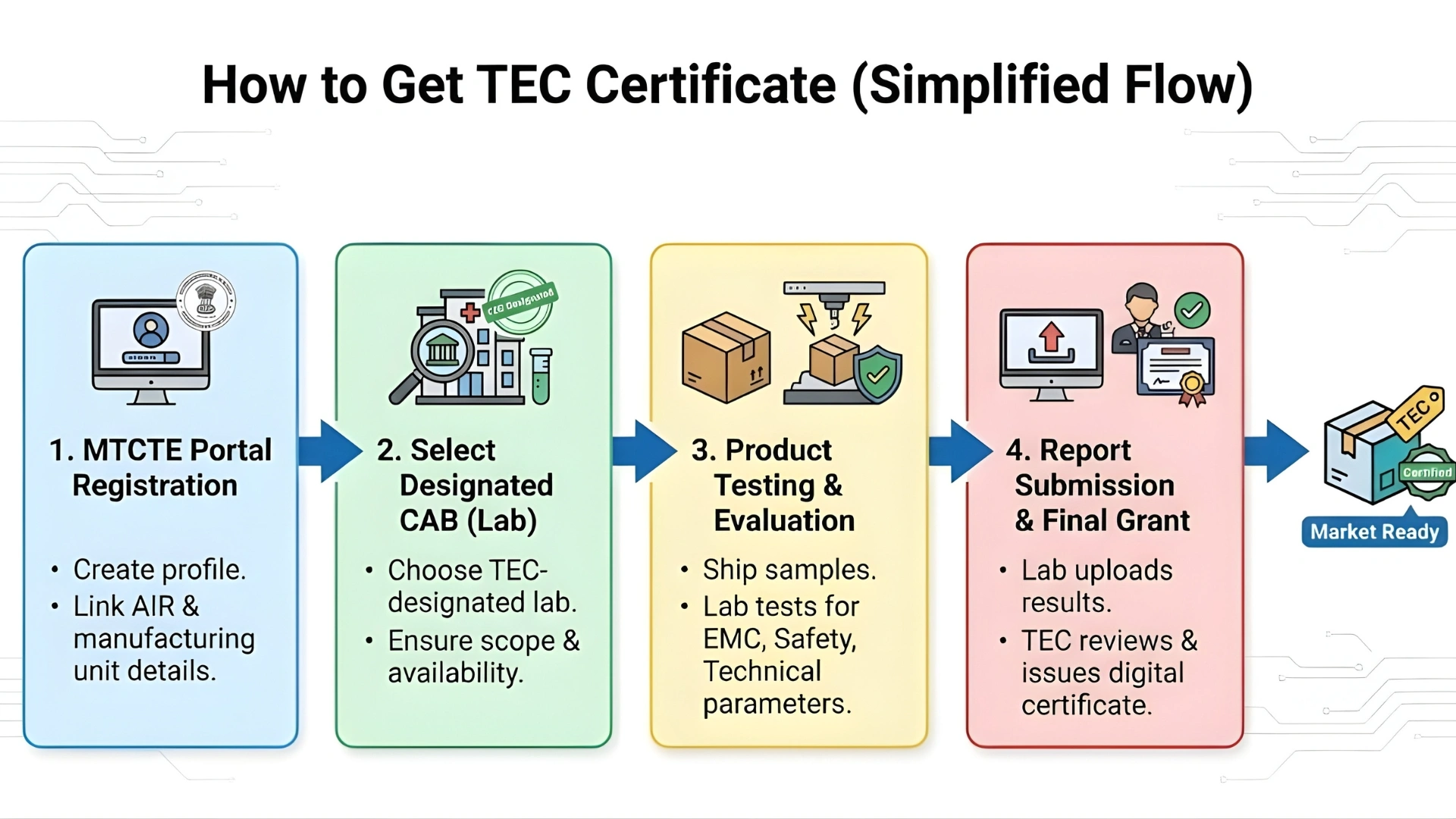
We create your user profile on the official government portal, linking your AIR (if foreign) and manufacturing unit details.
You cannot test just anywhere. We help you select a TEC-designated "Conformity Assessment Body" (CAB) that has the slot availability and scope for your specific product.
Your samples are shipped to the lab. They undergo rigorous testing for EMC (Electromagnetic Compatibility), Safety, and Technical parameters.
Once the lab uploads the test results, we submit the final file to TEC. Their officers review the data and, upon approval, issue the digital TEC Certificate.
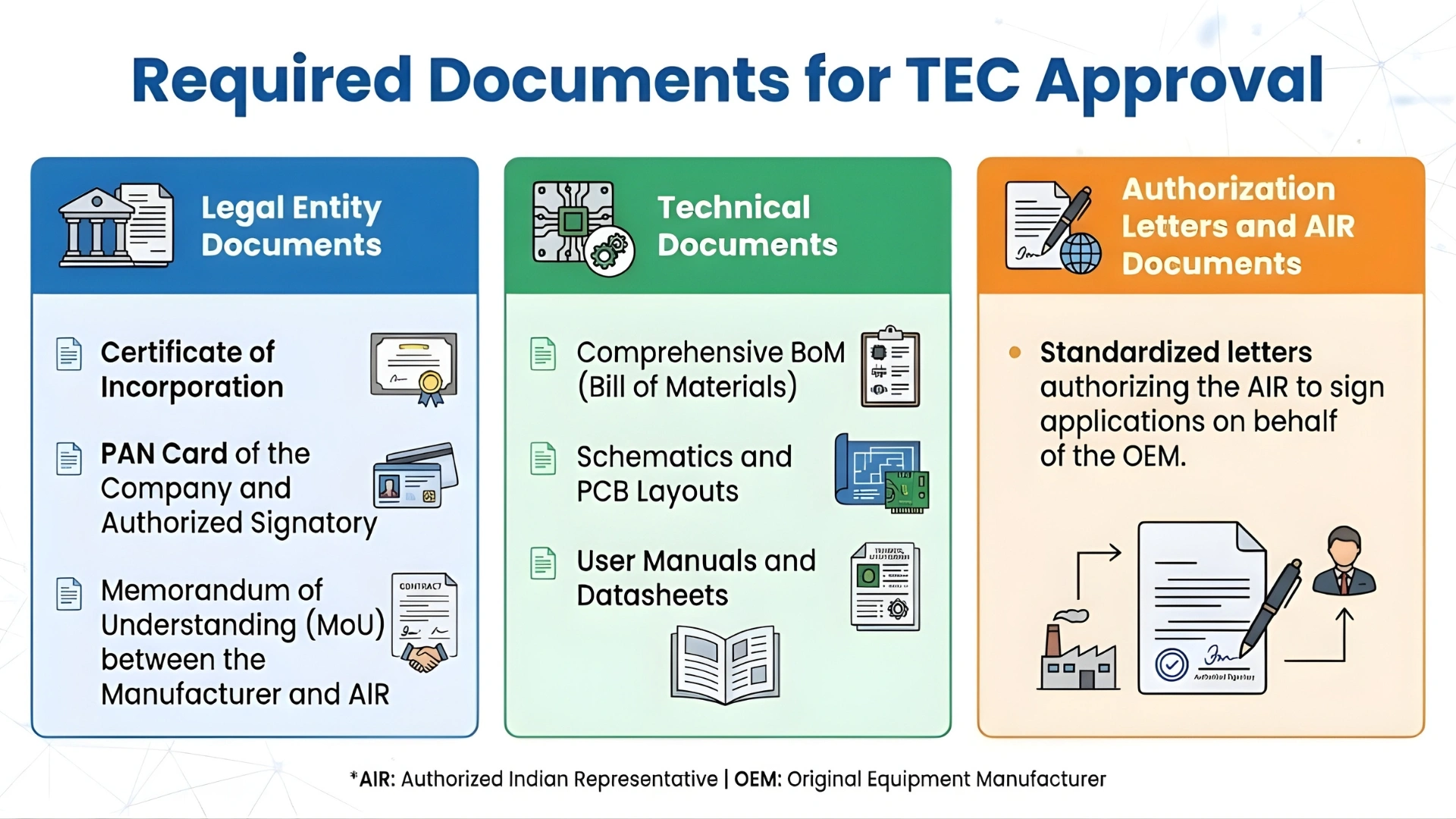
Standardized letters authorizing the AIR to sign applications on behalf of the OEM.
| Fee Component | Description | Estimated Cost / Note |
|---|---|---|
| Government Fee | A fixed administrative fee paid directly on the TEC portal to process the application. | ₹10,000 – ₹50,000+ (Varies based on Product Group A, B, or C) |
| Lab Testing Fee | Paid to the designated CAB (Laboratory) for safety, EMI/EMC, and technical testing. | Highly Variable (Simple modems cost less; 5G base stations may cost several lakhs) |
| Consultancy Fee | Service fee paid to Silvereye Certifications for end-to-end application and compliance management. | Custom Quote (Silvereye Certifications manages the complete process on your behalf) |
| Certification Scheme | Complexity Level | Estimated Timeline | Key Factors |
|---|---|---|---|
| SCS (Simplified Certification Scheme) | Low (e.g., 2-Wire Phones, Modems) |
4 to 6 Weeks | Relies mainly on Self-Declaration of Conformity (SDoC), enabling faster processing. |
| GCS (General Certification Scheme) | High (e.g., Routers, Switches, Firewalls) |
8 to 12 Weeks | Dependent on laboratory slot availability and detailed technical evaluation by TEC. |
| Aspect | Details | Key Note |
|---|---|---|
| Validity Period | Your TEC Approval Certificate is valid for 5 years from the date of issuance. | You must apply for renewal before the expiry date to avoid a lapse in compliance. |
| Renewal Process | If the product hardware remains unchanged, the renewal process is administrative and much simpler than the initial application. | No new testing is usually required if the technical standards (ERs) haven't changed. |
| Modification | If you change any hardware component (e.g., swapping a chipset, changing the PCB layout, or updating the power supply). | You cannot use the old certificate. You must apply for a "Modification", which often requires partial re-testing of the new components. |
In a market flooded with consultants who merely forward emails, Silvereye Certifications stands out because we act as your strategic compliance partner. Here is why industry leaders choose us.
We don't just do the easy stuff. While many agencies stick to simple SCS applications, we specialize in the General Certification Scheme (GCS)—the rigorous path required for major telecom infrastructure like Base Stations, Core Routers, and Satellite equipment.
Certification is rarely a straight line; it’s often a zig-zag of testing, failures, and re-testing. We don't just file papers; we manage the chaos.
For our international clients in the USA, Europe, and Asia, navigating Indian liability laws can be daunting. Silvereye Certifications provides a reliable, legally compliant Authorized Indian Representative (AIR) service.
TEC Approval is more than just a certificate; it is your product's passport to the Indian market. It proves your equipment is safe, secure, and legally compliant. Without it, you face customs seizures and legal bans. In short: Compliance is the key to unlocking India's massive telecom potential.
Don't let complex paperwork block your sales. Whether you need a reliable Authorized Indian Representative (AIR) or full support for GCS/SCS certification, Silvereye Certifications handles the heavy lifting for you.
Ready to launch? Contact us today and let’s get your products India-ready.
No, only for telecom and networking equipment that connects to the Indian telecom network (PSTN) or uses wireless frequencies (e.g., Routers, Smartwatches, IoT sensors). Generic consumer electronics (like washing machines) are exempt.
No. Foreign manufacturers cannot apply directly on the MTCTE portal. You must appoint an Authorized Indian Representative (AIR)—like Silvereye Certifications—to handle the application and legal liability in India.
It varies. You pay a Government Fee (₹10,000–₹50,000) plus a Lab Testing Fee (which ranges from thousands to lakhs depending on the product). Contact us for a precise quote.
Certificates issued after July 2022 are valid for 10 years, provided there are no changes to the product hardware or the government's technical standards
Generally, no. You must ship your samples to a TEC-designated laboratory in India for local testing. Foreign reports are rarely accepted for technical parameters.
Any hardware change (like a new chipset or PCB layout) invalidates the current certificate. You must apply for a "Modification" on the portal, which may require partial re-testing.
Yes. You can import small quantities for R&D or testing by obtaining a special Exemption Letter from the TEC. These units cannot be sold commercially.
It is illegal. Customs will seize and destroy your shipment, and the DoT can impose heavy fines or ban your company from the Indian market.
We don't just file papers. We provide end-to-end support, including legal AIR representation, technical debugging with labs to prevent failures, and a guaranteed compliance roadmap.