


It is the mandatory yearly reporting of how a business fulfilled its Extended Producer Responsibility (EPR) obligations.
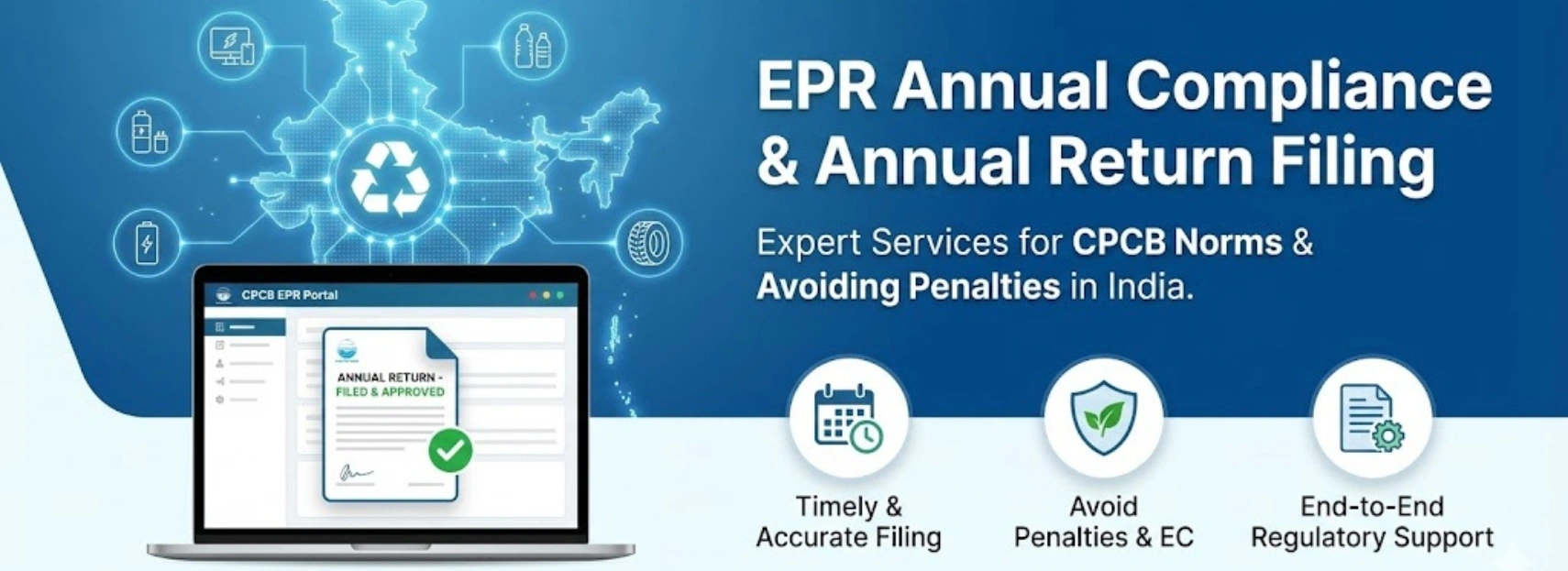
In recent years, India’s environmental compliance landscape has shifted from intent-based regulation to outcome-based accountability. One of the clearest examples of this shift is EPR Annual Compliance under the Extended Producer Responsibility (EPR) framework.
What was once seen as a one-time registration requirement has now evolved into a yearly performance assessment, where businesses must prove—every financial year—that they have met their waste management obligations.
For regulators, the EPR Annual Return is not just a report; it is the primary tool used to verify whether Producers, Importers, and Brand Owners (PIBOs) have actually fulfilled their responsibilities.
For businesses, it has become a make-or-break compliance milestone that directly affects authorization validity, renewal approvals, and exposure to penalties.
EPR Annual Compliance is the mandatory year-end regulatory process under India’s Extended Producer Responsibility (EPR) framework, where obligated businesses formally report how they fulfilled their EPR targets during a financial year.
Many businesses assume that once EPR authorization is granted, compliance is complete. This is one of the most common and costly misunderstandings.
| Aspect | EPR Authorization | EPR Annual Compliance |
|---|---|---|
| Purpose | Permission to operate under EPR rules | Proof of annual performance |
| Validity | Time-bound (usually 1–5 years) | Required every financial year |
| Focus | Eligibility & documentation | Targets, credits & execution |
| Authority | Granted by CPCB | Verified annually by CPCB |
| Risk if missed | Business cannot start | Penalties, EC, suspension |
EPR Annual Return Filing is not an administrative formality—it is a statutory requirement under India’s waste management rules.
The government mandates annual filing to ensure:
From 2024 onwards, CPCB has significantly tightened scrutiny. In 2026, portal validations, automated mismatch flags, and environmental compensation triggers have made non-filing or incorrect filing a high-risk event.
EPR Annual Return & Compliance in India is category-specific, meaning obligations, targets, and reporting formats vary depending on the type of waste generated by your products.
One of the most common compliance failures we see is businesses assuming a uniform EPR process across categories—which is incorrect and often penalised.
The Central Pollution Control Board (CPCB) has clearly defined separate EPR frameworks, portals, and annual return structures for each waste stream. Understanding your exact category is the first step toward accurate EPR Annual Compliance.
E-Waste EPR applies to businesses dealing in electrical and electronic equipment (EEE) such as IT devices, consumer electronics, telecom equipment, and appliances.
Under EPR Annual Return Filing, PIBOs must disclose:
Plastic Waste EPR covers rigid plastic, flexible plastic, multilayered packaging, and compostable plastic used for product packaging.
Annual compliance focuses on:
Battery Waste EPR applies to portable, automotive, and industrial batteries, including lithium-ion batteries used in EVs and electronics.
Annual return requirements include:
Battery EPR is under heightened scrutiny due to EV expansion, making accurate Annual Return Filing non-negotiable.
Waste Tyre EPR covers new tyres imported or manufactured in India, including tyres used in vehicles, equipment, and machinery.
Key annual compliance elements:
EPR Compliance in India is not limited to manufacturers alone. Under the Extended Producer Responsibility (EPR) framework, the obligation extends across the entire supply chain—from production and import to branding and digital marketplaces.
If your business introduces regulated products or packaging into the Indian market, EPR Annual Compliance is legally required, regardless of where manufacturing takes place.
A Producer is any entity that manufactures products in India that later generate regulated waste (e-waste, plastic, batteries, tyres, or used oil).
Producers require EPR Compliance if they:
An Importer is responsible for EPR Compliance when finished products, components, or packaged goods are imported into India.
Importers must comply if they:
A Brand Owner is the entity whose brand name appears on the product or packaging, regardless of who manufactures or imports it.
Brand Owners must ensure:
E-commerce has added a new layer to EPR enforcement. Marketplaces and online sellers may require compliance when they:
Marketplaces are increasingly asked by CPCB to:
Filing the EPR Annual Return is a legal obligation, not a best practice.
Under India’s Extended Producer Responsibility (EPR) framework, the responsibility to file the annual return rests with specific entities that are registered and regulated on the national EPR system.
In enforcement actions, regulators assess who filed, what was filed, and whether it matched actual performance.
All Producers, Importers, and Brand Owners (PIBOs) registered on the CPCB EPR portal are mandatorily required to file an EPR Annual Return, irrespective of business size or turnover.
This includes PIBOs who:
Bulk Consumers are entities that consume large quantities of regulated products for internal use—such as IT hardware, batteries, or machinery.
They are required to file EPR-related returns when:
Any entity holding a valid EPR Authorization for:
PIBO is a regulatory classification used under India’s Extended Producer Responsibility (EPR) framework. It stands for Producer, Importer, and Brand Owner—the three categories of entities that the law holds directly responsible for managing the environmental impact of products placed in the Indian market.
In enforcement terms, PIBO is not a label—it is a liability marker.
If your business falls under any one of these roles, you carry EPR Annual Compliance and Annual Return Filing obligations, regardless of company size or operational model.
Once classified as a PIBO, your responsibilities include:
EPR Obligation is the measurable, year-wise responsibility assigned to a business under India’s Extended Producer Responsibility (EPR) framework.
It defines how much waste you must collect, recycle, or process against the quantity of products you placed in the market during a specific financial year.
EPR targets are calculated using a formula-driven approach that varies by waste category (e-waste, plastic, battery, tyre, used oil). While percentages differ, the structure remains consistent.
Core inputs used for calculation:
| EPR Category | Obligation Target for FY 2025–26 | Governing Rules | Annual Return Filing Deadline |
|---|---|---|---|
| E-Waste | 70% of e-waste generated (by weight) | E-Waste (Management) Rules, 2022 | 30 June 2026 |
| Plastic Waste | Category-wise targets (approx. 40–60% depending on plastic type) | Plastic Waste Management Rules & EPR Guidelines | 30 June 2026 |
| Battery Waste | Schedule-based targets (varies by battery chemistry) | Battery Waste Management Rules, 2022 | 30 June 2026 |
| Waste Tyres | Weight-based recycling obligation linked to tyres introduced | Tyre Waste Management Rules, 2022 | 30 June 2026 |
By 2026, EPR Annual Return Compliance in India has clearly moved out of the “transition phase” and into a strict performance-based regulatory regime. What earlier worked with partial data, manual explanations, or post-filing corrections is no longer acceptable. Regulators now expect accuracy at the first submission, backed by verifiable data and portal-level reconciliation.
The most important shift in 2026 is how compliance is evaluated, not just whether it is filed.
The Central Pollution Control Board (CPCB) has aligned its digital infrastructure with enforcement objectives. Portal changes are designed to detect inconsistencies automatically, not manually.
For Producers, Importers, and Brand Owners (PIBOs), 2026 compliance expectations go beyond filing.
Enforcement intensity has increased in 2026, especially around Annual Return deadlines.
Importantly, enforcement is now data-driven, not complaint-driven. Even low-volume PIBOs are receiving notices if inconsistencies exist.
The EPR Annual Return is the formal mechanism through which regulators verify whether a business has actually fulfilled its Extended Producer Responsibility for a given financial year. It is not a summary report or an optional disclosure—it is a statutory compliance requirement linked directly to enforcement, penalties, and authorization renewal.
Any Producer, Importer, or Brand Owner (PIBO) registered on the EPR portal and active during a financial year must submit an annual return—even if sales were minimal or zero.
One of the most critical requirements of the EPR Annual Return is data reconciliation.
This reconciliation must be mathematically accurate and portal-aligned. Credits that exist only in invoices or agreements—but are not properly mapped on the system—are treated as non-existent for compliance purposes.
The Central Pollution Control Board (CPCB) uses the EPR Annual Return as its primary verification tool. Once submitted, the annual return becomes part of the entity’s permanent compliance record.
When filed correctly and on time, the EPR Annual Return becomes a risk-management tool. As enforcement has matured, what matters is whether the annual return accurately reflects compliance performance.
The most immediate benefit of timely filing is protection from Environmental Compensation (EC).
Renewals now depend on historical annual returns. Even a single defective return can delay renewals and trigger audits.
Accurate filing enhances regulatory credibility.
The EPR Annual Return Filing timeline defines when a business must report compliance. Regulators assess timeliness and accuracy together; missing timelines results in non-compliance even if targets are met.
The Central Pollution Control Board (CPCB) generally opens filing after the close of the financial year, typically in Q1 or early Q2 of the next FY.
| Cost Component | What It Covers | Typical Cost Range (₹) |
|---|---|---|
| EPR Credit Cost | Purchase of credits from authorised recyclers/processors | Varies by category, quantity & market rates |
| Annual Return Filing Fee | Preparation, reconciliation & filing of annual return | ₹15,000 – ₹60,000 |
| Data Reconciliation & Calculation | Obligation calculation, credit matching, error correction | ₹10,000 – ₹40,000 |
| Multi-Category Compliance | Additional cost if covered under more than one EPR category | +20%–40% per category |
| CPCB Query Handling | Responding to notices, clarifications, revisions | ₹5,000 – ₹25,000 |
| Penalty / EC (If Non-Compliant) | Environmental Compensation for delays or shortfalls | Variable, can be significantly higher than compliance cost |
Actual EPR Annual Compliance cost in India depends on product type, quantity placed in the market, accuracy of data, and timely filing. Professional compliance is generally far more cost-effective than post-penalty correction.
Non-compliance with EPR Annual Return requirements can lead to financial penalties, operational restrictions, and regulatory action. The Central Pollution Control Board (CPCB) treats delayed or incorrect filings as serious compliance failures, even if EPR targets were met.
| Enterprise Type | Penalty / Impact (Indicative) |
|---|---|
| Micro Enterprise | ₹25k–₹1L (late filing) + EC |
| Small Enterprise | ₹5k–₹10k/day + EC |
| Large Enterprise | ₹10k–₹20k per tonne EC |
EPR Annual Compliance involves complex calculations, strict timelines, and portal-based validations. Even small errors in data or credit adjustment can lead to penalties or renewal delays.
Key Reasons to Choose Professional Support
Professional support helps ensure error-free EPR Annual Compliance, protects authorization validity, and minimizes regulatory risk—making it a practical necessity, not an optional expense.
EPR Annual Compliance has become a core regulatory requirement, not a year-end formality. Accurate and timely EPR Annual Return filing validates your compliance performance, protects your authorization, and prevents penalties or operational disruptions.
Stay Compliant, Avoid Penalties & Ensure Business Continuity
Businesses that treat EPR as an ongoing process—supported by correct data, valid credits, and on-time filing—operate with far less regulatory risk. With structured planning and the right expertise, EPR Annual Compliance becomes predictable, defensible, and renewal-ready, ensuring uninterrupted operations in a stricter enforcement environment.
It is the mandatory yearly reporting of how a business fulfilled its Extended Producer Responsibility (EPR) obligations.
Yes. All registered PIBOs must file an EPR Annual Return every financial year.
The Central Pollution Control Board (CPCB) regulates and monitors EPR compliance.
Late or non-filing may result in Environmental Compensation (EC) and renewal delays.
No. Authorization permits participation; annual return proves compliance.
Yes. A nil declaration must still be filed.
Credits are generally year-specific and must align with the applicable obligation year.
E-waste, Plastic Waste, Battery Waste, Waste Tyres, and Used/Waste Oil.
Yes. CPCB reviews annual returns during authorization renewal.
To avoid calculation errors, penalties, and compliance delays.