


EPR Credit is a CPCB-verified digital compliance unit that proves a Producer, Importer, or Brand Owner has fulfilled its Extended Producer Responsibility obligations through authorised waste processing.
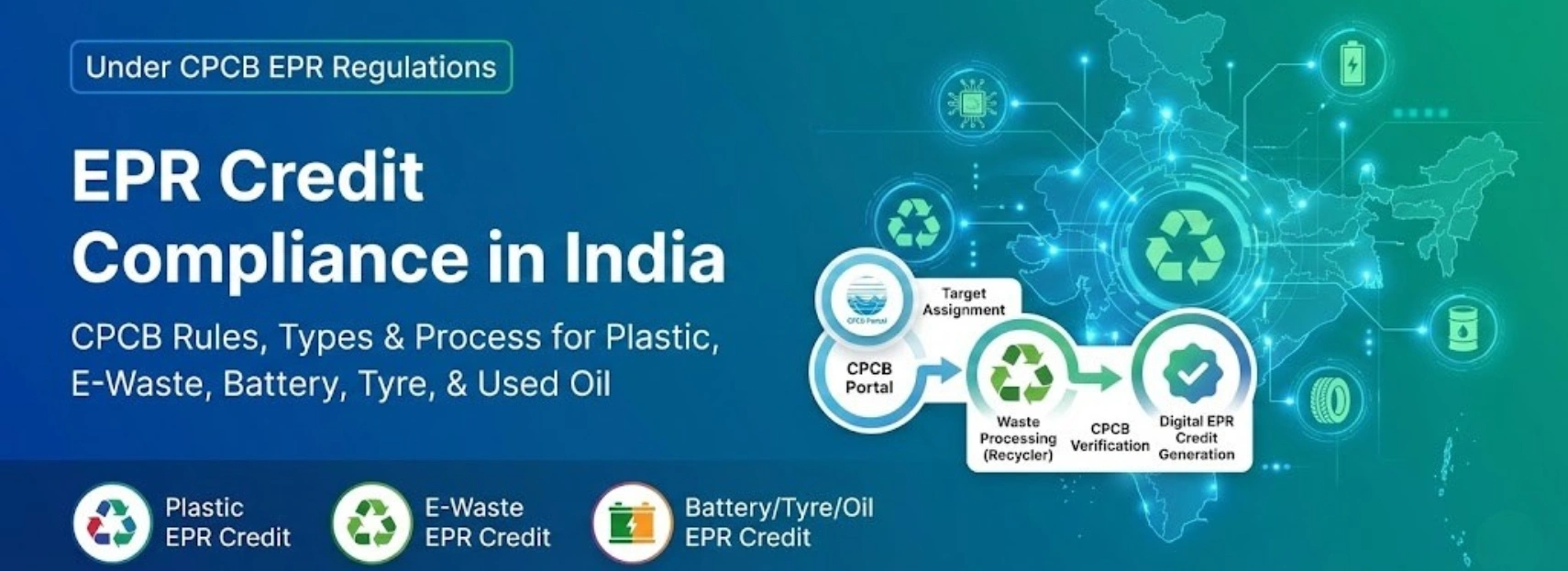
A few months ago, a mid-size FMCG brand approached us after receiving a notice from the CPCB portal. Their EPR registration was active, targets were assigned—but EPR Credit mapping was incomplete. Like many Indian businesses, they assumed registration alone was compliance.
That assumption is where most compliance failures begin.
In India’s evolving environmental regulatory framework, EPR Credit compliance has become the backbone of Extended Producer Responsibility. It is no longer enough to “intend” compliance; businesses must now demonstrate fulfilment through verified EPR Credits recorded on CPCB portals.
EPR Credit is a digitally recorded compliance unit recognised by the Central Pollution Control Board (CPCB) that proves an obligated entity has fulfilled its Extended Producer Responsibility (EPR) targets through authorised waste collection, recycling, recovery, or processing activities.
It is regulatory evidence, not a financial instrument. It confirms that a specific quantity of waste—linked to plastic, e-waste, batteries, tyres, or used oil—has been processed in accordance with CPCB-approved standards and recorded on the official EPR portal.
EPR Credit is a CPCB-verified digital record used to demonstrate compliance with India’s Extended Producer Responsibility rules for regulated waste categories.
The primary purpose of Credits is to convert environmental responsibility into measurable compliance. Under India’s EPR framework, registration alone does not establish compliance. CPCB requires verifiable proof of fulfilment, which is achieved through EPR.
It is designed to:
India’s EPR framework does not treat all waste the same. EPR are category-specific, issued only when waste is processed in line with the rules notified by the Ministry of Environment, Forest and Climate Change and administered by the Central Pollution Control Board.
Plastic EPR Credit applies to businesses that introduce plastic packaging or plastic products into the Indian market. Credits are generated when authorised recyclers or processors collect and process plastic waste in compliance with CPCB standards.
Who it applies toE-waste Credit is mandatory for producers and importers of electrical and electronic equipment (EEE). Credits are issued for dismantling, recycling, or refurbishment performed by authorised e-waste recyclers.
Battery EPR Credit was introduced to regulate the fast-growing battery ecosystem, including EVs and energy storage systems. Credits are generated through environmentally sound recycling or recovery of batteries.
Who it applies toUsed Oil EPR Credit applies to producers and importers of lubricating oils. Credits are issued when used oil is collected and re-refined or disposed of through authorised facilities.
Who it applies toTyre EPR Credit is mandatory for entities placing tyres in the Indian market. Credits are generated through recycling, recovery, or retreading activities conducted by authorised processors.
Who it applies to
EPR Credit compliance flows from statutory rules notified by the Ministry of Environment, Forest and Climate Change and enforced by CPCB.
These rules legally bind PIBOs to:
India faces mounting waste generation.Shift responsibility from municipalities to producers
Failure to comply may lead to:
EPR Credit compliance is not industry-optional or size-dependent. It applies to any business entity that introduces regulated products into the Indian market and falls within the scope of India’s Extended Producer Responsibility framework enforced by the Central Pollution Control Board.
Under CPCB regulations, a Producer is any entity that manufactures regulated products or materials and introduces them into the Indian market for sale, distribution, or consumption.
Producers typically include:Importers are fully liable under EPR rules, even if the products are manufactured outside India. CPCB treats importing and placing goods in the Indian market as equivalent to production for EPR purposes.
Importers commonly covered include:A Brand Owner is any entity that sells products under its own brand name, regardless of who manufactures or imports the goods.
This category also extends to:
The entire EPR Credit ecosystem in India is designed, governed, and enforced by the Central Pollution Control Board (CPCB).
From defining who must comply to validating whether compliance is genuine, CPCB acts as the single nodal authority that ensures EPR are credible, traceable, and legally enforceable.
CPCB functions under the policy direction of the Ministry of Environment, Forest and Climate Change and is legally empowered to implement India’s Extended Producer Responsibility framework.
One of CPCB’s most significant contributions to EPR Credit management is the shift to fully digital compliance monitoring.
CPCB operates dedicated online portals for:
Through these portals, CPCB:
EPR Credits do not become valid simply because waste has been processed. CPCB requires verification and approval before credits can be adjusted against EPR targets.
Key verification controls include:
EPR Credit compliance in India is not based on informal practices or voluntary sustainability claims. It is governed by statutory regulations issued by the Government of India and implemented by the Central Pollution Control Board under the policy framework of the Ministry of Environment, Forest and Climate Change.
CPCB does not operate a single, generic EPR regulation. Instead, EPR governance is category-specific, with each waste stream regulated under separate notified rules.
| Waste Category | Governing Regulation | Compliance Authority |
|---|---|---|
| Plastic Waste | Plastic Waste Management Rules | CPCB |
| E-Waste | E-Waste Management Rules | CPCB |
| Battery Waste | Battery Waste Management Rules | CPCB |
| Used Oil | Hazardous & Other Wastes Rules | CPCB |
| Tyres | CPCB Tyre EPR Guidelines | CPCB |
CPCB regulations clearly state that Credits can only be generated through authorised and verified waste processing activities. Any deviation—whether in documentation, processor authorisation, or timing—can invalidate credits.
CPCB regulations place strong emphasis on continuous disclosure and reporting, not just year-end compliance.
All reporting is conducted through CPCB’s digital EPR portals, which function as the single source of compliance truth.
EPR Credit compliance in India is not based on fixed or optional benchmarks. Targets are legally assigned, time-bound, and enforceable under the framework administered by the Central Pollution Control Board.
Understanding how EPR Credit targets are calculated and how they must be fulfilled is critical, because most compliance failures occur at the target–credit alignment stage, not at registration.
EPR Credit targets are calculated every financial year based on the quantity of products or materials placed in the Indian market during the previous reference period, as declared on CPCB portals.
For example:
Once published on the CPCB portal, annual targets are binding unless formally revised by CPCB.
CPCB mandates that EPR Credit fulfilment must align with the same financial year in which the target is assigned.
Standard compliance expectation:
EPR Credit compliance in India continues to evolve rapidly as regulators strengthen enforcement, improve digital oversight, and introduce flexible timelines to help obligated entities meet their obligations reliably.
To address practical challenges faced by Producers, Importers, and Brand Owners (PIBOs), the CPCB and MoEFCC have extended deadlines for filing annual returns under the Plastic Waste Management Rules for the financial year 2024–25.
New extended deadline: 31 January 2026 for Plastic EPR Annual Returns.
CPCB has upgraded its EPR portals to improve transparency, traceability, and authenticity of EPR Credits—especially for Plastic and other waste categories.
Key developments include:
While much of the public focus has been on Plastic EPR compliance deadlines, CPCB continues to apply uniform scrutiny across all EPR waste streams, including:
Although specific credit-related deadline extensions have been most visible for plastics, the regulatory environment for other categories also reflects greater enforcement expectations and tighter credit validation norms.
Amendments to broader waste rules signal that EPR-style accountability could extend to additional waste categories (e.g., non-ferrous metals) from April 2026 under new hazardous waste amendments.
While not yet directly tied to EPR Credits, this reflects a broader regulatory trend toward systemic EPR compliance expectations across multiple sectors.
EPR Credit compliance begins with mandatory registration on the CPCB EPR portal under the relevant waste category (Plastic, E-Waste, Battery, Tyre, or Used Oil).
Once registered:
These targets are quantitative and binding. From this point onward, compliance shifts from registration to target fulfillment.
EPR Credits are generated only when waste is processed by CPCB-authorised recyclers or processors. The process typically works as follows:
After credit mapping, CPCB conducts system-based and manual verification before treating compliance as complete.
Verification includes:
EPR Credit compliance is always linked to a specific financial year:
Credits from one year cannot be freely carried into another unless CPCB rules explicitly allow it.
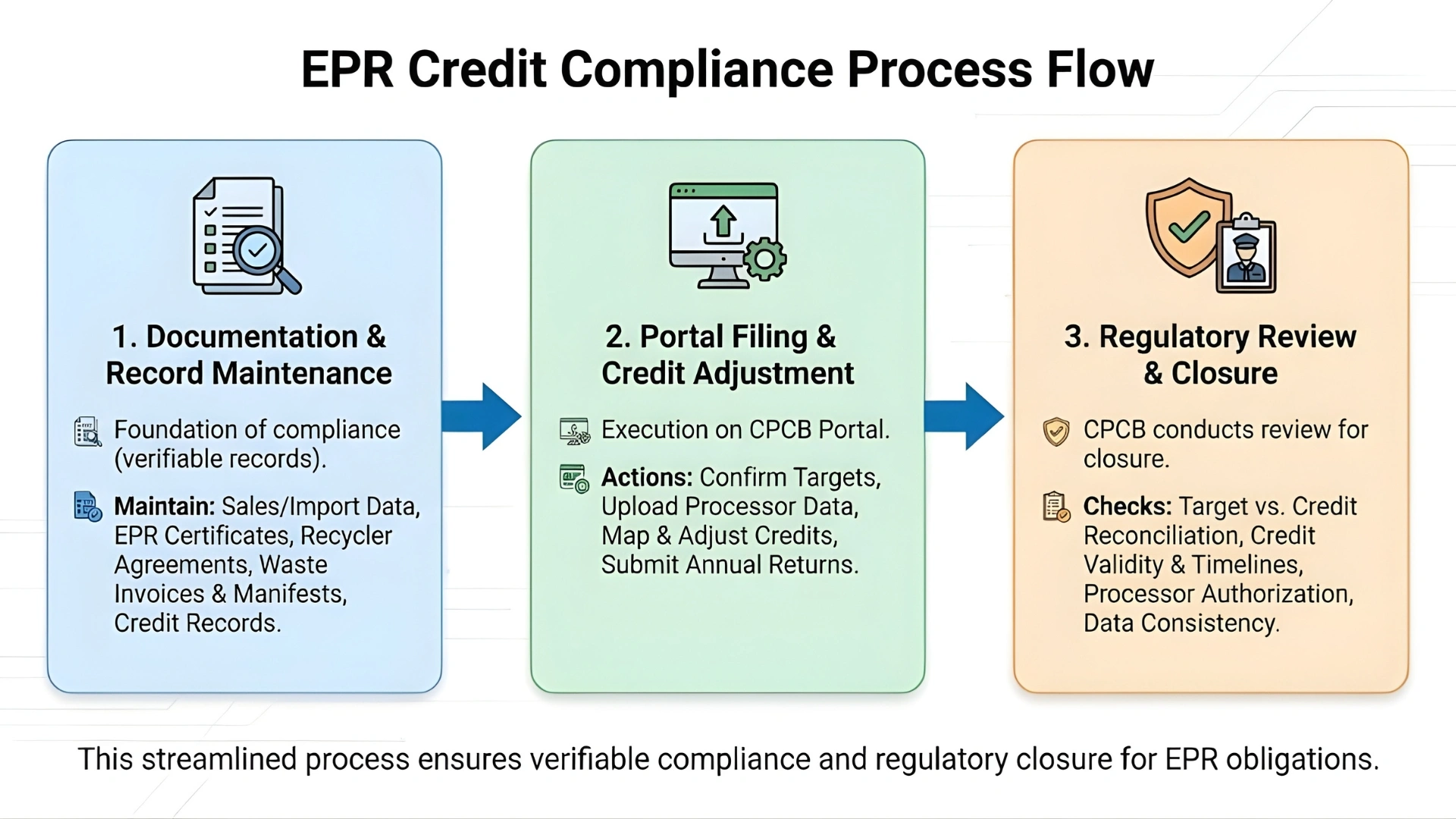
Documentation is the foundation of EPR Credit compliance. CPCB evaluates compliance based on verifiable records, not declarations.
Once documentation is in place, compliance shifts to portal-based execution. CPCB operates category-specific EPR portals, which serve as the only recognised compliance interface.
After portal filing, CPCB conducts a regulatory review to determine whether the compliance cycle can be closed.
During review, CPCB checks:
EPR Credits are issued with category-specific validity, governed by CPCB rules and portal logic, which determines whether a credit can be used for compliance in a given financial year.
Key principles CPCB applies to validity:
A credit generated during FY 2024–25 is generally intended to fulfil FY 2024–25 obligations, unless CPCB explicitly allows carry-forward into FY 2025–26.
Adjustment is the regulatory act that converts an available EPR Credit into recognised compliance.
For adjustment to be accepted by CPCB:
Credits follow a defined regulatory lifecycle controlled entirely by CPCB systems.
| Lifecycle Stage | Description |
|---|---|
| Generation | Waste processed by authorised recycler |
| Validation | CPCB verifies processor and quantity |
| Availability | Credit appears as usable on portal |
| Adjustment | Credit mapped to annual target |
| Closure | Target marked fulfilled |
| Expiry | Unused credit lapses after validity |
Once a credit expires, it exits the lifecycle permanently and cannot be recovered.
Non-compliance with EPR Credit rules is treated by regulators as a statutory failure, not a procedural lapse.
Under India’s Extended Producer Responsibility framework, failure to meet EPR Credit obligations can lead to financial penalties, regulatory restrictions, and long-term operational risk.
The most immediate consequence of Credit non-compliance is the imposition of environmental compensation (EC). CPCB calculates EC when:
EPR Credit non-compliance directly affects an entity’s standing on CPCB portals.
CPCB may:
For businesses operating across multiple product lines, a blocked registration can halt imports, sales, or expansions, creating immediate commercial disruption.
Beyond financial penalties, EPR Credit non-compliance exposes businesses to broader risks:
EPR Credit compliance is not a checklist exercise—it is a regulatory lifecycle that requires accuracy, timing, and continuous alignment with CPCB systems.
Our role is to translate complex EPR regulations into a structured, low-risk compliance process for your business, while ensuring every step stands up to scrutiny by the Central Pollution Control Board.
We begin with applicability and obligation clarity—the most overlooked step in EPR compliance. Many entities are over- or under-reporting simply because their scope is not correctly mapped.
Our advisory support includes:
CPCB portals are the single source of regulatory truth for EPR compliance. Errors at the portal level—incorrect mapping, late adjustments, or data mismatches—are the most common reasons for notices.
We handle:
EPR compliance does not end with one successful filing. CPCB continuously refines its digital controls and enforcement approach, making ongoing monitoring essential.
Our ongoing support includes:
Silvereye Certifications offers clear, CPCB-aligned EPR Credit compliance support designed to reduce regulatory risk and ensure timely fulfilment.
EPR Credit compliance in India is no longer optional or procedural—it is a measurable, enforceable obligation. Businesses that treat EPR Credits as an afterthought risk penalties, disruption, and reputational damage.
Handled correctly, however, EPR Credits become a structured pathway to regulatory certainty and environmental responsibility.
If your organisation operates under India’s EPR framework, timely and accurate EPR Credit compliance is the difference between regulatory confidence and continuous risk.
EPR Credit is a CPCB-verified digital compliance unit that proves a Producer, Importer, or Brand Owner has fulfilled its Extended Producer Responsibility obligations through authorised waste processing.
EPR Credits are regulated and validated by the Central Pollution Control Board under India’s notified EPR rules.
Yes. EPR Credit compliance is annual and must be fulfilled financial year-wise (e.g., FY 2024–25, FY 2025–26) as per CPCB-assigned targets.
EPR Credits apply to Plastic Waste, E-Waste, Battery Waste, Tyre Waste, and Used Oil, each governed by category-specific CPCB rules.
No. Registration only identifies applicability. Compliance is achieved only after valid EPR Credits are adjusted against assigned targets on the CPCB portal.
No. EPR Credits are non-transferable across categories. For example, Plastic EPR Credits cannot fulfil E-Waste or Battery EPR obligations.
CPCB may impose environmental compensation, block portal access, or delay renewals. Non-fulfilment also increases scrutiny in future years.
Yes. EPR Credits are time-bound. Expired credits cannot be adjusted, even if recycling activity was completed.
Carry-forward is limited and category-specific. It is allowed only if CPCB rules and portal settings permit it for the relevant financial year.
By planning targets early, working only with authorised processors, maintaining accurate documentation, and completing portal-based credit adjustment within the financial year.