


Yes. EPR E-Waste Management is legally mandatory for producers, importers, and brand owners dealing in electronic products under the E-Waste Rules, 2022.
In mid-2023, a Delhi-based electronics importer contacted us after their Amazon listings were suddenly blocked. The reason wasn’t GST. It wasn’t BIS. It was non-availability of a valid EPR E-Waste Registration.
The reason wasn’t GST. It wasn’t BIS. It was non-availability of a valid EPR E-Waste Registration.
This scenario is no longer rare.
India is now the third-largest generator of electronic waste globally, and regulators are enforcing Extended Producer Responsibility (EPR) far more strictly than before. If you
manufacture, import, or sell electronic products, EPR E-Waste Management is no longer optional—it’s a legal prerequisite.
EPR E-Waste Management refers to the legal obligation placed on producers, importers, and brand owners to collect, recycle, and responsibly dispose of electronic waste generated from their products.
Under India’s E-Waste (Management) Rules, 2022, the responsibility of managing electronic waste has shifted upstream—from municipalities to businesses placing products in the market.
This framework aligns India with global circular economy practices followed in the EU and OECD countries.
If your business places electronic or electrical products into the Indian market, you are legally required to comply with EPR E-Waste Management—regardless of whether you manufacture the product yourself or not.
This obligation comes directly under India’s E-Waste (Management) Rules, 2022, enforced by the Central Pollution Control Board (CPCB).
Any company that manufactures electrical or electronic equipment in India for sale under its own brand or for other brands.
Businesses importing finished electronics, components, or assemblies into India for commercial use or resale.
Companies that sell electronic products under their own trademark, even if manufacturing and importing are outsourced.
Sellers operating on platforms like Amazon or Flipkart where:
Overseas brands selling electronics in India through:
In such cases, the Indian entity becomes legally responsible for EPR compliance.
Beyond legal compliance, structured Electronic Waste Management creates long-term business advantages.
Under India’s E-Waste (Management) Rules, 2022, Extended Producer Responsibility (EPR) is no longer a paper-based formality. It is a performance-driven, digitally monitored obligation enforced by the Central Pollution Control Board (CPCB).
No electronic product can be legally sold, imported, or listed on e-commerce platforms without a valid EPR Registration for E-Waste.
Businesses must declare:
Any mismatch between declared data and actual sales/import figures is treated as misreporting.
Each registered entity must meet year-wise E-Waste recycling targets, calculated based on:
Targets are fulfilled by purchasing recycling certificates only from CPCB-authorised recyclers.
The 2022 Rules strictly prohibit:
All recycling must be routed through authorised recyclers listed on the CPCB portal, ensuring traceability and environmental safety.
The new framework operates on a digital credit mechanism:
False or duplicate credit usage is treated as a serious compliance violation.
Registered entities must file:
Non-filing or delayed filing is one of the most common reasons for EPR suspension.
Businesses must maintain:
CPCB has the authority to conduct audits, inspections, and data cross-verification at any time.
For manufacturers and importers, EPR E-Waste Management is not a generic environmental obligation—it is a core statutory compliance directly linked to production volume, import data, and market placement of electronic products in India.
Under the E-Waste (Management) Rules, 2022, manufacturers and importers are classified as “Producers” and are regulated by the Central Pollution Control Board (CPCB).
Manufacturers and importers control the first point of entry of electronic equipment into the Indian market. For this reason:
In enforcement actions seen after 2023, most penalty notices were issued to import-heavy electronics businesses rather than retailers.
Manufacturers producing electronic or electrical equipment in India must ensure end-to-end lifecycle accountability.
Key obligations include:
Even manufacturers supplying products exclusively to other brands or distributors remain responsible unless legally transferred through approved arrangements.
Importers face an additional layer of regulatory complexity due to customs integration.
Importer-specific obligations:A frequent compliance issue arises when import volumes exceed declared EPR quantities, triggering CPCB clarification notices.
In cases where:
The brand owner is usually treated as the Producer, unless a formal responsibility transfer is approved by CPCB. Informal agreements are not recognised.
Recycling obligations are calculated based on:
Targets must be met through authorised recycler certificates only.
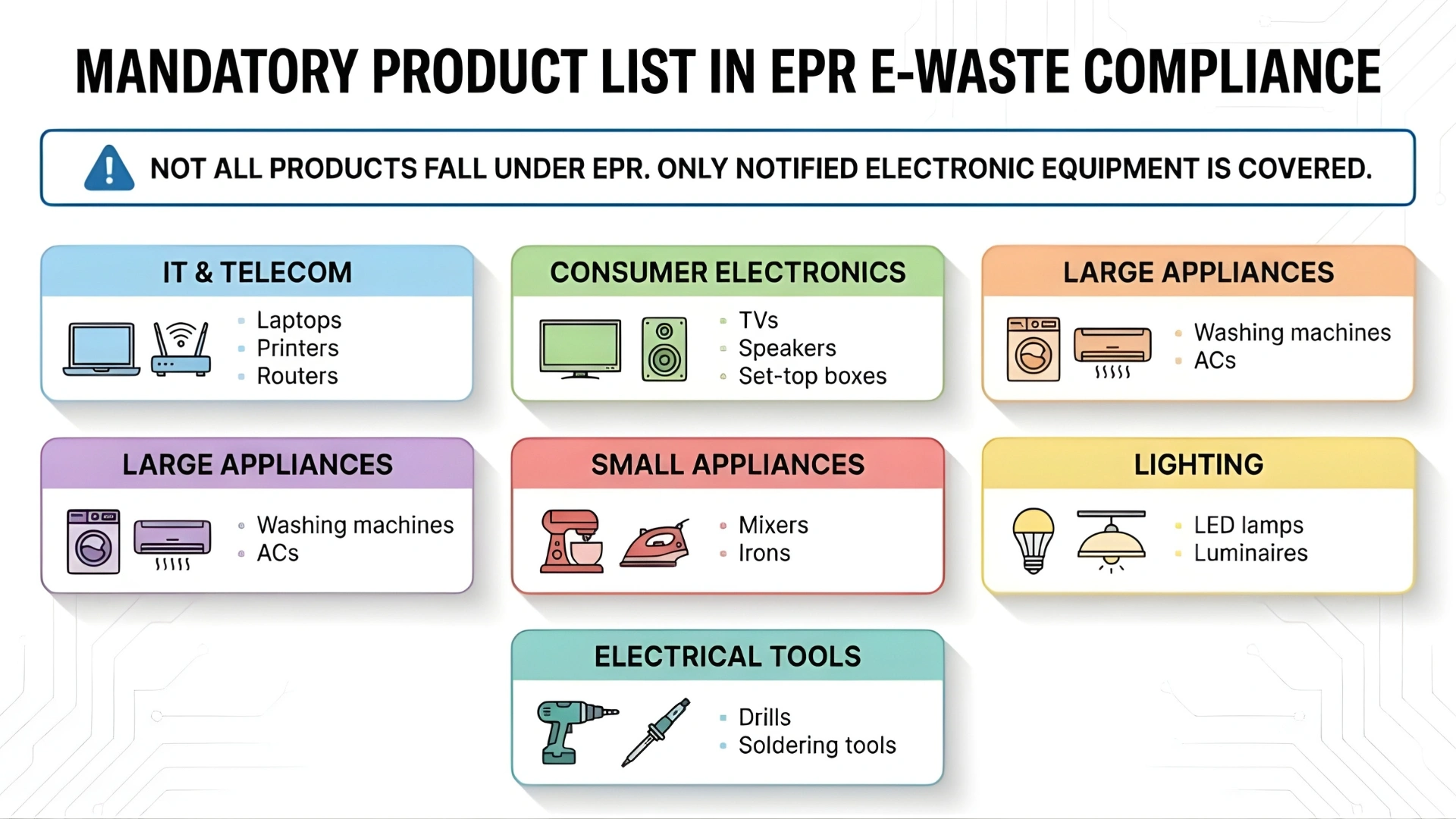
Not all products fall under EPR. Only notified electronic equipment is covered.
| Category | Packaging Type |
|---|---|
| Category | Examples |
| IT & Telecom | Laptops, printers, routers |
| Consumer Electronics | TVs, speakers, set-top boxes |
| Large Appliances | Washing machines, ACs |
| Large Appliances | Washing machines, ACs |
| Small Appliances | Mixers, irons |
| Lighting | LED lamps, luminaires |
| Electrical Tools | Drills, soldering tools |
If your product uses electric current or batteries, EPR likely applies.
When businesses search for “EPR Authorisation Cost” or “CPCB EPR Portal Login”, the intent is usually practical—not theoretical. They want to know how much EPR compliance will actually cost, where the cost arises, and how to correctly access and use the CPCB portal without delays or rejection.
There is no fixed government fee called “EPR authorisation cost” payable to CPCB. Instead, the total cost of EPR E-Waste Management depends on multiple compliance components.
| Category | Packaging Type |
|---|---|
| Cost Component | What It Covers |
| Recycling Credits | Mandatory purchase from CPCB-authorised recyclers |
| Compliance Planning | Product mapping, quantity calculation, targets planning |
| Portal Handling | CPCB EPR portal application & clarifications |
| Annual Returns | Filing, reconciliation, audit readiness |
| Consultant Fees | Optional but critical for error-free approval |
CPCB does not charge a fixed EPR registration fee. Most of the cost goes towards actual recycling and compliance execution, not paperwork.
In practice, businesses with poor initial planning often end up paying more later due to penalties, revised targets, or rejected credits.
Because recycling rates fluctuate, EPR authorisation cost cannot be standardised—any consultant promising a “flat CPCB EPR fee” is misrepresenting the framework.
All EPR activities are conducted through the official CPCB digital system managed by the Central Pollution Control Board.
The CPCB EPR Portal Login is mandatory for:Step 2:
Step 3:
Step 4:
Access dashboard for:These issues frequently delay EPR Registration for E-Waste even when documents are otherwise correct.
For sellers on Amazon and Flipkart, EPR E-Waste Management is no longer a background regulatory formality. It has become a platform-level onboarding and continuity requirement. In practical terms, without valid EPR compliance, your listings can be blocked—even if everything else is in place. Both platforms now align their internal compliance checks with data issued by the Central Pollution Control Board (CPCB) under the E-Waste (Management) Rules, 2022.
E-commerce marketplaces are legally required to ensure that sellers offering electronic products meet environmental regulations. As a result:
EPR compliance is mandatory if:
Even resellers may be asked for EPR details if the brand owner’s compliance is unclear.
| Seller Type | EPR Responsibility |
|---|---|
| Brand Owner | Fully responsible |
| Importer-brand | Fully responsible |
| Authorized Reseller | Must ensure brand’s EPR is valid |
| Dropshipper | Responsibility depends on branding & import trail |
Marketplaces typically hold the brand owner or importer accountable, not the warehouse or logistics partner.
From real compliance cases:
These triggers often lead to sudden EPR document requests from the platform.
Platforms verify:
Any mismatch between marketplace listing data and CPCB records can result in temporary suspension.
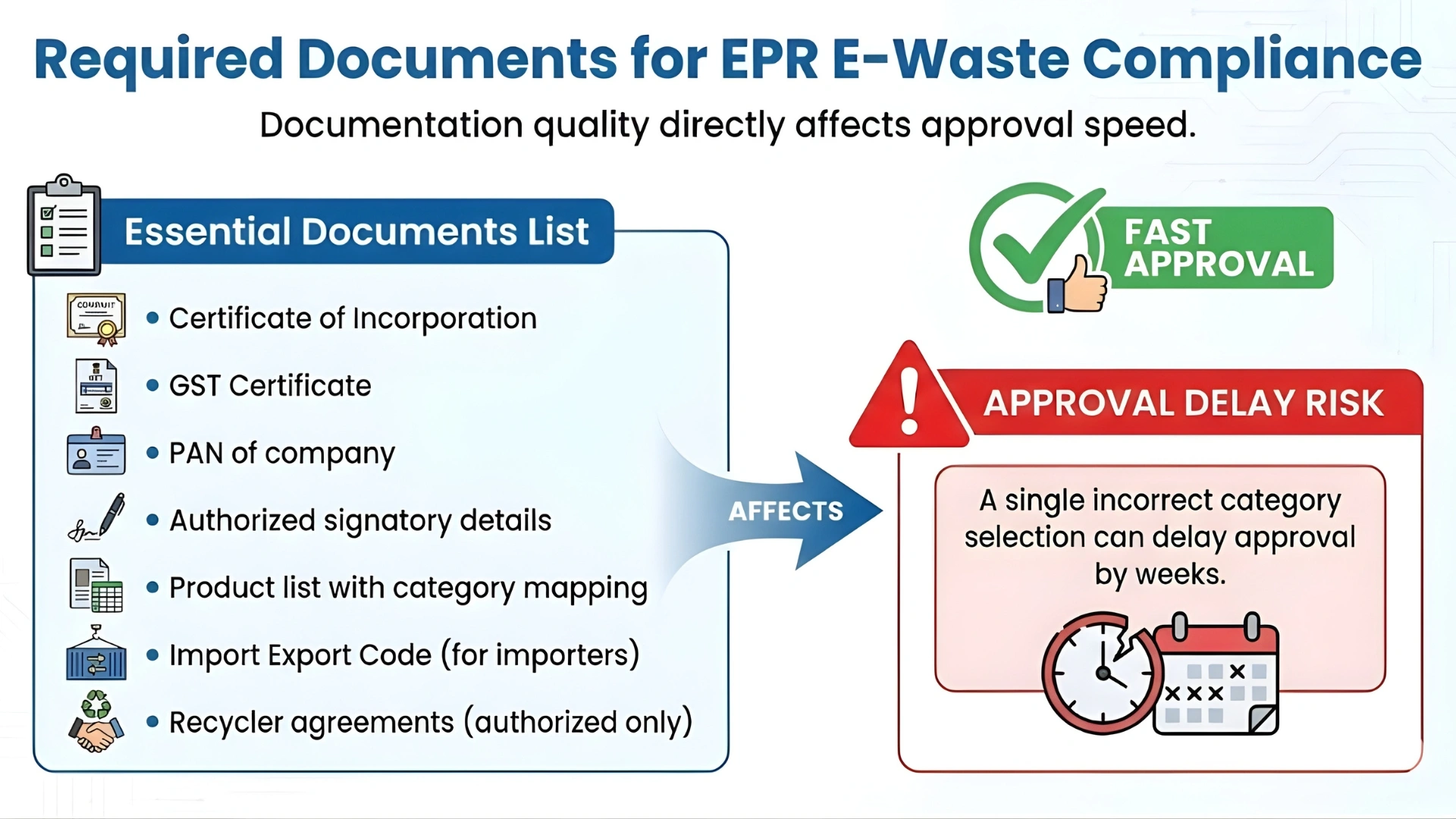
Documentation quality directly affects approval speed.
A single incorrect category selection can delay approval by weeks.
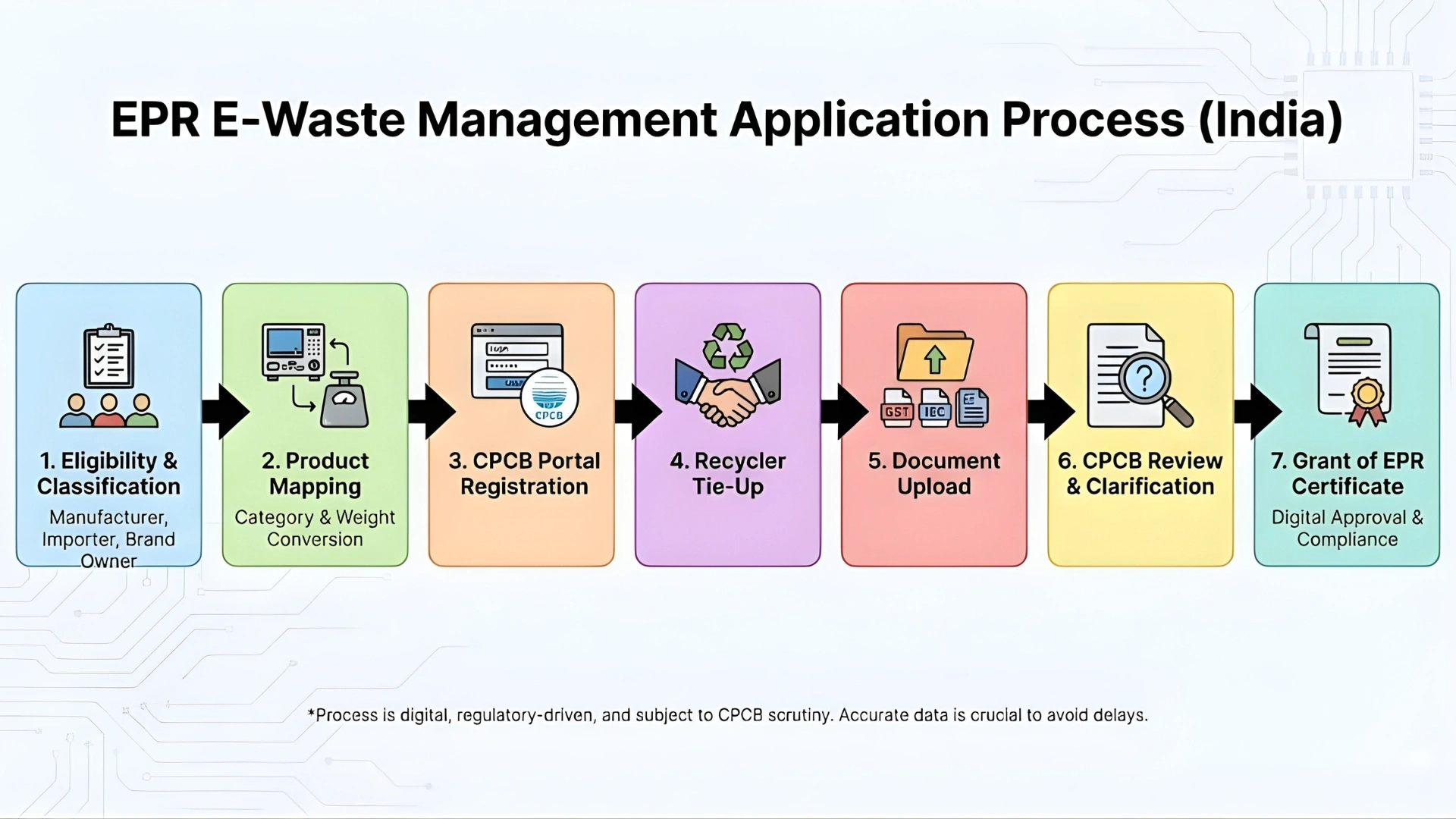
The EPR E-Waste Management application process in India is entirely digital, but it is regulatory-driven, data-sensitive, and closely reviewed by the Central Pollution Control Board (CPCB).
A single error in product categorisation or quantity declaration can delay approval by weeks.
Below is the actual, field-tested process followed for successful EPR Registration for E-Waste.
The first step is determining how CPCB classifies your business:
This classification decides legal responsibility, documentation, and recycling targets. Misclassification is one of the most common causes of application rejection.
Each electronic product must be:
Incorrect category mapping leads to incorrect recycling target calculation, which CPCB flags during review.
The applicant must create an account on the CPCB EPR portal and submit:
All information must exactly match GST, IEC, and incorporation records.
Before submission, applicants must:
Only recyclers listed on the CPCB portal are legally acceptable.
Mandatory documents are uploaded, including:
After submission, the application enters CPCB scrutiny mode.
CPCB may:
Timely and technically accurate responses are critical at this stage to avoid rejection.
Once approved:
This certificate must be maintained throughout sales, imports, and renewals.
Obtaining EPR Registration for E-Waste is only the starting point. Under India’s E-Waste (Management) Rules, 2022, real compliance is measured after registration—through continuous performance, verified recycling, and timely return filing.
Most regulatory actions by the Central Pollution Control Board (CPCB) arise not from missing registration, but from post-registration non-compliance.
EPR compliance is an ongoing, annual obligation, not a one-time approval.
It involves:Failure at any of these stages can lead to suspension of the EPR certificate.
Every registered producer, importer, or brand owner is assigned year-wise E-Waste recycling targets.
Targets are calculated based on:Recycling targets cannot be carried forward or ignored. Shortfalls in one year attracts regulatory action
All registered entities must file annual E-Waste returns through the CPCB portal.
Annual returns typically include:Returns must be:
Delayed or incorrect returns are a primary trigger for CPCB notices.
Businesses must maintain:
CPCB has the authority to:
EPR E-Waste compliance requires producers, importers, and brand owners to meet annual recycling targets through authorised recyclers, purchase valid recycling credits, file accurate annual returns, and maintain audit-ready records as mandated under the E-Waste Rules 2022.
CPCB has intensified enforcement.
Penalties are linked to quantity of non-compliance, not flat fees.
There is no fixed government fee, but compliance cost varies per business model.
Missing annual filings can affect renewal eligibility.
At Silvereye Certifications, we don’t just file applications—we manage compliance as a system.
Our role:Clients typically choose us after facing rejection, delay, or penalty notices.
EPR E-Waste Management is no longer a backend formality—it is a core compliance requirement for doing business in India’s electronics ecosystem.
Whether you are a startup importer or an established brand, EPR Registration for E-Waste protects your operations, brand credibility, and legal standing.
If you want zero-error registration, predictable cost, and long-term compliance clarity, professional guidance makes the difference.
Speak to Silvereye Certifications to align your electronic waste management with India’s evolving regulatory framework—correctly, completely, and on time.
Yes. EPR E-Waste Management is legally mandatory for producers, importers, and brand owners dealing in electronic products under the E-Waste Rules, 2022.
Manufacturers, importers, brand owners, private-label sellers, and certain e-commerce sellers of electronic or electrical equipment must obtain EPR registration.
Yes. Amazon and Flipkart require valid EPR registration for sellers offering electronic products to prevent listing suspension or account restrictions.
No. CPCB does not charge a fixed EPR authorization fee. The cost depends on recycling targets, product category, and recycling credit procurement.
Non-filing or delayed filing of annual returns can lead to EPR certificate suspension, penalties, and sales restrictions.
No. Importers are independently responsible for EPR compliance unless CPCB formally approves responsibility transfer to the brand owner.
EPR registration is generally valid for five years, subject to continuous annual compliance and return filing.
Products using electricity or batteries—such as electronics, IT equipment, appliances, and lighting products—are covered under notified EEE categories.
No. Recycling must be done only through CPCB-authorized recyclers. Informal or unregistered recyclers are not permitted.
Incorrect product categorization, under-declaration of quantities, and mismatch between CPCB filings and sales or import data are the most common reasons.