


It is mandatory approval issued by the Central Pollution Control Board (CPCB) requiring tyre producers to manage end-of-life tyre waste responsibly.
In early 2023, a mid-sized tyre importer approached us after their shipments were held at port—not due to customs issues, but because their EPR Tyre Registration was incomplete. Like many businesses, they assumed tyre waste compliance applied only to manufacturers. That assumption cost them weeks of delay and significant financial exposure.
Tyre waste is no longer treated as an environmental afterthought in India. With rising vehicle ownership, India generates millions of tonnes of waste tyres annually. To address this, the government introduced a structured EPR for tyre waste regime, enforced digitally by the Central Pollution Control Board (CPCB).
When India introduced formal rules for tyre waste, it changed how tyre businesses operate—quietly but decisively. EPR Tyre Authorization in India is the legal approval granted by the Central Pollution Control Board (CPCB) that allows eligible businesses to place tyres in the Indian market only after taking responsibility for their end-of-life management.
If your company manufactures, imports, or sells tyres in India, the law expects you to ensure that an equivalent quantity of waste tyres is collected, recycled, or processed through authorised channels. This responsibility is enforced through Extended Producer Responsibility (EPR) .
Extended Producer Responsibility shifts waste management accountability upstream, from municipalities to businesses that introduce products into the market.
For tyres, EPR means:
EPR Tyre Authorization operates under India’s Tyre Waste Management Rules, notified under the Hazardous and Other Wastes (Management and Transboundary Movement) Rules.
Key regulatory pillars include:
The Central Pollution Control Board (CPCB) is the apex authority responsible for administering and enforcing waste tyre EPR in India.
Its role includes:
EPR Tyre Waste Management is India’s legally mandated system that makes tyre producers accountable for what happens after tyres reach the end of their life.
Instead of leaving collection and disposal to local bodies, the law requires businesses that introduce tyres into the market to ensure their environmentally sound recycling or processing—and to prove it digitally.
India’s tyre EPR regime operates under the Tyre Waste Management Rules, notified within the Hazardous and Other Wastes (Management and Transboundary Movement) Rules.
These rules were introduced to curb long-standing issues such as illegal dumping, uncontrolled burning, and misuse of imported scrap tyres.
Key features of the framework include:
The Central Pollution Control Board (CPCB) administers and enforces these rules nationally, ensuring uniform compliance across states.
EPR tyre waste management applies broadly across categories, including:
Both new and used tyres introduced into the Indian market are considered while calculating EPR obligations. This wide coverage prevents regulatory gaps and discourages informal disposal channels.
The tyre EPR framework is designed with clear, outcome-oriented goals:
EPR Tyre Waste Certification is not limited to a single category of business. The law looks at who places tyres into the Indian market, not who physically generates waste. If your commercial activity results in tyres eventually becoming waste, EPR compliance applies to you.
Under India’s tyre waste management framework, the Central Pollution Control Board (CPCB) clearly defines the obligated entities. Many businesses overlook this and assume EPR is someone else’s responsibility—until enforcement begins.
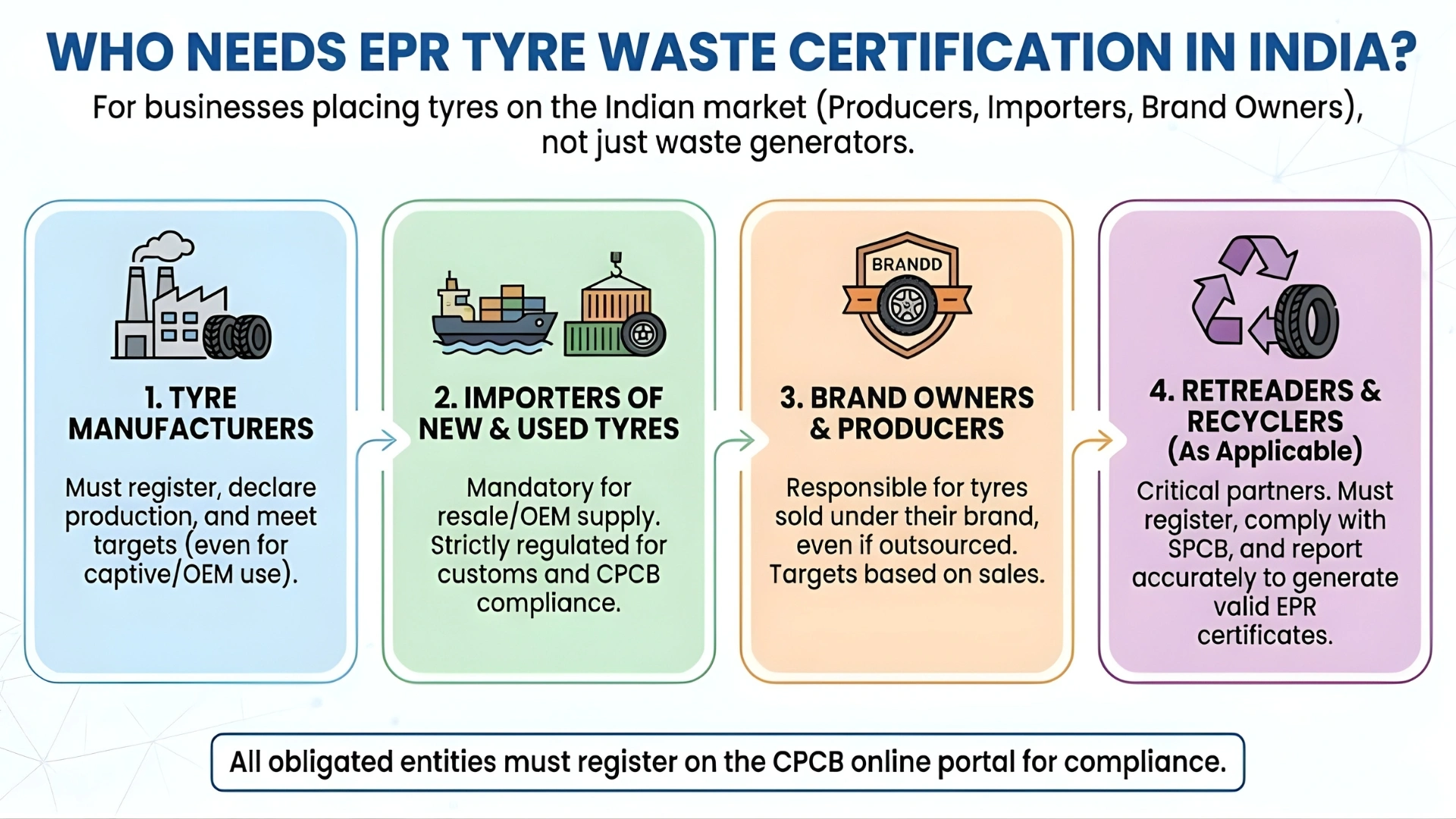
Any company that manufactures tyres in India—whether for domestic sale or export-linked distribution—must obtain EPR Tyre Certification.
Manufacturers are required to:
Even captive or OEM-focused manufacturing units are not exempt.
Importers are one of the most strictly regulated categories under waste tyre EPR.
EPR Tyre Waste Certification is mandatory if you import:
Importers often face enhanced scrutiny because historically, waste tyres were misdeclared as reusable imports. Today, customs clearance, DGFT checks, and CPCB compliance are closely interconnected.
If tyres are sold under your brand name, you are considered responsible—even if manufacturing is outsourced.
This includes:
From a regulatory standpoint, brand ownership equals market responsibility. CPCB assigns EPR targets based on sales data, not factory ownership.
While retreaders and recyclers do not have EPR targets in the same way as producers, they are still critical participants in the EPR ecosystem.
Their obligations include:
Only CPCB-authorised recyclers can generate valid EPR certificates. If a recycler is non-compliant, the producer using those certificates is also exposed to risk
Implementing EPR for tyre waste is not just about meeting a legal requirement—it delivers tangible operational, commercial, and environmental advantages.
The most immediate benefit of EPR is regulatory certainty. By obtaining EPR Tyre Authorization and fulfilling annual targets, businesses remain aligned with the guidelines issued by the Central Pollution Control Board (CPCB).
This ensures:
EPR compliance increasingly functions as a market-entry requirement, not just an environmental obligation.
Many OEMs, institutional buyers, and global partners now:
Having a valid EPR framework signals that your brand operates responsibly and understands regulatory expectations—an advantage in competitive procurement scenarios.
From an environmental standpoint, EPR tyre waste management creates a structured path for:
Tyres processed under EPR are converted into useful outputs such as crumb rubber, recovered steel, or energy products. This reduces fire hazards, air pollution, and long-term soil contamination—issues that unregulated tyre dumping has historically caused in India.
Non-compliance under waste tyre EPR attracts environmental compensation charges, which are often significantly higher than the cost of proactive compliance.
EPR helps businesses:
EPR introduces predictability into compliance planning by:
This allows businesses to budget, plan recycler tie-ups, and manage compliance timelines without operational surprises
The importance of EPR for tyre waste goes far beyond regulatory compliance. It addresses a structural problem India has struggled with for decades—how to manage millions of end-of-life tyres without harming the environment, public health, or the formal recycling economy.
Discarded tyres are not inert waste. When dumped or burned, they release toxic pollutants and pose serious fire risks. EPR tyre waste management ensures that these tyres are channelled into authorised recycling processes where they become secondary raw materials.
Under EPR:
Before EPR enforcement, illegal tyre stockpiling and open dumping were common, particularly near industrial zones and highways. EPR introduces traceability, making it harder for tyres to disappear into unregulated channels.
Key outcomes include:
When each tyre is linked to a producer’s responsibility, accountability replaces anonymity.
EPR has helped formalise the tyre recycling sector by:
Authorised recyclers benefit from predictable material flow, while producers gain access to verified EPR certificates.
EPR for tyre waste aligns with broader national goals related to:
By integrating waste management into business operations, EPR ensures that environmental responsibility becomes part of economic decision-making—not an afterthought.
Understanding the eligibility criteria for EPR for tyre waste is critical because CPCB does not grant registration based on intent alone.
Manufacturers and importers form the primary obligated category under waste tyre EPR.
You are eligible—and required—to obtain EPR Tyre Authorization in India if:
Brand owners are explicitly covered under EPR, even if manufacturing is outsourced.
You fall under this category if:
From a compliance standpoint, CPCB assigns responsibility to the entity benefiting from market presence, not the entity operating machinery.
While recyclers and retreaders do not have EPR targets like producers, their eligibility is essential to the system.
To register, they must:
Only CPCB-registered recyclers are allowed to generate EPR certificates. Producers using certificates from unregistered entities are considered non-compliant.
Regardless of category, all applicants must meet baseline compliance conditions:
Incomplete data, inconsistent declarations, or non-aligned recycler linkages are common reasons for registration delays or rejections.
Entities may face rejection or suspension if:
Eligibility is not permanent—it depends on continuous compliance.
Tyre waste EPR compliance in India has moved decisively from a declarative system to a verification-driven regime.
In the last few compliance cycles, regulators have tightened controls to address misuse, data manipulation, and paper-only compliance. Businesses that continue to follow outdated assumptions are now the most exposed during audits.
The Central Pollution Control Board (CPCB) has significantly strengthened scrutiny across the tyre EPR ecosystem, particularly focusing on credibility of fulfilment rather than mere registration.
Regulatory attention is now centred on:
The CPCB online portal is no longer a static registration platform. It now functions as a live compliance monitoring system.
Key operational changes include:
In select compliance years, CPCB has allowed extended deadlines to help businesses transition into the digital EPR framework. However, this flexibility should not be mistaken for leniency.
The current enforcement approach reflects:
In effect, the compliance window may appear wider on paper, but the In effect, the compliance window may appear wider on paper, but the tolerance for non-performance has narrowed sharply.
From a risk perspective, the biggest shift is this:
EPR compliance is now evidence-based, not intent-based.
Businesses must ensure:
Those who adapt early face minimal disruption. Those who don’t often discover gaps only when notices arrive.
Document readiness plays a decisive role in the approval and continuity of EPR for tyre waste compliance.
These documents establish the legal identity of the applicant and are mandatory for all entity types.
Required documents include:
CPCB determines EPR targets based on market placement data, making commercial records critical.
Typically required documents:
These documents must:
Inflated or understated figures can result in incorrect EPR targets, exposing the entity to future penalties.
These documents are essential where recycling or retreading activity is involved.
Applicable documents include:
CPCB requires formal declarations to ensure accountability and legal enforceability.
Common declarations include:
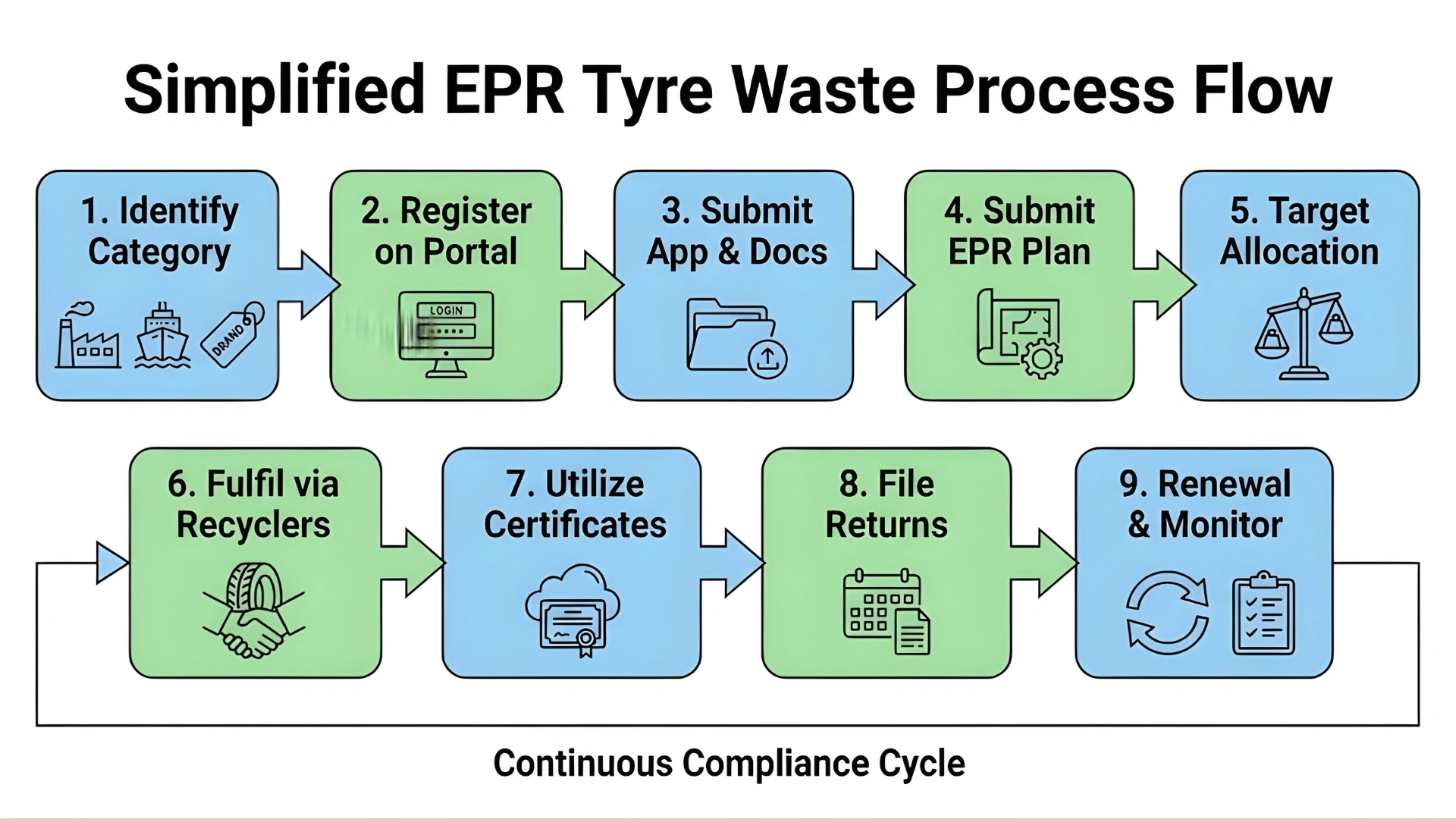
The EPR for tyre waste management process follows a clearly defined, regulator-driven sequence. Treating it as a stepwise compliance workflow—rather than a one-time formality—is essential to avoid rejection, penalties, or audit exposure.
Before initiating registration, the business must correctly identify its role in the tyre supply chain:
All obligated entities must create an account on the CPCB online portal managed by the Central Pollution Control Board (CPCB).
During registration, applicants must:
Once submitted, CPCB verifies the registration credentials.
After account creation, the applicant submits a formal EPR application, supported by:
At this stage, CPCB evaluates:
Incomplete or inconsistent data is the most common cause of application objections.
The EPR plan outlines how the entity will meet its tyre waste obligations.
It includes:
The plan must demonstrate practical feasibility, not just intent.
Based on submitted data, CPCB assigns annual EPR targets:
These targets form the benchmark for compliance.
To meet assigned targets, the entity must:
Only recycling carried out by authorised facilities is recognised for EPR fulfilment.
Once recycling is completed:
Invalid or duplicate certificates are rejected during verification.
Ongoing compliance requires:
EPR compliance is reviewed annually. For renewal:
Non-fulfilment impacts future registrations and may attract penalties.
Non-compliance with tyre waste EPR requirements is no longer treated as a minor procedural lapse. The Central Pollution Control Board (CPCB) has moved toward deterrent enforcement, where financial penalties, operational restrictions, and reputational risks are applied together.
For businesses that delay or partially fulfil obligations, the consequences often escalate quickly.
The primary penalty for non-compliance is environmental compensation (EC), imposed when EPR targets are not met within the prescribed compliance period.
Key points businesses should understand:
Importantly, paying environmental compensation does not replace EPR fulfillment. The obligation continues until targets are fully met.
Repeated non-compliance, false reporting, or use of invalid EPR certificates can lead to:
Beyond financial penalties, CPCB can initiate further action, including:
A critical but often overlooked risk is shared liability. If a producer uses EPR certificates later found to be:
Both the recycler and the producer may be penalised. CPCB places the responsibility of due diligence squarely on the obligated entity.
| Stage / Item | Typical Timeline | Indicative Cost |
|---|---|---|
| CPCB EPR Portal Registration | 1–3 working days | ₹25,000* Govt. fee for new producer registration (one-time) |
| EPR Registration Renewal | Within 30 days before expiry | ₹12,500* Govt. renewal fee |
| EPR Certificate Fulfilment Costs | Ongoing throughout FY | Cost driven by EPR certificates purchased (recycler pricing) |
| EPR Certificates (Recycling Credits) | Quarterly/Annual | Varies by recycler & tyre volume (market-linked) |
| Professional Support / Compliance Assistance | Varies by scope | ₹10,000–₹50,000+ (industry estimate) |
The validity and renewal of Tyre Waste EPR are directly linked to annual compliance performance.
| Item | Details |
|---|---|
| Validity Period | 1 financial year |
| Issuing Authority | Central Pollution Control Board (CPCB) |
| Renewal Requirement | Mandatory every year |
| Renewal Basis | Fulfilment of EPR targets |
| Key Condition | All returns filed & certificates utilised |
| Delay Impact | Penalties, suspension risk |
Silvereye Certifications provides end-to-end support for EPR tyre waste management, helping businesses stay fully compliant with CPCB requirements while avoiding penalties and operational delays.
We assist with EPR Tyre Registration, target planning, recycler coordination, certificate tracking, and timely return filing on the CPCB portal. Our compliance-first approach ensures accurate data submission and audit-ready documentation at every stage.
Why clients trust Silvereye Certifications:
With Silvereye Certifications, tyre waste EPR compliance is simplified, reliable, and built for long-term regulatory confidence.
EPR Tyre Authorization in India is not a paperwork exercise—it is a business-critical compliance requirement under CPCB enforcement. With rising audits and digital traceability, companies that delay EPR Tyre Registration expose themselves to avoidable risk.
A structured, expert-led approach ensures not just compliance, but long-term operational confidence. If tyre waste management feels complex, it’s because it is—but it doesn’t have to be confusing.
It is mandatory approval issued by the Central Pollution Control Board (CPCB) requiring tyre producers to manage end-of-life tyre waste responsibly.
Tyre manufacturers, importers, brand owners, and producers placing tyres in the Indian market must obtain EPR certification.
Yes. Importers of new (and permitted used) tyres must register on the CPCB portal and fulfil EPR obligations.
All categories of tyres—two-wheeler, passenger, commercial, OTR, and industrial tyres—are covered under EPR.
Targets are calculated based on the quantity of tyres sold or imported during the applicable financial year.
EPR authorization is valid for one financial year and must be renewed annually.
Through authorised recyclers who process waste tyres and generate valid EPR certificates on the CPCB portal.
Yes. CPCB requires quarterly return filing along with annual compliance reporting.
Non-compliance attracts environmental compensation, possible suspension, and increased audit scrutiny.
No. Certificates are valid only if generated by CPCB-registered and authorised recyclers.