- Importing Wireless Products carries a Mandatory Requirement: You cannot clear customs for wireless goods (Bluetooth, Wi-Fi, RFID) without a valid WPC Import License and ETA Approval.
- WPC License for Import vs. ETA: The Key Difference is that ETA certifies your product's technology, whereas the WPC Import License permits the specific shipment quantity.
- WPC Import License Timeline & Cost: ETA takes roughly 1-2 weeks; WPC Import Licenses take 2-4 weeks. Government fees start at ₹10,000 for ETA and ₹500 for the license application.
Introduction
Your shipment of 5,000 smartwatches has just landed at the Nhava Sheva port in Mumbai. You have your IEC code, your GST is in order, and your marketing team is ready to launch. But then, you get a frantic call from your Customs House Agent (CHA).
"Sir, the customs officer is asking for the WPC Certificate. The shipment is on hold."
This is a nightmare scenario we see far too often at Silvereye Certifications. Every day that shipment sits in the bonded warehouse, you are paying demurrage charges, and your market launch is delayed.
If you are Importing Wireless Products into India—whether it's a simple Bluetooth speaker, a Wi-Fi router, or a high-end drone—you are dealing with the Department of Telecommunications (DoT), specifically the Wireless Planning and Coordination (WPC) wing.
India controls its radio frequency spectrum strictly. To ensure your devices don’t interfere with defense or telecom networks, you need specific approvals before your goods leave the factory of origin. This guide is your roadmap to navigating the WPC Import License process without the headaches, delays, or hidden costs.
What is Importing Wireless Products?
Importing Wireless Products refers to the legal process of bringing devices that emit or receive radio frequencies (RF) into India from a foreign country. Under Indian law, this is not just a logistics activity but a regulated compliance procedure overseen by the WPC Wing.
Unlike importing standard goods (like furniture or textiles), importing wireless products requires proving that your devices will not interfere with India’s national defense or telecom networks.
To be classified as "Importing Wireless Products," your shipment must contain:
- Transmitters: Devices that send signals (e.g., Wi-Fi Routers, Remote Controls).
- Receivers: Devices that capture signals (e.g., GPS modules, Radio sets).
- Transceivers: Devices that do both (e.g., Smartphones, Bluetooth Speakers, RFID Tags).
Many importers assume "Wireless" means only Wi-Fi. In the eyes of the WPC, even a small wireless doorbell, a drone controller, or a smart lightbulb counts as a wireless product and requires a license.
What is a WPC Import License?
The WPC Import License is an official permit issued by the WPC Wing of the DoT. It grants an importer the legal right to bring wireless apparatus into Indian territory.
Many importers confuse this with the WPC ETA Approval (Equipment Type Approval). Let’s clear that up immediately, as they are two different steps in the same ladder.
WPC ETA vs. WPC Import License: What Do You Actually Need?
This is where 90% of importers get confused. Do you need an ETA or an Import License? The answer depends on your product's frequency.
1. WPC ETA (Equipment Type Approval)
- For Whom: Products operating in De-licensed Frequency Bands (e.g., Bluetooth, Wi-Fi, Zigbee, RFID).
- Process: You apply for ETA-SD (Self-Declaration) on the Saral Sanchar Portal.
- Import License? NO. For these products, the ETA Certificate itself is sufficient for customs clearance. You do not need a separate "Import License" for every shipment.
2. WPC Import License
- For Whom: Products operating in Licensed Frequency Bands (e.g., Walkie-talkies, Drones, Radio Broadcast Equipment).
- Process: You first get the ETA, AND THEN you must apply for a specific Import License for every shipment to get permission for the specific quantity.
Comparison Table: ETA vs. Import License
| Feature | WPC ETA (Equipment Type Approval) | WPC Import License |
| Primary Purpose | Approves the Technology/Model. | Approves the Shipment Quantity. |
| Applicability | Mandatory for ALL wireless products. | Mandatory ONLY for Licensed Bands (Non-Consumer). |
| Validity | Lifetime (for that specific model). | 6 Months to 1 Year (or until quantity is exhausted). |
| Primary Doc | RF Test Report (from NABL/ILAC labs). | Commercial Invoice & ETA Certificate. |
Is the WPC Import License Mandatory?
Yes. Under the Indian Telegraph Act, 1885, and the Indian Wireless Telegraphy Act, 1933, possessing or trading wireless equipment without a license is a punishable offense.
Legal Implications of Importing Without a License
If you attempt to import wireless goods without a WPC License, you risk:
- Confiscation: Customs has the authority to seize and destroy non-compliant wireless goods.
- Demurrage: Your goods will sit at the port while you scramble for paperwork, racking up daily storage fees.
- Penalties: Penalties can range from heavy fines to legal action against the Director of the importing company.
Who is Exempt from WPC Import Licensing?
Technically, very few are "exempt" from the rules, but the process differs. For example, products operating in "De-licensed Frequency Bands" (like standard Wi-Fi and Bluetooth) still need an ETA (Self-Declaration), but the import license process is smoother. True exemptions are rare and usually reserved for specific government bodies or non-transmitting receivers.
Key Products Requiring WPC Import License
Mandatory Product List for WPC Import License
Not all wireless products are treated equally. The WPC divides products into two main categories: those operating in De-licensed Frequency Bands (Consumer goods) and those in Licensed Frequency Bands (Industrial/Restricted goods).
1. Consumer Electronics (De-Licensed Bands)
These products operate on free frequencies (like 2.4 GHz or 5 GHz). They require an ETA (Equipment Type Approval) followed by an Import Undertaking on the Saral Sanchar portal.
- Smartphones & Tablets (Wi-Fi/Bluetooth enabled)
- Laptops & Notebooks
- Smartwatches & Fitness Trackers
- Bluetooth Accessories:
- Headphones / Earbuds / TWS
- Bluetooth Speakers
- Car Stereos (Infotainment systems)
- Computer Peripherals:
- Wireless Mouse & Keyboards
- Wi-Fi Dongles & Adapters
- Smart Home Devices (IoT):
- Smart Bulbs & Plugs
- Wireless Doorbells
- Robotic Vacuum Cleaners (with Wi-Fi)
2. Commercial & Industrial Equipment
These often require specific scrutiny because they can interfere with critical radio networks if not regulated.
- Wi-Fi Routers & Modems (Home & Industrial)
- RFID Devices:
- RFID Tags & Readers (for toll plazas, inventory tracking)
- NFC Terminals (Point of Sale machines)
- Drones & UAVs (Unmanned Aerial Vehicles):
- Note: Remote controllers for drones strictly require WPC Approval.
- Medical Devices:
- Wireless Patient Monitors
- Hearing Aids (with wireless connectivity)
- Automotive:
- Remote Keyless Entry (RKE) systems (Car keys)
- Automotive Radar Sensors
3. Restricted & Licensed Band Equipment (Strict Control)
These items cannot be imported via "Self-Declaration." They require a full WPC Import License with rigorous scrutiny.
- Walkie-Talkies & Two-Way Radios
- Satellite Phones & VSAT Equipment
- Broadcast Transmitters (FM/AM Radio equipment)
- Marine & Aviation Radio Equipment
Benefits of Obtaining a WPC Import License
Why should you view this as an investment rather than a hurdle?
Seamless Customs Clearance in India
When your CHA presents a valid WPC Certificate for import along with the Bill of Entry, customs officials clear the wireless aspect of your shipment immediately. No questions asked, no holds.
Building Trust and Brand Credibility
Displaying the WPC ID on your product packaging tells your customers (and competitors) that your brand follows the law. It signals quality and safety, ensuring your device won't interfere with their other electronics.
Avoiding Legal Penalties
The cost of compliance is a fraction of the cost of non-compliance. A single seized container can bankrupt a small importer. A valid license is your insurance policy.
Eligibility Criteria for Importers
Who Can Apply? (Indian Manufacturers vs. Authorized Agents)
- Indian Manufacturers: Can apply directly using their business credentials.
- Importers: Must hold a valid IEC (Import Export Code).
- Foreign Manufacturers: Cannot apply directly. They must appoint an Authorized Indian Representative (AIR)—like a local office or a consultant like Silvereye Certifications—to apply on their behalf.
The Role of the Authorized Indian Representative (AIR)
If you are a foreign brand (e.g., based in China or the USA) selling to India, you need an AIR. The AIR takes legal responsibility for the product's compliance within India.
Documents Required for WPC Import License
To ensure a smooth application on the Saral Sanchar portal, keep these documents ready.
RF (Radio Frequency) Test Reports
This is the heart of your application. You need a test report from an ISO 17025 accredited laboratory (ILAC or NABL). The report must confirm the product operates in de-licensed bands (e.g., 2.4 GHz for Bluetooth).
Product Technical Literature
- User Manual
- Block Diagram
- Circuit Diagram
- Technical Specifications sheet showing frequency range and power output (EIRP).
ETA (Equipment Type Approval) Certificate
As mentioned earlier, you must obtain the WPC ETA Approval first. The ETA certificate number is mandatory for the import license application.
Purchase Order and Invoice Details
For the import license specifically, you must prove you have a shipment incoming. You will need to upload the Purchase Order (PO) or Proforma Invoice showing the quantity and model numbers.
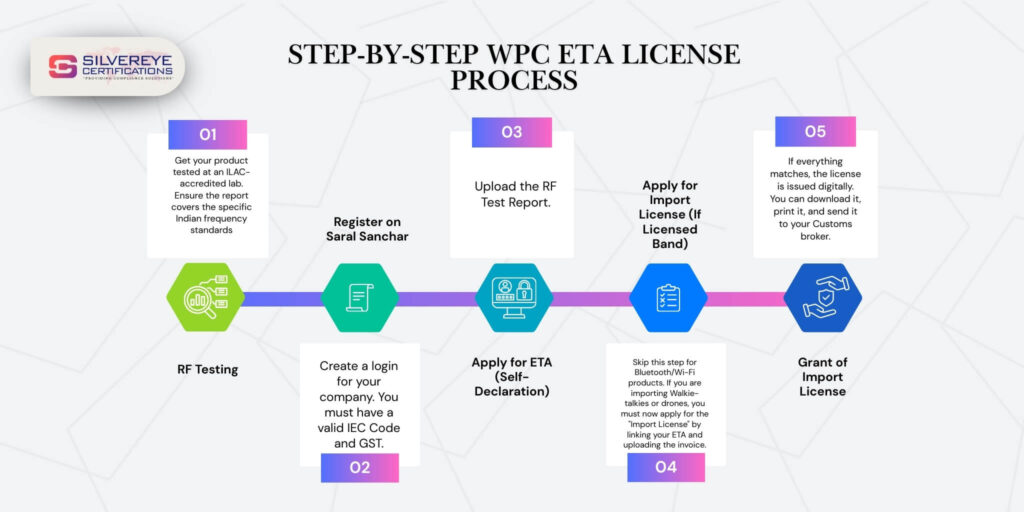
Step-by-Step Process to Get a WPC Import License
The process has moved online to the Saral Sanchar portal, making it more transparent but also more technical.
Step 1: RF Testing
Get your product tested at an ILAC-accredited lab. Ensure the report covers the specific Indian frequency standards (e.g., EN 300 328 for 2.4GHz).
Step 2: Register on Saral Sanchar
Create a login for your company. You must have a valid IEC Code and GST.
Step 3: Apply for ETA (Self-Declaration)
Upload the RF Test Report.
- Fee: ₹10,000 per model.
- Outcome: If the test report is valid, the ETA Certificate is generated instantly (or within 24-48 hours).
Step 4: Apply for Import License (If Licensed Band)
Skip this step for Bluetooth/Wi-Fi products. If you are importing Walkie-talkies or drones, you must now apply for the "Import License" by linking your ETA and uploading the invoice.
- Fee: ₹500 per application.
- Timeline: 15–30 days for scrutiny.
Step 5: Grant of Import License
If everything matches, the license is issued digitally. You can download it, print it, and send it to your Customs broker.
Timeline and Cost of the WPC Import License
Budgeting is critical for importers. Here is a realistic breakdown of the WPC License costs.
| Component | Estimated Cost (INR) | Estimated Timeline |
| Government Fee (ETA) | ₹10,000 per model | 2-3 Working Days |
| Government Fee (Import License) | ₹500 per application | 2-3 Working Days |
| Consultancy & Processing | Varies (Contact SEYECS) | - |
| RF Testing (If required) | ₹30,000 - ₹60,000 (approx) | 2 - 3 Weeks |
Note: Timelines depend heavily on the accuracy of your documents. A single error can restart the clock.
Validity and Renewal for WPC Import License
How Long is the Import License Valid?
The Import License is generally issued for a specific validity period (often 6 months or 1 year) or for a specific quantity. Once you have imported the quantity declared in your license, the license is exhausted.
The Renewal Process
Unlike the ETA (which is lifetime for that model), you will need a new Import License for subsequent shipments if your previous license has expired or the quantity limit is reached. However, since your ETA is already done, getting a fresh import license is much faster.
Why Choose Silvereye Certifications for your WPC Import License Consultant?
Navigating the Department of Telecommunication corridors can be daunting. One wrong technical parameter in your application can lead to a "Query Raised" status, delaying you by weeks.
At Silvereye Certifications (SEYECS), we don't just fill forms; we strategize your compliance.
- Pre-Compliance Audit: We check your RF reports before submission to ensure they will pass WPC scrutiny.
- End-to-End Support: From obtaining the WPC ETA Approval to getting the final Import License, we handle the entire lifecycle.
- Customs Assistance: If your goods are stuck, our team can help draft the necessary technical justifications to release them.
We have helped hundreds of manufacturers and importers bring their wireless technology to the Indian market.
Conclusion
Importing Wireless Products into India offers massive business potential, but it comes with strict regulatory responsibilities. The WPC Import License is not just a piece of paper; it is your passport to the Indian market.
Don't let regulatory hurdles stall your business growth. Whether you need a WPC Certificate for import, ETA Approval, or guidance on the Saral Sanchar portal, getting expert help saves time and money.
Ready to import your wireless products without the stress?
Contact Silvereye Certifications today for a free consultation. Let’s get your products cleared and onto the shelves.
Frequently Asked Questions
Do I need a WPC Import License for Bluetooth Speakers?
Technically, no. For Bluetooth speakers (which operate in the de-licensed 2.4 GHz band), you only need the WPC ETA (Equipment Type Approval). You do not need a separate "Import License" document for every shipment. The ETA certificate is sufficient for customs clearance.
How long is the WPC ETA valid?
The WPC ETA is valid for the lifetime of the product model, provided the technical specifications (design and frequency) do not change. You do not need to renew it annually.
What is the Saral Sanchar Portal?
Saral Sanchar is the Department of Telecommunications' (DoT) official portal for online licensing. All applications for ETA and Import Licenses must be filed digitally here; offline applications are no longer accepted.
Can a foreign manufacturer apply for WPC directly?
No. Foreign entities cannot log in to the Indian government portal. They must appoint an Authorized Indian Representative (AIR)—like Silvereye Certifications—to apply on their behalf.
What happens if my goods are stuck at Customs without WPC?
You will need to apply for the ETA immediately. However, you will pay heavy demurrage (storage) charges while the approval is processed. In some cases, Customs may penalize you or demand re-export of the goods.
Is RF Testing mandatory for WPC?
Yes. You cannot get WPC approval without a valid Radio Frequency (RF) Test Report from an accredited lab (ILAC or NABL). This report proves your device operates on the allowed frequencies.
Does the WPC License cover the adapter/charger too?
No. The WPC covers only the wireless function. The power adapter/charger requires a separate BIS CRS Certification (ISI Mark) to be imported legally.