Home
›
FSSAI registration
Introduction
Every food business in India — whether it's a home baker selling on Instagram, a cloud kitchen on Swiggy, or a multi-state food manufacturer — needs FSSAI Registration before it can legally operate. This guide walks through exactly what FSSAI Registration is, the types of registration and licence available, the newly revised 2026 turnover thresholds, eligibility, documents, the step-by-step application process, fees, and validity — including the recent regulatory order that has changed how food businesses are categorised and how long their licence stays valid.
What Is FSSAI Registration?
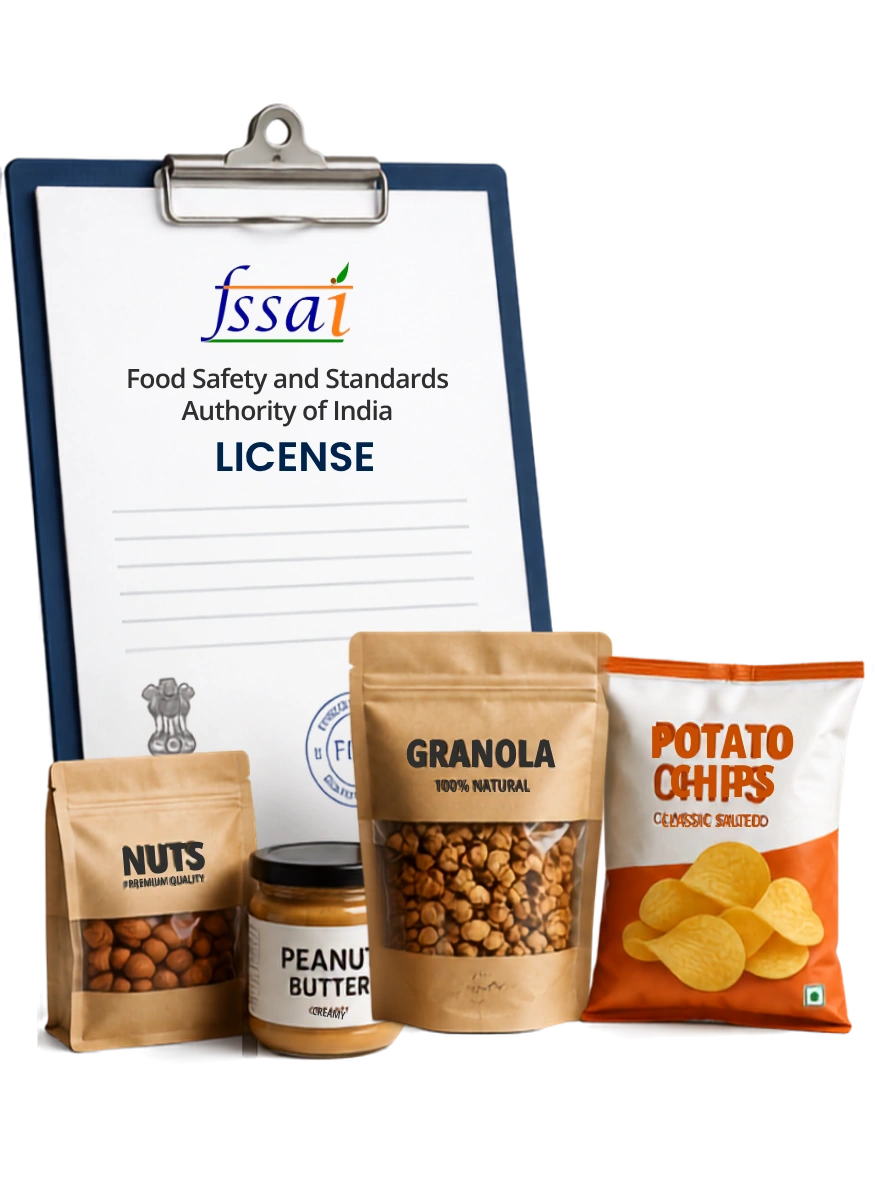
FSSAI Registration is the certification issued by the Food Safety and Standards Authority of India (FSSAI) — a statutory authority established under the Food Safety and Standards Act, 2006, functioning under the Ministry of Health and Family Welfare. It is the legal permission required by every Food Business Operator (FBO) engaged in manufacturing, processing, packaging, storage, distribution, transportation, or sale of food products in India.
Once granted, FSSAI Registration or licence issues a unique 14-digit registration number that must be displayed on the food product label, at the business premises, and on restaurant or cloud-kitchen menus. This number allows consumers, regulators, and marketplace platforms such as Swiggy, Zomato, and Amazon to verify that a food business meets India's food safety standards.
All FSSAI applications, renewals, and modifications are filed through FoSCoS (Food Safety Compliance System) — the official online portal at foscos.fssai.gov.in — which replaced the earlier FLRS system.
2026 Regulatory Update: New Turnover Thresholds and Perpetual Validity
On 13 March 2026, FSSAI's Regulatory Compliance Division issued an official order (F. No. RCD-01002/1/2021-Regulatory-FSSAI-Part(1)) implementing the Food Safety and Standards (Licensing and Registration of Food Businesses) Amendment Regulations, 2026. This order followed recommendations from NITI Aayog's High-Level Committee on Non-Financial Regulatory Reforms and was approved by the Food Authority and the Ministry of Health and Family Welfare.
The amendment introduces three key changes for food business operators:
Revised turnover thresholds for categorising food businesses into Registration, State License, and Central License — detailed in the table below
Perpetual validity of FSSAI registration and licences, subject to risk-based inspections, replacing the earlier fixed 1-to-5-year validity and renewal cycle
Enabling provisions addressing dual compliance requirements for the registration of street food vendors
These revised turnover thresholds officially came into effect from 1 April 2026 and supersede all earlier orders and regulations on this classification.
| Category |
Revised Turnover Threshold (Effective 01.04.2026) |
| Registration |
Turnover up to Rs. 1.5 crore |
| State License |
Turnover above Rs. 1.5 crore and up to Rs. 50 crore |
| Central License |
Turnover above Rs. 50 crore |
Source Note
The turnover thresholds and the perpetual-validity provision above are drawn directly from FSSAI's official order dated 13 March 2026 (Gazette Notification No. RCD-01002/1/2021-Regulatory-FSSAI-Part(1), effective 01.04.2026). Operational details such as ongoing annual fee payment, annual return filing, or inspection frequency under the perpetual-validity regime are still being clarified across official guidance — confirm the latest procedural requirements on the FoSCoS portal or with our compliance team before relying on them for a specific business.
Why FSSAI Registration Matters
Legal requirement: operating a food business without valid FSSAI registration is an offence under the Food Safety and Standards Act, 2006
Consumer trust: the 14-digit FSSAI number reassures customers that your food business meets recognised safety and hygiene standards
Marketplace access: platforms such as Swiggy, Zomato, and e-commerce food sellers require a valid FSSAI number before onboarding
Avoiding penalties: non-compliance can attract fines and, in serious cases, imprisonment under Section 63 of the FSS Act
Business credibility: a valid licence supports loan applications, vendor contracts, and government tenders that require proof of regulatory compliance
Types of FSSAI Registration and License
FSSAI classifies food businesses into three categories based on annual turnover and the nature of business activity:
1. FSSAI Basic Registration (Form A)
For small food businesses with an annual turnover up to Rs. 1.5 crore under the revised 2026 threshold. This covers petty food manufacturers, small retailers, home-based food businesses, hawkers, and small-scale food vendors. It requires the fewest documents and is the fastest to process.
2. FSSAI State License (Form B)
For medium-sized food businesses with turnover above Rs. 1.5 crore and up to Rs. 50 crore under the revised threshold. This applies to mid-sized manufacturers, transporters, marketers, hotels, restaurants, and traders operating within a single state.
3. FSSAI Central License (Form B)
For large food businesses with turnover above Rs. 50 crore. A Central License is also mandatory regardless of turnover for certain activity types, including:
Import and export of food products
100% export-oriented food units
Businesses supplying food products to Central Government agencies or departments
Operations spanning multiple states (multi-state manufacturing, distribution, or head office functions)
Note:
some activity-based triggers for Central License (such as e-commerce food business classification) are reported by industry sources but are not part of the official 13 March 2026 order provided — confirm activity-based applicability for your specific business model on FoSCoS or with our team.
Who Needs FSSAI Registration?
Home-based food businesses selling tiffins, pickles, bakery items, or snacks online or locally
Restaurants, cafes, cloud kitchens, and catering businesses
Food manufacturers, processors, and packagers
Wholesalers, distributors, and retailers of packaged or fresh food
Food importers and exporters
Food transporters and cold-storage operators
E-commerce platforms and food aggregators listing food products or restaurants
Documents Required for FSSAI Registration
Document requirements scale with the category applied for. At a broad level:
| Category |
Typical Documents Required |
| Basic Registration (Form A) |
Passport-size photograph, government ID proof, address proof, declaration of food category/products, business constitution proof |
| State License (Form B) |
All Basic Registration documents plus: layout plan of premises, list of equipment and machinery, water test report, food safety management plan, NOC from local municipal authority, rent agreement (minimum 6 months validity) |
| Central License (Form B) |
All State License documents plus: import-export code (for importers/exporters), proof of turnover, business incorporation certificate, additional constitution documents based on entity type (proprietorship, partnership, LLP, or company) |
FSSAI Registration Process: Step-by-Step
Step 1 — Determine Your Category
Assess your annual turnover and business activity against the revised 2026 thresholds to decide whether you need Basic Registration, State License, or Central License.
Step 2 — Register on the FoSCoS Portal
Visit foscos.fssai.gov.in, create an account using your email and mobile number, and complete OTP verification.
Step 3 — Select Application Type and Category
Choose 'New License/Registration', then select your state and Kind of Business (KoB), which determines the exact category and form applicable.
Step 4 — Fill the Application Form
Complete Form A (Basic Registration) or Form B (State/Central License) with business details, food product categories, and turnover information.
Step 5 — Upload Supporting Documents
Upload the category-specific documents listed above, ensuring scanned copies (not phone photographs) are used to avoid rejection.
Step 6 — Pay the Applicable Fee
Pay the government fee online through net banking, UPI, or card payment based on your category.
Step 7 — Verification and Inspection
For State and Central License applications, a Food Safety Officer may inspect the premises against food safety and hygiene standards before approval.
Step 8 — Certificate Issuance
Once verified, the FSSAI certificate bearing your unique 14-digit registration number is issued and should be displayed prominently at your premises and on product labels.
FSSAI Registration Fees
Government fees are charged based on category. Commonly reported figures across current sources are:
| Category |
Approximate Government Fee |
| Basic Registration |
Around Rs. 100 per year |
| State License |
Roughly Rs. 2,000 – Rs. 5,000 per year, depending on business type |
| Central License |
Around Rs. 7,500 per year |
These figures do not include professional/consultancy charges. Fee schedules and whether an annual fee continues to apply under the new perpetual-validity system are being updated across official channels — confirm the exact, current fee for your category on the FoSCoS portal or with our compliance team before budgeting.
FSSAI Validity and Renewal Under the 2026 Amendment
| Aspect |
Details |
| Validity (from 01.04.2026 amendment) |
Perpetual validity for registrations and licences issued under the amended regulations, subject to risk-based inspections, per FSSAI's official 13 March 2026 order |
| Previous system |
Earlier licences were valid for a chosen period of 1 to 5 years and required renewal before expiry |
| Transition for existing licence holders |
Businesses currently holding a fixed-term licence should verify with FSSAI/FoSCoS whether their existing licence transitions to perpetual validity at next renewal or under a separate transition process |
| Ongoing compliance |
Continued validity is subject to risk-based inspections; specific ongoing obligations (such as annual returns or periodic fee payment) should be confirmed on FoSCoS, as reporting on this varies across sources |
Why Choose Silvereye Certifications for FSSAI Registration
FSSAI registration looks simple on the surface, but choosing the wrong category, missing a document, or misreading the 2026 turnover update can cost weeks of delay — and in some cases, a rejected application. Silvereye Certifications manages the entire process so your food business stays compliant from day one.
Accurate category mapping: We assess your turnover and business activity against the revised 2026 thresholds to recommend the correct registration or licence type the first time
End-to-end documentation support: From Form A/Form B preparation to food safety management plans, layout plans, and water test coordination
FoSCoS portal expertise: Application filing, tracking, and query resolution handled directly on your behalf
Multi-domain regulatory experience: Our team also supports CDSCO, BIS, BEE, PESO, and EPR compliance, so growing food businesses needing overlapping approvals (like packaging or import compliance) get coordinated support
Transparent, no-hallucination guidance: We flag regulatory ambiguity honestly, as with the ongoing clarifications around the 2026 perpetual-validity rollout, rather than guessing at figures
Renewal and transition support: For existing FBOs, we help assess whether your current licence needs action under the new perpetual-validity transition
Get Expert FSSAI Support
Whether you're registering a home food business for the first time or reassessing your licence category under the new 2026 turnover thresholds, Silvereye Certifications can determine the right category, prepare your documentation, and manage your FoSCoS application end-to-end.
Frequently Asked Questions on FSSAI Registration
FSSAI Registration is the mandatory certification from the Food Safety and Standards Authority of India required for any business involved in manufacturing, processing, storage, distribution, or sale of food products in India.
There are three categories: Basic Registration, State License, and Central License, classified based on annual turnover and the nature of the food business activity.
Effective 1 April 2026, Basic Registration applies up to Rs. 1.5 crore turnover, State License from above Rs. 1.5 crore up to Rs. 50 crore, and Central License above Rs. 50 crore, per FSSAI's official order dated 13 March 2026.
Under the 2026 amendment, registrations and licences carry perpetual validity, subject to risk-based inspections, replacing the earlier 1-to-5-year validity system.
Yes. Any home kitchen selling food commercially — including tiffins, pickles, baked goods, or online food sales — needs at least Basic Registration.
Basic Registration is generally faster to process, while State and Central Licenses typically take longer due to premises verification and additional documentation review. Exact current timelines should be confirmed on the FoSCoS portal.
Typically a photograph, government ID proof, address proof, and a declaration of the food products or categories being handled.
Yes. All FSSAI applications are filed through the FoSCoS portal at foscos.fssai.gov.in.
You would need to apply for the next higher category (for example, from Basic Registration to State License) once your turnover crosses the applicable threshold.
Yes, in specific cases — food importers, exporters, 100% export-oriented units, and businesses supplying food to Central Government agencies require a Central License regardless of turnover.