EPR Registration for E-Waste
Introduction
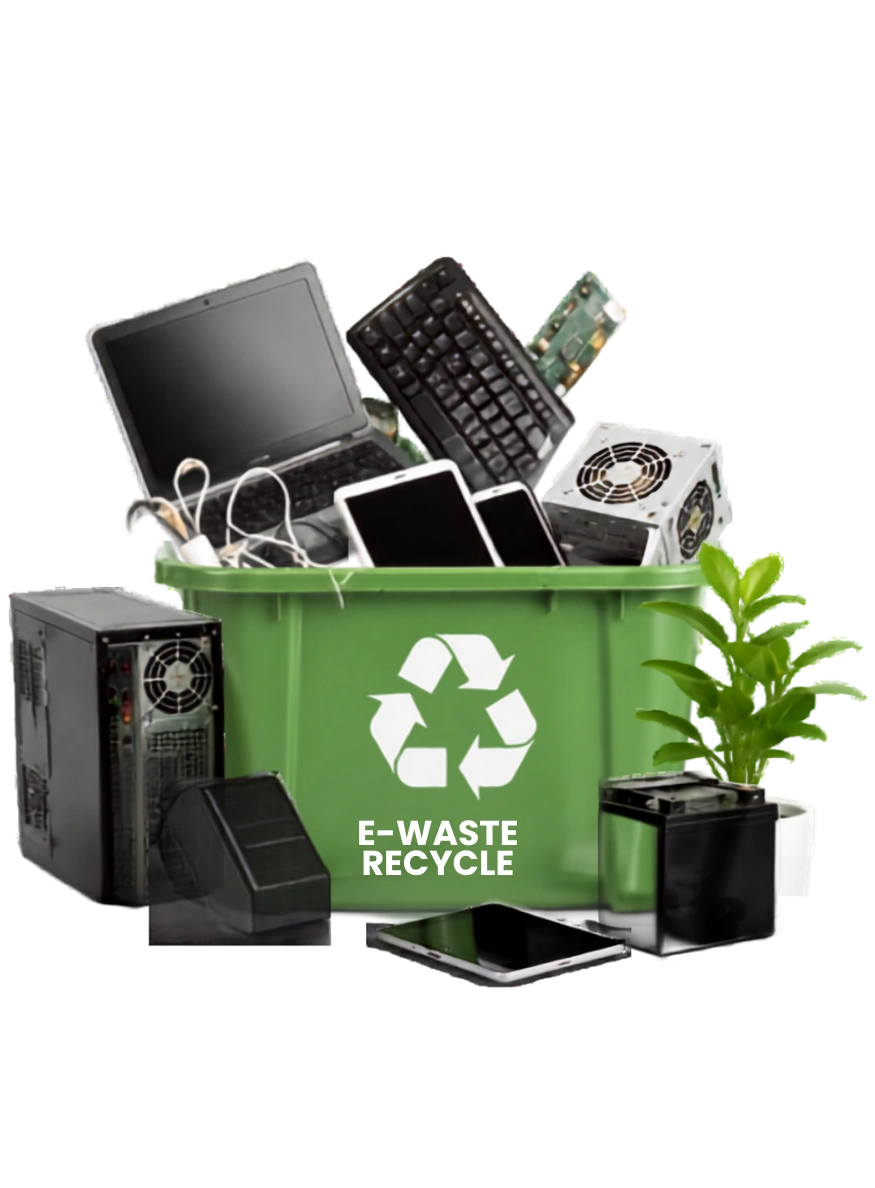
EPR registration for e-waste is a mandatory CPCB approval required under the E-Waste (Management) Rules, 2022, for every Manufacturer, Producer, Importer and Brand Owner that places electrical or electronic equipment (EEE) on the Indian market.
It is filed on CPCB’s centralised E-Waste EPR Portal and applies to all 106 EEE categories listed in Schedule I, from IT and telecom equipment to consumer electronics, appliances, and solar PV modules. Registration involves submitting company KYC, product details mapped to Schedule I, and (for recyclers and refurbishers) facility and capacity documentation.
Registered entities must meet annual recycling targets, currently 70% of generation for FY 2025-26 and FY 2026-27, and file quarterly and annual returns to stay compliant.
What Is EPR Registration for E-Waste?
Extended Producer Responsibility (EPR) for e-waste places the legal responsibility for a product’s end-of-life management on the company that manufactures, imports or brands it — not just on the consumer who eventually discards it. Under the E-Waste (Management) Rules, 2022, this responsibility is formalised through registration on CPCB’s centralised e-waste portal, where every Producer, Importer and Brand Owner declares the electrical and electronic equipment (EEE) it places in the market and commits to recycling a defined share of that quantity each year.
EPR registration for e-waste is therefore the entry point into India’s regulated e-waste ecosystem. Without it, a business is not permitted to legally manufacture, sell or import EEE listed under Schedule I, and importers in particular can face consignments held at customs (ICEGATE) pending a valid registration.
Legal Framework Governing E-Waste EPR in India
E-waste EPR is governed by the E-Waste (Management) Rules, 2022, notified by the Ministry of Environment, Forest and Climate Change (MoEF&CC) and administered by CPCB. The rules replaced the earlier E-Waste (Management) Rules, 2016, and came into force on 1 April 2023.
E-Waste (Management) Rules, 2022 — Effective 1 April 2023, expanded Schedule I coverage from 21 product categories under the 2016 rules to 106 categories, and introduced the centralised EPR portal, EPR certificates and Environmental Compensation for shortfalls
E-Waste (Management) Second Amendment Rules, 2023 (notified 24 July 2023) — Introduced RoHS (Restriction of Hazardous Substances) provisions, restricting the use of substances such as lead, mercury, cadmium and hexavalent chromium in EEE
Solar photovoltaic modules, panels and cells — Explicitly brought under the E-Waste Rules, 2022, with manufacturers and producers required to store solar PV waste generated up to the year 2034-35 as per the phased timeline set out in the rules
The rules apply to every manufacturer, producer, refurbisher, dismantler and recycler dealing in EEE listed in Schedule I, including the components, consumables, parts and spares that make the product operational.
Who Needs EPR Registration for E-Waste?
| Entity |
Description |
| Manufacturer |
Manufactures EEE or its components; must register, collect e-waste generated during manufacturing, and file returns |
| Producer |
Sells EEE listed in Schedule I under its own brand, sells assembled EEE under its brand, or sells imported EEE, including importers |
| Refurbisher |
Restores used EEE for resale; must register, route collected e-waste to registered recyclers, and follow BIS/MeitY refurbishment standards |
| Recycler / Dismantler |
Processes end-of-life EEE; requires registration plus Consent to Establish/Operate, and generates EPR certificates for verified processing |
| Bulk Consumer |
Organisations using EEE at scale; must hand over generated e-waste only to registered producers, refurbishers or recyclers |
| Producer Responsibility Organisation (PRO) |
Manages EPR compliance on behalf of Producers; must obtain its own separate CPCB registration before operating |
Where you register depends on your role: Producers, Manufacturers and Importers register with CPCB’s centralised e-waste EPR portal, while Recyclers and Refurbishers also need Consent to Establish (CTE) and Consent to Operate (CTO) from their State Pollution Control Board or Pollution Control Committee for their processing facility.
Understanding E-Waste Categories Under Schedule I
Schedule I of the E-Waste (Management) Rules, 2022 lists 106 categories of electrical and electronic equipment — a significant expansion from the 21 categories under the 2016 rules. Every applicant must map its products against the relevant Schedule I codes, since misclassification is a common reason for portal queries and delayed approval.
| Product Group |
Representative Examples |
| IT & Telecommunication Equipment |
Laptops, desktops, servers, smartphones, routers, printers, mainframes |
| Consumer Electronics |
Televisions, audio systems, video cameras, monitors, set-top boxes |
| Large Household Appliances |
Refrigerators, washing machines, air conditioners |
| Small Household Appliances |
Mixers, toasters, vacuum cleaners, irons |
| Lighting Equipment |
Fluorescent and other mercury-containing lamps, LED fixtures |
| Electrical & Electronic Tools |
Drills, saws and other powered tools with circuitry |
| Toys, Leisure & Sports Equipment |
Electronic toys, treadmills and similar equipment with electrical components |
| Medical Devices (non-implanted, non-infected) |
Thermometers, blood pressure monitors, ECG machines, dialysis units, X-ray systems |
| Monitoring & Control Instruments |
Smoke detectors, thermostats, weighing scales, pressure gauges, flow meters |
| Solar Photovoltaic Equipment |
Solar PV modules, panels and cells, with a deferred storage/recycling timeline up to 2034-35 |
Implanted or infected medical devices are excluded from Schedule I and are instead governed under the Bio-Medical Waste Rules. Waste batteries and packaging plastics also fall outside the E-Waste Rules, since they are separately regulated under the Battery Waste Management Rules, 2022 and the Plastic Waste Management Rules, 2016 respectively.
Eligibility Criteria and Exemptions For EPE E-Waste
EPR registration for e-waste applies broadly, and unlike the plastic EPR framework, there is no blanket MSME exemption for producers of EEE. The E-Waste (Management) Rules, 2022 exclude only the following from their scope:
Waste batteries — Covered separately under the Battery Waste Management Rules, 2022
Packaging plastics — Covered separately under the Plastic Waste Management Rules, 2016
Micro enterprises — As defined under the Micro, Small and Medium Enterprises Development Act, 2006
Radio-active wastes — Covered under the Atomic Energy Act, 1962
CPCB has also clarified that producer registration is not required where an importer brings in EEE not listed in Schedule I, or imports Schedule I EEE solely to sell it to a producer that is already registered on the portal. Consumers and bulk consumers importing EEE purely for self or captive use (not for resale) may instead file a self-declaration with customs and CPCB, rather than obtaining producer registration.
Documents Required for EPR Registration E-Waste
Document requirements vary slightly by entity type, but a typical Producer/Importer application includes:
Certificate of Incorporation, LLP Certificate or Partnership Deed, as applicable
Company PAN and GST registration
Import Export Code (IEC), for importers
Authorised signatory details and identity proof
Product list mapped to Schedule I categories (commonly filed as Enclosure A), with past sales or import data
RoHS compliance declaration confirming restricted-substance limits are met
Recycling capacity details covering both raw material and product output, for Recyclers and Refurbishers
Geotagged video of the operational unit with installed plant and machinery, for Recycler/Refurbisher applications
Consent to Establish/Operate under the Air and Water Acts, for manufacturing and recycling facilities
Step-by-Step EPR Registration Process For E-Waste
Create an account on CPCB’s centralised E-Waste EPR Portal.
Select your entity type — Manufacturer, Producer, Refurbisher or Recycler — and complete Part A (basic company information).
Complete Part B with detailed information, including your EEE product list mapped to Schedule I codes and past sales/import quantities.
Upload supporting documents — incorporation certificate, PAN, GST, IEC (if applicable), RoHS declaration, and (for recyclers/refurbishers) capacity details and a geotagged facility video.
CPCB reviews the application — typically within 25 working days for Producers and 30 working days for Recyclers/Refurbishers — and may raise a digital checklist of shortcomings.
Respond to any CPCB queries within 7 working days to keep the application moving.
On approval, receive your Registration Certificate through the portal, carrying your registration number and your assigned EPR targets/obligations.
File quarterly and annual returns on the portal, reporting e-waste collected and channelised, and procure or trade EPR certificates to meet your annual target.
EPR Registration Fees for E-Waste
Under Rule 4(6) of the E-Waste (Management) Rules, 2022, CPCB is empowered to charge a registration fee and an annual maintenance charge based on the capacity of e-waste generated, recycled or handled by the applicant, as approved by the Steering Committee.
These fees are structured on a capacity-slab basis rather than a single flat amount, so the exact figure applicable to your business depends on your declared EEE sales volume or processing capacity. Because CPCB periodically revises this fee schedule, always confirm the current slabs on the portal at the time of filing, or check with a compliance consultant before budgeting for your application.
EPR Targets and Compliance Timeline
EPR obligations for e-waste became effective from 1 April 2023, and the recycling target (as a share of the quantity of e-waste generated) has been phased upward:
| Financial Year |
EPR Target (Share of E-Waste Generation) |
| FY 2023-24 and FY 2024-25 |
60% |
| FY 2025-26 and FY 2026-27 |
70% |
| FY 2027-28 onwards |
80% |
For producers who have recently started selling EEE and do not have historical generation data, targets are instead calculated as a share of sales under Schedule IV: 15% of 2021-22 sales (applicable FY 2023-24), 20% of FY 2022-23 sales (applicable FY 2024-25), and 20% of the corresponding financial year’s sales figure from FY 2025-26 onward.
Bulk consumers of Schedule I equipment must hand over the e-waste they generate only to a registered Producer, Recycler or Refurbisher, ensuring the material stays within the formally tracked and audited system.
RoHS Compliance for EPR-Registered Producers
The E-Waste (Management) Second Amendment Rules, 2023 introduced Restriction of Hazardous Substances (RoHS) requirements, limiting substances such as lead, mercury, cadmium, hexavalent chromium and certain brominated flame retardants in EEE sold in India. Producers seeking EPR registration are required to submit documentation demonstrating RoHS compliance for the equipment they place on the market, and to maintain records that support this declaration in the event of a CPCB audit.
Environmental Compensation and Penalties for Non-Compliance
Selling or importing Schedule I equipment without valid EPR registration is not permitted, and CPCB actively tracks unregistered entities through data linkages with GST and customs (ICEGATE) records. Where a registered entity is found to have furnished false information or wilfully concealed information at the time of registration, or in its returns, CPCB can revoke the registration for a period of up to three years, in addition to levying Environmental Compensation. Consequences of sustained non-compliance can include:
Revocation of EPR registration for up to three years, after an opportunity to be heard
Environmental Compensation charges for shortfalls against the annual recycling target
Consignments held at customs (ICEGATE) for importers lacking valid registration
Loss of eligibility to supply to B2B buyers, e-commerce platforms and government procurement channels that now mandate a valid EPR certificate
Reputational impact on ESG scoring and investor confidence
What’s New: E-Waste EPR Updates for 2025-2026
The FY 2025-26 and FY 2026-27 cycle carries a 70% recycling target, up from 60% in the preceding two years, with 80% due from FY 2027-28
Portal-based EPR certificate trading continues to expand, allowing registered recyclers to generate credits that Producers purchase to close their annual target
Solar photovoltaic waste obligations remain on a deferred timeline, with manufacturers and producers required to store PV module waste generated up to 2034-35 rather than recycle it immediately
Enforcement scrutiny has increased, with CPCB cross-checking registered sales and import data against GST and customs records to identify unregistered producers and importers
Benefits of Getting EPR Registration for E-Waste
Legal permission to manufacture, import or sell electrical and electronic equipment in India without risk of enforcement action or customs holds
Access to a network of registered recyclers, refurbishers and PROs to systematically meet annual recycling targets
Eligibility to supply B2B buyers, e-commerce marketplaces and government procurement programmes that now require a valid EPR certificate
Reduced exposure to Environmental Compensation and the risk of registration revocation
Demonstrable ESG and circular-economy credentials that support brand reputation and investor confidence
Why Choose Silvereye Certifications for EPR Registration
Silvereye Certifications supports businesses across India’s regulatory compliance landscape — CDSCO, BIS, BEE, PESO, FSSAI, DPIIT/QCO and environmental approvals — which means your e-waste EPR registration is handled with a clear view of how it connects to your other product, import and manufacturing compliances. Our team manages Schedule I classification, documentation, portal filing, and ongoing quarterly and annual return support, so your business stays compliant without diverting internal resources to track every regulatory update.
Get Your EPR Registration for E-Waste Started
Talk to Silvereye Certifications for end-to-end support on EPR registration for e-waste — from Schedule I classification and documentation to portal filing, annual returns and renewal. Contact our compliance team today to get your CPCB e-waste EPR registration sorted without delays.
Frequently Asked Questions on EPR Registration for E-Waste
It is the mandatory CPCB approval that Manufacturers, Producers, Importers and Brand Owners must obtain under the E-Waste (Management) Rules, 2022, before placing electrical or electronic equipment listed in Schedule I on the Indian market.
Manufacturers, Producers (including importers and brand owners), Refurbishers, Recyclers, Dismantlers and Producer Responsibility Organisations (PROs) all require registration, and Bulk Consumers must hand over e-waste only to registered entities.
106 categories of electrical and electronic equipment, including IT and telecom equipment, consumer electronics, large and small household appliances, lighting, tools, toys, non-implanted medical devices, monitoring instruments, and solar PV modules.
Only micro enterprises, as defined under the MSME Development Act, 2006, are exempt. Unlike the plastic EPR framework, there is no blanket exemption for small or medium brand owners of EEE.
No. Consumers and bulk consumers importing EEE purely for self or captive use, and not for resale, can file a self-declaration with customs and CPCB instead of obtaining producer registration.
Incorporation certificate, PAN, GST, IEC (for importers), authorised signatory details, a product list mapped to Schedule I codes, and a RoHS compliance declaration; recyclers and refurbishers additionally need recycling capacity details and a geotagged facility video.
CPCB typically reviews Producer applications within 25 working days and Recycler/Refurbisher applications within 30 working days, provided the applicant responds to any queries within 7 working days.
70% of e-waste generation for FY 2025-26 and FY 2026-27, rising to 80% from FY 2027-28 onward. New producers without generation history are assessed against a percentage of past sales instead.
Selling or importing Schedule I equipment without valid registration is not permitted, and CPCB can revoke a registration for up to three years for false or concealed information, alongside Environmental Compensation for shortfalls.
CPCB charges a registration fee and annual maintenance charge based on your declared e-waste generation, recycling or handling capacity. The exact slab-wise amount should be confirmed on the portal at the time of filing, as CPCB revises the fee schedule periodically.