Introduction
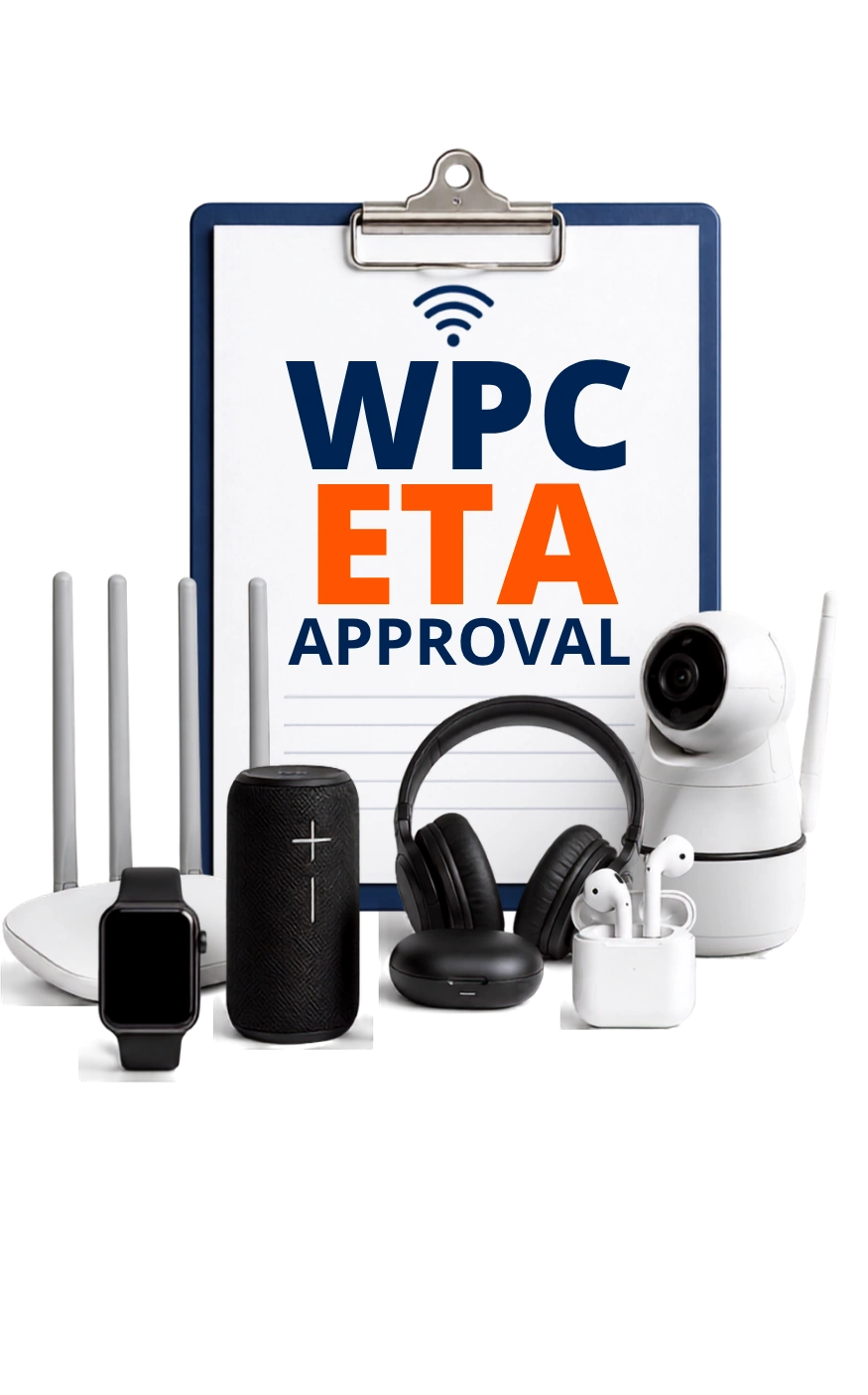
If you manufacture, import, or sell a wireless product in India — a Wi-Fi router, a Bluetooth speaker, a smartwatch, or an industrial IoT sensor — there is one regulatory checkpoint you cannot skip: WPC ETA Approval. Many businesses discover this requirement only after their shipment gets stuck at customs, which is exactly the scenario this guide helps you avoid.
Below, we cover what WPC ETA Approval is, who needs it, the step-by-step registration process, documents, fees, validity, renewal, common pitfalls, and how Silvereye Certifications can manage the entire process for you.
What Is WPC ETA Approval?
WPC ETA Approval, short for Equipment Type Approval, is a certification issued by the Wireless Planning and Coordination (WPC) Wing — a division of India's Department of Telecommunications (DoT) under the Ministry of Communications. WPC was established in 1952 and operates from its headquarters in New Delhi, with regional wireless monitoring stations supporting its work across the country.
The WPC Wing is responsible for managing India's radio frequency spectrum and issuing wireless licences to individuals, businesses, and government departments. WPC ETA Approval specifically certifies that a wireless product:
Operates only within the frequency bands: permitted for its device category in India
Transmits at power levels: within the limits prescribed for that frequency band
Does not generate spurious emissions: that could interfere with other spectrum users
Meets applicable Indian technical standards: for wireless and radio frequency equipment
Why WPC ETA Approval Matters for Your Business
WPC ETA is not a formality — it is a legal prerequisite for market entry. Here is why it deserves priority in your product launch timeline:
Legal market access: without a valid ETA, wireless products cannot be legally imported, manufactured, or sold in India.
Customs clearance: Indian customs authorities increasingly cross-check RF compliance during shipment clearance; products without valid ETA face detention or seizure at the port.
Avoiding penalties and demurrage: applying after goods have already arrived risks storage costs, demurrage charges, and regulatory penalties.
Buyer and marketplace trust: e-commerce platforms and B2B buyers increasingly ask for ETA documentation before listing or purchasing wireless products.
Spectrum protection: at a systemic level, ETA ensures millions of wireless devices operating in India do not interfere with each other or with licensed spectrum users.
Which Products Require WPC ETA Approval?
Any product that transmits or receives signals using a de-licensed radio frequency band typically requires WPC ETA. This spans a wide range of consumer, industrial, and enterprise wireless devices.
| Product Category |
Examples |
| Consumer electronics |
Wi-Fi routers, Bluetooth speakers, wireless headphones and earphones, smartwatches, smart bands |
| Mobile & computing devices |
Smartphones, tablets, laptops, electronic notepads |
| IoT and smart home |
Smart plugs, home automation hubs, wireless sensors, smart locks |
| Short-range devices |
Microphones, RFID tags and readers, Zigbee and Z-Wave devices, remote controls |
| Industrial and enterprise |
POS machines, wireless CCTV systems, barcode scanners, LoRa/NB-IoT modules |
| Peripherals |
Wireless printers, scanners, cameras, gaming controllers |
Important DistinctionSelf-declaration ETA (the faster, commonly used route) does not apply to four categories: radar equipment, cellular jamming devices, drones/UAVs, and satellite equipment such as VSAT terminals. These require a more detailed WPC review rather than self-declaration.
Who Needs to Apply: Eligibility and Applicant Categories
| Applicant Type |
Requirement |
| Foreign manufacturer, no Indian branch office |
Must appoint an Authorized Indian Representative (AIR) to apply for WPC ETA on their behalf |
| Manufacturer with an Indian branch office |
Can apply directly for WPC ETA without needing an AIR |
| Importer of finished wireless products |
Must obtain WPC ETA (self-declaration route, where applicable) before customs clearance |
| Domestic manufacturer using pre-approved RF modules |
No separate ETA needed if the RF module already holds a valid ETA and is used without modification |
| Domestic manufacturer of the RF module itself |
The RF module requires its own ETA if sold or supplied separately |
Documents Required for WPC ETA Registration
RF (radio frequency) test report from an ISO/IEC 17025 / NABL-accredited laboratory, or an accredited international lab, confirming frequency, power, and emission compliance
Technical product specification sheet detailing wireless technologies used (Wi-Fi, Bluetooth, Zigbee, LoRa, GPS, NB-IoT, etc.) and operating frequency bands
Company incorporation and business registration documents (for the Indian entity or Authorized Indian Representative)
Authorization letter/agreement appointing the Authorized Indian Representative, where applicable
Self-declaration form for the specific commodity being imported or manufactured
Import Export Code (IEC) issued by DGFT, for importers
Product photographs and user manual, where requested during scrutiny
Existing international type-approval certificates (FCC, CE/ETSI), if available, to support the technical file
WPC ETA Approval Process: Step-by-Step
The WPC ETA approval process follows a defined sequence on the Saral Sanchar portal. Here is how it works:
Step 1 — Product and Technology Assessment
Identify every wireless technology in your device — Wi-Fi (2.4 GHz/5 GHz), Bluetooth, Zigbee, Z-Wave, LoRa, GPS, NB-IoT, or others — since each technology and frequency band determines the applicable approval category. Products combining multiple technologies (for example, a smartwatch with both Wi-Fi and Bluetooth) may need approval covering each technology.
Step 2 — RF Testing at an Accredited Laboratory
Get your product tested for frequency range, transmission power, and spurious emissions at an NABL-accredited or equivalent international accredited RF testing laboratory. This test report is the single most technically critical document in the entire application.
Step 3 — Registration on the Saral Sanchar Portal
Create an account on the Saral Sanchar online portal, the official platform for WPC ETA applications, and generate your applicant profile.
Step 4 — Application and Self-Declaration Filing
Submit the online application specifying the commodity, generate your import ID, and file the self-declaration confirming the product falls within permitted de-licensed frequency bands.
Step 5 — Document Upload and Technical Submission
Upload the RF test report, technical specifications, authorization documents, and other supporting paperwork through the portal.
Step 6 — WPC Wing Scrutiny
The WPC Wing reviews the application and technical file for completeness and compliance. Queries, if any, are raised at this stage and must be addressed promptly to avoid delays.
Step 7 — ETA Certificate Issuance
Once scrutiny is complete and the application is found compliant, the WPC Wing issues the Equipment Type Approval certificate for that specific product model.
Step 8 — Customs Clearance and Ongoing Compliance
Use the ETA certificate number for customs clearance on import, and retain records for compliance checks, renewals, or future audits.
Plan Ahead
WPC ETA should be obtained before your first shipment arrives in India — not during or after. Applying retroactively risks customs delays, storage and demurrage costs, and possible penalties. Engage a consultant well ahead of your planned import or launch date.
WPC ETA Approval Fees
| Fee Component |
Details |
| Fee Basis |
WPC ETA fees are charged on a per-model basis. |
| Fee Amount |
Fees vary depending on the product category, wireless technology, and the applicable WPC scheme. |
| Indicative Fee Range |
Approximately ₹500 to ₹50,000 per model, depending on the product category. |
| Alternative Fee Reference |
Some schemes may have a fee of around ₹10,000 per product/model. |
| Fee Revision |
WPC ETA fee schedules are revised periodically by the WPC Wing, Government of India. |
WPC ETA Approval Validity, Renewal, and Timeline
| Aspect |
Details |
| Processing timeline |
Typically 4–8 weeks (approximately 30–60 working days), depending on application completeness and query resolution |
| Validity period |
Varies by product category and scheme — some approvals are issued for a fixed multi-year term, while certain self-declaration ETAs carry no fixed expiry. Confirm the exact validity applicable to your product category with the WPC Wing or your compliance consultant |
| Renewal |
Where a fixed validity period applies, renewal should be initiated well before expiry to avoid a compliance gap; product design changes typically require a fresh application rather than a renewal |
| Factory inspection |
Not required — testing can be conducted at any accredited laboratory, in India or overseas |
| Per-model basis |
ETA is issued separately for each product model; a new model variant generally requires its own application |
Why Choose Silvereye Certifications for WPC ETA Approval
Navigating WPC ETA Approval involves technical frequency assessments, accredited lab coordination, and precise documentation — a process where a single error can cost weeks. Silvereye Certifications manages the process end-to-end so you can focus on your product launch.
End-to-end regulatory guidance: From product technology assessment to certificate issuance, handled by consultants experienced across CDSCO, BIS, BEE, PESO, FSSAI, and telecom compliance frameworks.
Accurate frequency and category mapping: Correct classification of Wi-Fi, Bluetooth, Zigbee, LoRa, GPS, and other wireless technologies to avoid rejection or resubmission.
Accredited lab coordination: Support in identifying and coordinating with NABL-accredited or equivalent international RF testing laboratories.
Documentation precision: Complete preparation of self-declarations, technical files, and AIR-related paperwork for foreign manufacturers.
Transparent timelines and communication: Realistic timeline planning so your import or launch schedule is never derailed by last-minute compliance gaps.
Single point of contact across approvals: For products needing both WPC ETA and BIS certification, Silvereye coordinates both processes together, saving time and reducing duplication of effort.
Get Expert WPC ETA Support
Whether you are importing your first wireless product into India or managing ETA renewals across an existing product line, Silvereye Certifications can assess your requirement, coordinate RF testing, and manage your Saral Sanchar application from start to finish.
Frequently Asked Questions on WPC ETA Approval
WPC ETA (Equipment Type Approval) is a mandatory certification from the Wireless Planning and Coordination Wing confirming that a wireless product complies with India's radio frequency regulations before it is imported, manufactured, or sold.
Manufacturers, importers, and Authorized Indian Representatives of products using Wi-Fi, Bluetooth, Zigbee, RFID, LoRa, GPS, or similar de-licensed wireless technologies need to apply.
No. Factory inspection is not required. RF testing can be conducted at any accredited laboratory, including facilities located outside India.
Processing typically takes around 4 to 8 weeks (roughly 30 to 60 working days), depending on how complete the application and technical documentation are.
Saral Sanchar is the official online portal through which WPC ETA applications, self-declarations, and related telecom approvals are filed and tracked.
Yes. A foreign manufacturer without an Indian branch office must appoint an Authorized Indian Representative (AIR) to file and manage the WPC ETA application.
No. WPC ETA verifies radio frequency and spectrum compliance, while BIS certification verifies product safety and quality standards. Some products require both.
Products without valid ETA can be detained or seized by customs authorities at Indian ports, and the importer may face penalties and shipment delays.
No. Radar equipment, cellular jamming devices, drones/UAVs, and satellite equipment such as VSAT terminals are excluded from the self-declaration route and require separate WPC review.
Generally no, provided the RF module already holds a valid ETA and is integrated into the finished product without modification. If the module is altered or sold separately, it needs its own approval.