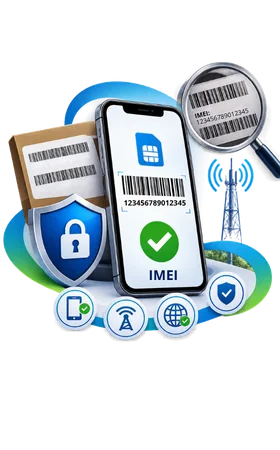
IMEI Registration in India is the mandatory process of recording every IMEI-bearing device's identity — mobile handsets, modules, modems, SIM boxes, tablets, and similar equipment — with the Department of Telecommunications (DoT) before it is imported or sold. As of 2025–2026, this is done on the Device Setu (Indian Counterfeited Device Restriction – ICDR) portal under the Telecom Cyber Security Rules, 2024.
Importers must register before customs clearance; manufacturers must register before first sale, testing, or R&D. Unregistered or duplicate IMEIs can be blocked from Indian telecom networks, and tampering with an IMEI is now a cognizable, non-bailable offence under the Telecommunications Act, 2023.
Compliance Expert
If you import phones, modules, or any device with an IMEI into India — or you manufacture them here — you've probably run into three confusing acronyms in the same sentence: IMEI registration, Device Setu, and ICDR. Add CEIR, WPC ETA, and BIS CRS into the mix, and it's easy to see why so many importers get stuck at customs over paperwork they didn't know they needed.
This guide walks through the entire process the way it actually works in 2026, based on the current DoT rules and the live Device Setu portal — not the older, informal system that most articles online are still describing.
IMEI Registration is the process of registering a mobile device’s unique 15-digit International Mobile Equipment Identity (IMEI) with the relevant Indian government system before the device is imported, manufactured, or placed on the Indian market. The IMEI acts as a unique identity for a mobile device and helps authorities and telecom operators identify and verify individual devices.
In India, IMEI-bearing devices such as smartphones, tablets, cellular modules, modems, mobile hotspots, SIM boxes, smartwatches, and cellular laptops may fall under this requirement. The registration is handled through the Device Setu (ICDR) portal and helps verify device identities, prevent counterfeit or cloned IMEIs, and support network-level device tracking. For importers and manufacturers, completing IMEI registration is an important compliance step before the relevant devices enter the Indian market.
The requirement applies to a wider set of products than most people expect. It's not just smartphones — it covers any IMEI-bearing telecommunication equipment.
The obligation, however, isn't identical for everyone — the timing depends on which side of the supply chain you're on.
| Category | Who It Applies To | When Registration Must Happen |
|---|---|---|
| Importers | Any business bringing IMEI-bearing devices into India for sale, testing, R&D, or any other purpose | Before the device is imported into India — i.e., before customs clearance, not after |
| Manufacturers | Domestic manufacturers assembling or producing IMEI-bearing devices in India | Before the device's first sale, testing, R&D, or any other use — i.e., before it leaves the factory for any purpose |
| Brand owners / OEMs selling under their own label | Companies that outsource manufacturing but sell under their own brand | Before first sale in the Indian market, same as manufacturers, with brand-TAC linkage required |
| Benefit | Description |
|---|---|
| Prevents Counterfeit Devices | Helps verify genuine devices and reduce counterfeit products. |
| Prevents IMEI Cloning | Helps identify duplicate, cloned, or invalid IMEI numbers. |
| Supports Customs Clearance | Helps importers meet IMEI-related requirements during customs clearance. |
| Reduces Network Blocking | Helps prevent devices from being blocked due to invalid or unregistered IMEIs. |
| Ensures Compliance | Supports compliance with applicable Indian telecom regulations. |
| Improves Device Security | Enables better identification and traceability of IMEI-bearing devices. |
The process runs in a defined sequence, and skipping a step simply blocks you from the next one. Here's how it plays out end to end:
For businesses shipping in bulk, IMEIs are typically uploaded in batch files rather than one at a time, which is why accurate documentation and correctly formatted TAC data upfront save real time later — most delays happen because of mismatched or incomplete records, not the portal itself.
Documentation requirements differ slightly for importers and manufacturers, but the core company-verification paperwork is consistent across both.
| Document | Applicable To | Notes |
|---|---|---|
| Certificate of Incorporation (or Partnership Deed / LLP Agreement) | Both | Self-attested with company stamp |

| PAN card of the company | Both | Required for portal registration |

| GST registration certificate | Both | Confirms the business is a valid, tax-registered Indian entity |
| IEC (Import Export Code) | Importers | Mandatory for any import transaction in India |
| Authorised signatory ID and address proof | Both | Aadhaar/PAN/passport of the person operating the account |
| Brand authorisation letter | Importers of third-party brands | Confirms you're authorised to import/sell that brand in India |
| GSMA TAC allocation proof | Both | Confirms the device model's Type Allocation Code is genuine |
| CHA authorisation (if applicable) | Importers using a customs agent | Links your Customs House Agent to your ICDR profile |
| Digital Signature Certificate (DSC) | Both | Often required for authenticating submissions |
Everything submitted needs to be self-attested and carry the company stamp — scanned copies without these are a common reason applications get sent back for correction.

| Particular | IMEI Registration Details |
|---|---|
| Registration Cost | The DoT has not specified a single standardised government fee for IMEI registration. Costs may include documentation, Digital Signature Certificate (DSC), attestation/notarisation, and professional consultancy fees, if applicable. |
| Validity | IMEI registration is linked to the registered device/model and submitted IMEI information. The available guidance does not specify a separate fixed validity period for the IMEI Registration Certificate. |
| Renewal | No specific periodic renewal requirement or standard renewal fee is stated in the available guidance. New device models or IMEI batches generally require the relevant registration/submission through Device Setu (ICDR). |
| Additional Cost | If a valid GSMA TAC is not already available, TAC allocation may involve a separate fee payable to GSMA. |
| Processing Time | Typically, the process may take **a few working days to a few weeks**, depending on the completeness and accuracy of the documents and IMEI/TAC information submitted. Make a bootstrap table and fill the given content here without any changes in content |

Silvereye Certifications helps importers, manufacturers, OEMs, and brand owners navigate the IMEI Registration process in India with a structured and documentation-focused approach. Our team assists with the key stages of compliance, from preparing the required documents and setting up the Device Setu (ICDR) profile to brand and model registration, GSMA TAC linkage, IMEI submission, validation, and certificate follow-up.

With experience in regulatory compliance, we help businesses reduce documentation errors, avoid unnecessary delays, and understand the requirements applicable to their specific device and business model. Our goal is to make the IMEI registration process clear, efficient, and easier to manage from application to completion.
Get Free Consultation
Speak directly with our compliance experts and get professional guidance for BIS, BEE, CDSCO, EPR, WPC, TEC/MTCTE, EMI/EMC Testing and other regulatory approvals.
Explore our certification and compliance solutions.
See what our clients say about our compliance and certification services.
Silvereye helped us complete our BIS Certification quickly and professionally.
Their CDSCO team handled all documentation and approvals without delays.
Excellent support for EPR Registration and annual compliance management.
Very responsive team. Our registration was completed before expected timelines.
Silvereye helped us complete our BIS Certification quickly and professionally.
Their CDSCO team handled all documentation and approvals without delays.