Home
›
EPR Annual Compliance
Introduction
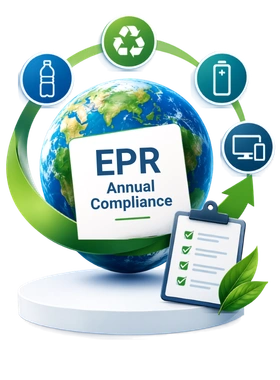
EPR Annual Compliance refers to the ongoing obligations every CPCB-registered producer, importer, brand owner, or recycler must fulfil after obtaining EPR registration — most importantly, filing annual (and in some categories, quarterly) returns that report sales or import volumes, EPR certificates purchased, and progress against recycling targets. This applies across all five regulated waste categories: plastic packaging, e-waste, battery, tyre, and used oil.
Deadlines are typically 30 June following the close of the financial year, though CPCB has periodically extended specific category deadlines. Missing a return can trigger show-cause notices, environmental compensation charges, suspension of registration, and — for importers — blocked customs clearance on future consignments.
What Is EPR Annual Compliance?
EPR Annual Compliance is the set of recurring obligations a business must meet every year after it has registered under any Extended Producer Responsibility framework in India — plastic packaging, e-waste, battery, waste tyre, or used oil. Registration is only the starting point; CPCB requires every registered entity to file periodic returns confirming the quantity of regulated material placed in the market, the EPR certificates purchased or generated, and whether the year's recycling or recovery target has been met.
In practical terms, annual compliance means logging into the relevant CPCB EPR portal each year, uploading verified sales/import data, attaching supporting invoices and recycler certificates, reconciling the numbers against your declared EPR target, and submitting the return before the notified deadline. Some categories additionally require quarterly progress filings during the year, with the annual return acting as the final consolidated submission.
Legal Framework Behind EPR Annual Compliance
Annual return filing obligations are built into the rules governing each waste category, all issued under the Environment (Protection) Act, 1986:
| Waste Category |
Governing Rules & Filing Basis |
| Plastic Waste |
Plastic Waste Management Rules, 2016, as amended by the PWM (Amendment) Rules, 2022; annual return filed on the Centralized EPR Portal for Plastic Packaging. |
| E-Waste |
E-Waste (Management) Rules, 2022; quarterly and annual returns filed on the E-Waste EPR Portal. |
| Battery Waste |
Battery Waste Management Rules, 2022; annual return filed on the Battery EPR Portal, covering sales volumes and EPR certificates purchased. |
| Waste Tyre |
Hazardous and Other Wastes (Management and Transboundary Movement) Amendment Rules, 2022 (Schedule IX); quarterly and annual returns on the Waste Tyre EPR Portal. |
| Used Oil |
Hazardous and Other Wastes (Management and Transboundary Movement) Second Amendment Rules, 2023 (Chapter VII), effective 1 April 2024; quarterly and annual returns on the Used Oil EPR Portal. |
Who Must File EPR Annual Returns?
Annual (and where applicable, quarterly) return filing applies to every entity holding a valid EPR registration, regardless of category:
| Entity Type |
Filing Obligation |
| Producers / Manufacturers |
Must file returns reporting quantities manufactured and sold, and EPR certificates purchased against their target. |
| Importers |
Must file returns covering quantities imported and sold domestically, with the same certificate-reconciliation requirement. |
| Brand Owners |
Must file returns for products sold under their own brand, even if manufactured by a third party. |
| Recyclers / Processors |
Must file returns confirming quantities processed and EPR certificates generated and sold. |
| Retreaders (Tyre only) |
Must file returns confirming Retreading Certificates generated. |
| Collection Agents (Used Oil only) |
Must file returns on quantities of used oil collected and supplied to recyclers. |
Why Timely EPR Annual Compliance Matters
Keeps your CPCB EPR registration active and in good standing: avoiding suspension or cancellation.
Prevents environmental compensation (EC) charges: that accrue for unmet or unreported targets.
Avoids customs clearance holds: several categories now link import clearance to valid, up-to-date EPR compliance.
Builds a clean audit trail: that speeds up renewal applications and reduces scrutiny during CPCB reviews.
Protects your brand's reputation: with B2B partners, retailers, and e-commerce platforms that require EPR proof.
Preserves your ability to carry forward and later fulfil any unmet target: instead of forfeiting compliance credit entirely.
Eligibility: When Does Annual Compliance Apply to You?
Annual compliance isn't optional or need-based — once you're registered under any EPR framework, filing becomes mandatory. You must file returns if:
You hold an active CPCB EPR registration: under plastic, e-waste, battery, tyre, or used oil rules.
You manufactured, imported, sold, or processed any regulated material during the financial year: even if the volume was small.
You purchased or generated EPR certificates during the year: that need to be reconciled against your declared target.
Your registration certificate specifies a quarterly and/or annual filing frequency: (visible on your CPCB registration document).
Documents Required for EPR Annual Return Filing
| Document |
Purpose |
| EPR Registration Certificate |
Confirms your registered category and filing frequency. |
| Sales/Import/Production Data |
Quantity of regulated material placed in the market during the financial year, matched to internal records. |
| EPR Certificates Purchased/Generated |
Proof of certificates bought from recyclers (for producers) or generated (for recyclers/retreaders). |
| Purchase & Sales Invoices |
Supporting evidence for the declared quantities, in the format prescribed by CPCB. |
| Recycler/Processor Agreements |
MoUs or tie-ups with CPCB-registered recyclers used to meet targets. |
| Previous Year's Return Acknowledgment |
Reference document showing prior compliance status and any carried-forward liability. |
Step-by-Step Process for Filing an EPR Annual Return
Log In to the Relevant CPCB Portal: Access the specific EPR portal for your waste category (plastic, e-waste, battery, tyre, or used oil) using your registered credentials.
Select the Return Type & Period: Choose the annual return (or the applicable quarter, if quarterly filing is required) for the financial year in question.
Enter Sales/Import/Processing Data: Fill in verified figures for quantities manufactured, imported, sold, or processed, ensuring they match your internal records.
Upload EPR Certificates & Invoices: Attach recycler certificates, purchase invoices, and other supporting documents in the prescribed format.
Reconcile Against Your EPR Target: Confirm whether the year's target has been fully met, partially met, or carried forward, based on certificates reported.
Review Before Submission: Check all entries carefully — most portals do not allow edits once a return is submitted.
Submit and Download Acknowledgment: Submit the return and save the portal-generated acknowledgment receipt as proof of timely filing.
Track Status & Respond to Queries: Monitor your dashboard for CPCB remarks or clarification requests, and respond promptly to avoid delays.
Fees for EPR Annual Compliance
| Particulars |
Details |
| CPCB Annual Return Filing Fee |
There is generally no separate CPCB fee for filing the EPR Annual Compliance return. |
| EPR Certificate Cost |
Producers, Importers, and Brand Owners (PIBOs) must purchase the required EPR Certificates to meet their annual recycling or compliance targets. This is the primary compliance cost. |
| Consultancy Charges |
Professional consultancy fees may apply for document preparation, data verification, EPR certificate management, and annual return filing. |
| EPR Registration Renewal Fee |
Registration renewal fees are charged separately when the EPR registration expires. These are generally similar to the initial registration fee, subject to CPCB guidelines. |
| Additional Charges |
Any category-specific fees, penalties, or compliance-related costs will depend on the applicable EPR rules and CPCB notifications. |
Annual Compliance Timeline and Key Deadlines
| Waste Category |
Typical Filing Frequency & Deadline |
| Plastic Waste |
Annual return typically due by 30 June following the financial year; MoEFCC has previously granted extensions (e.g., FY 2024-25 deadline was extended to 30 September 2025). |
| E-Waste |
Quarterly returns plus a final annual return, typically due by 30 June; CPCB has granted extensions in past cycles. |
| Battery Waste |
Annual return due by 30 June of the following financial year, as mandated under the Battery Waste Management Rules, 2022. |
| Waste Tyre |
Quarterly returns due by the end of the month following each quarter, plus a final annual return. |
| Used Oil |
Quarterly and annual returns required from Producers, Importers, Collection Agents, and Recyclers, per CPCB's notified schedule. |
Because CPCB and MoEFCC periodically extend specific deadlines — as seen with plastic and e-waste filings in recent cycles — always check your category's official portal or a recent CPCB circular for the exact current-year deadline rather than assuming a fixed date.
Penalties for Missing EPR Annual Compliance
Missing an annual return deadline is treated as a compliance failure in its own right, separate from missing a recycling target, and can trigger escalating consequences under Section 15 of the Environment (Protection) Act, 1986:
Show-cause notices: from CPCB or the concerned SPCB/PCC for non-filing or incomplete filing.
Environmental compensation (EC) charges: calculated on the unfulfilled or unreported quantity.
Suspension of your EPR registration: until compliance is restored, halting your ability to legally sell the regulated product.
Blocked customs clearance: for importers without valid, up-to-date EPR compliance on record.
Delayed or denied renewal of your EPR registration: when it next comes up for renewal.
For willful or repeated non-compliance: prosecution under Section 15 — potentially including imprisonment and daily fines for continuing violations.
On a positive note, several categories allow unfulfilled targets to be carried forward for a limited period (commonly up to three financial years for plastic waste) with partial EC refunds if the shortfall is fulfilled within Year 1, Year 2, or Year 3 — so timely catch-up filing can still reduce your financial exposure even after a missed target.
Why Choose Silvereye Certifications for EPR Annual Compliance
Silvereye Certifications supports producers, importers, brand owners, and recyclers across plastic, battery, e-waste, tyre, and used oil categories — managing data preparation, quarterly and annual return filing, EPR certificate reconciliation, and renewal tracking on your behalf. Our team monitors CPCB and MoEFCC circulars for deadline extensions and portal updates, so your compliance calendar never slips
Never Miss an EPR Deadline — Talk to Silvereye Certifications
Silvereye Certifications manages end-to-end EPR annual compliance for producers, importers, and brand owners across plastic, battery, e-waste, tyre, and used oil categories — data preparation, quarterly and annual return filing, EPR certificate reconciliation, and renewal tracking.
Connect with our regulatory consultants today so you never miss a CPCB filing deadline again.
Frequently Asked Questions on EPR Annual Compliance
It's the recurring obligation of every CPCB-registered entity to file periodic returns — usually annual, sometimes quarterly — reporting sales/import volumes, EPR certificates purchased or generated, and progress against recycling targets.
Any entity holding a valid EPR registration — producers, importers, brand owners, recyclers, retreaders, and collection agents — across plastic, e-waste, battery, tyre, and used oil categories.
Most categories set the deadline around 30 June following the close of the financial year, though CPCB and MoEFCC have periodically granted extensions for specific categories and years.
E-waste, tyre, and used oil generally require quarterly filings plus a final annual return, while plastic and battery waste are typically filed annually.
You may face show-cause notices, environmental compensation charges, suspension of your registration, and — for importers — blocked customs clearance on future consignments.
Generally, no. Most CPCB portals do not allow edits once a return is submitted, so it's important to review all entries carefully before final submission.
Typically your EPR registration certificate, sales/import/processing data, EPR certificates purchased or generated, supporting invoices, and recycler/processor agreements.
Yes, in several categories such as plastic waste, unfulfilled targets can be carried forward for up to three financial years, with partial environmental compensation refunds available if fulfilled within that window.
CPCB typically does not charge a distinct filing fee for the return itself; the main cost lies in purchasing EPR certificates to meet your target and any consultant fees for preparing the filing.
Yes. Consistent, timely annual return filing is generally required for smooth registration renewal; incomplete or missed filings can delay or jeopardize renewal approval.